Select Language:
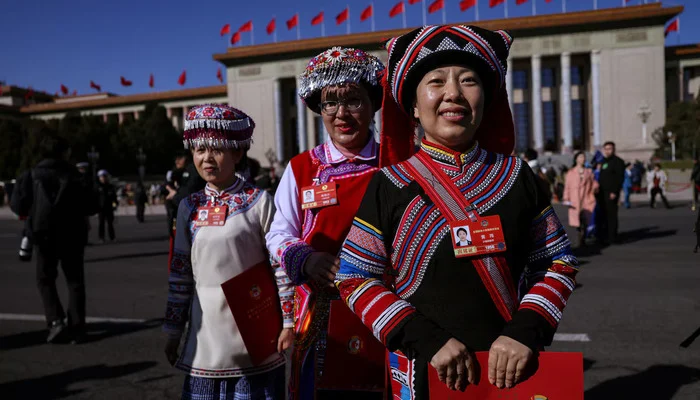
China approved a law promoting a unified national identity among its 55 recognized ethnic groups Thursday, a move critics say may undermine the cultural identities of non-Han populations and criminalize any dissent against “unity.”
Titled “Promoting Ethnic Unity and Progress,” the legislation aims to foster national cohesion and advance China’s rejuvenation with the Communist Party at its helm, according to a draft of the law. It was adopted during the final session of the National People’s Congress with 2,756 votes in favor, only three votes against, and three abstentions, reports Reuters. The law will officially take effect on July 1.
China officially recognizes 56 ethnic groups, with Han Chinese constituting over 91% of its 1.4 billion citizens. Ethnic minorities, including Tibetans, Mongols, Hui, Manchus, and Uyghurs, are primarily concentrated in regions covering about half of the country’s landmass, much of it rich in natural resources.
The legislation seeks to promote integration among different ethnicities through initiatives in education, housing, migration policies, cultural promotion, tourism, and economic development. It stipulates that Mandarin Chinese shall be the primary language for schooling, government operations, and official communications.
In environments where Mandarin and minority languages are used together, Mandarin must be given priority in terms of placement and prominence, the draft states. The law also affirms that the government will respect and protect the use of ethnic languages and scripts.
Religious organizations, educational institutions, and religious sites are mandated to align with the state’s efforts to Sinicize religion, the draft says. Marriage between individuals of different ethnic backgrounds or religions is to be encouraged, prohibiting interference based on ethnicity, customs, or faith.
Allen Carlson, an associate professor of government at Cornell University, commented that the law clearly indicates a push toward assimilation. “President Xi Jinping’s government expects non-Han minorities to integrate more closely with the Han majority and demonstrate loyalty to Beijing,” he explained.
The legislation also incorporates ethnic issues into China’s broader social governance framework, emphasizing anti-separatism, border security, risk management, and social stability. An editorial in China Daily noted the law’s careful legislative process, including multiple readings and consultations with ethnic communities, emphasizing that it aims to preserve cultural traditions alongside economic development.
 ChatGPT
 Perplexity
 Gemini AI
 Grok AI