Select Language:
China has extended an invitation to international scientists to participate in a groundbreaking new collaboration aimed at advancing nuclear fusion—an energy source similar to the sun that promises to provide a vast, clean power supply and have the potential to revolutionize global energy systems.
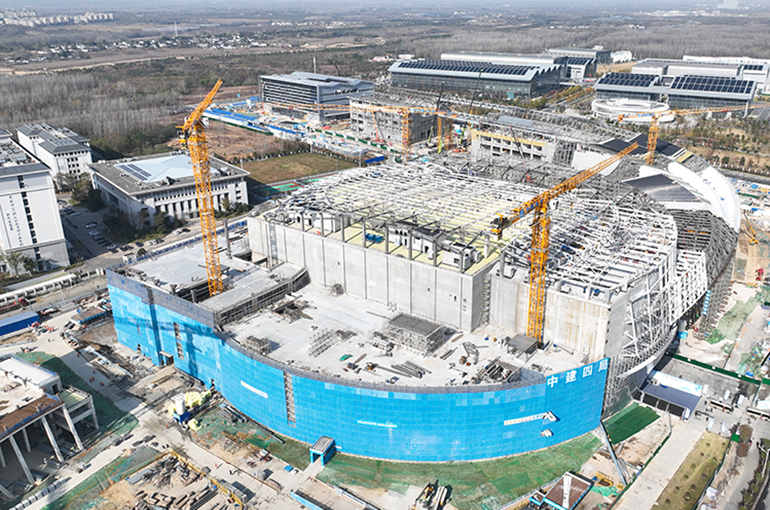
The initiative provides access for global partners to several key research platforms operated by the Institute of Plasma Physics, including the Burning Plasma Experimental Superconducting Tokamak (BEST). Additionally, an open research fund has been established to facilitate ongoing expert exchanges, according to official reports.
As an initial step, fusion scientists representing over 10 countries—including France, the United Kingdom, and Germany—gathered today in Hefei, at Future Great Science City, to sign the Hefei Fusion Declaration. This agreement encourages worldwide researchers to conduct fusion studies within China.
Recent progress has been notable, with advancements such as the Experimental Advanced Superconducting Tokamak (EAST), which achieved the world’s first sustained plasma burn at 100 million degrees Celsius for a full 1,000 seconds this past January.
The country’s recent development plan (2026-2030) emphasized the importance of emerging industries for the first time, calling for the acceleration of cutting-edge technologies including quantum physics, bio-manufacturing, and nuclear fusion.
Construction of BEST, designed to succeed EAST as a next-generation device, began in January 2023 and is slated for completion by 2027. The experimental facility will test burning plasma operations, aiming to sustain long-pulse steady-state operation and generate between 20 to 200 megawatts of fusion power—ensuring these outputs surpass energy inputs and demonstrating the viability of fusion-based energy production.
“We are on the verge of entering a new era of burning plasma research, which is essential for future fusion engineering,” said the director of the Institute of Plasma Physics. “This new international program leverages China’s strengths in superconducting tokamaks and brings together global expertise to push the frontiers of fusion physics.”
 ChatGPT
 Perplexity
 Gemini AI
 Grok AI