
Select Language:
A senior Russian general was killed in southern Moscow on Monday morning when a car bomb exploded. The blast, which took place just hours after Russian and Ukrainian representatives held separate discussions in Miami aimed at ending the conflict, marks the latest high-profile attack on Russian military figures. The incident drew little official comment from Kyiv, but Russian investigators are examining whether the explosion was connected to Ukrainian special forces. Similar assassinations of generals and pro-war figures—either claimed or widely suspected to be orchestrated by Ukraine—have occurred previously.
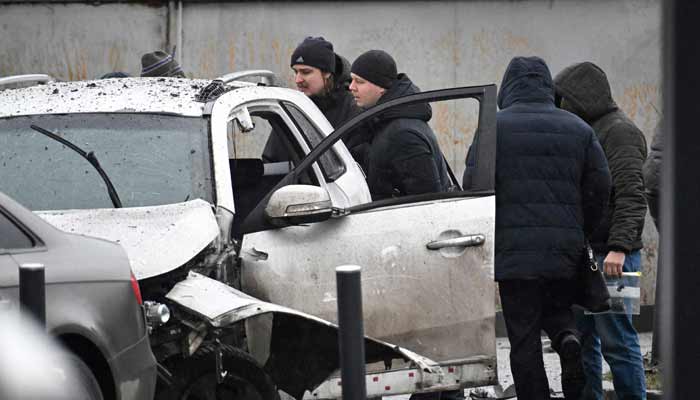
Lieutenant General Fanil Sarvarov, 56, who led the Russian General Staff’s training department, was killed when a bomb under his parked vehicle detonated in a residential area of southern Moscow. On the scene, AFP reporters observed a battered white Kia SUV with shattered doors and a broken rear window, its frame twisted from the explosion. Authorities had secured the area, and investigators searched through the wreckage. Witnesses described hearing a loud bang, with Tatiana, a 74-year-old resident, saying, “We didn’t see it coming. We thought we were safe, and then this happened right next to us.” Grigory, 70, added, “The windows rattled. It was definitely an explosion.” He also commented, “We need to stay calm. This is part of the costs of war.”
Russia’s Investigative Committee, which handles major crimes, announced they are exploring multiple angles, including the possibility that Ukrainian intelligence was involved. Sarvarov’s military background included combat in the North Caucasus during the 1990s, notably in Chechnya, as well as commanding Russian forces in Syria during 2015-16.
Meanwhile, tensions escalate over ongoing peace negotiations. The Kremlin reported that President Putin was briefed on the assassination, which occurred amid three days of diplomatic talks in Miami, involving the U.S., Ukraine, and Russian officials, as Washington pushes to broker a ceasefire. U.S. special envoy Steve Witkoff and Ukrainian negotiator Rustem Umerov described the discussions as productive. Additionally, Russian representative Kirill Dmitriev met with U.S. officials—including Jared Kushner—indicating some diplomatic engagement.
A U.S. proposal initially outlined a 28-point plan aiming to end the war, aligning with Moscow’s core demands; this alarmed Kyiv and European capitals, who see the plan as potentially requiring Ukraine to cede significant territory, including the entire eastern Donbas region. Ukraine’s President Volodymyr Zelensky remains skeptical about Russia’s true intentions, questioning whether Moscow genuinely seeks peace or aims for territorial expansion. The Kremlin has denied reports suggesting Putin’s ambitions extend beyond eastern Ukraine, despite U.S. intelligence indicating otherwise.
Since Russia’s invasion in February 2022, Kyiv has blamed Moscow for multiple attacks targeting Russian military officials and pro-Kremlin figures, both inside Russia and in occupied Ukrainian territories. Notable incidents include the April killing of General Yaroslav Moskalik near Moscow; the December 2024 assassination of Igor Kirillov, head of Russia’s chemical and biological defense forces, by a booby-trapped electric scooter claimed by Ukraine’s security service; the April 2023 killing of military blogger Maxim Fomin in Saint Petersburg; and the August 2022 car bombing that killed Daria Dugin, daughter of a prominent ultranationalist thinker.
These attacks reflect a pattern of targeted violence against Russian military and political figures amid the ongoing conflict.
 ChatGPT
 Perplexity
 Gemini AI
 Grok AI