Select Language:
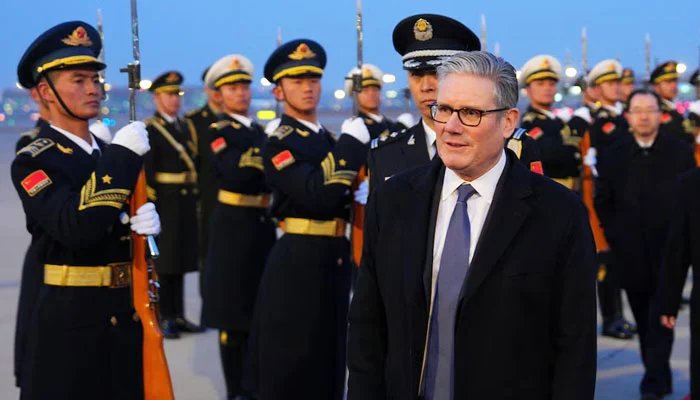
British Prime Minister Keir Starmer arrived in Beijing on January 28, 2026. — Reuters
BEIJING: The UK and China are preparing to sign a cooperation agreement Thursday aimed at disrupting supply chains behind migrant smuggling networks, according to Downing Street, as Prime Minister Keir Starmer visits the Chinese capital.
Starmer’s visit on Wednesday marks the first time a British prime minister has traveled to China since 2018. He’s seeking to foster what he describes as a “pragmatic” relationship with the Asian nation after years of tense and complicated diplomatic ties.
The topic of irregular migration is particularly sensitive for the Labour leader, who has pledged to crack down on people smuggling and prevent the surge of arrivals that has contributed to growing support for far-right political groups.
Last year, nearly 42,000 migrants arrived on England’s southern coast after crossing the perilous English Channel from northern France—making it the second-highest annual total on record.
A statement from Downing Street highlighted, “More than half of the small boat engines used by people smugglers crossing the English Channel are manufactured in China,” as Starmer is scheduled to meet with Chinese President Xi Jinping.
The leaders are expected to have lunch in Beijing Thursday, with Starmer also scheduled to meet Premier Li Qiang.
The forthcoming agreement focuses on intelligence sharing and “direct engagement with Chinese manufacturers” of boat parts to prevent organized crime from exploiting these supply chains, the statement added.
Additionally, the deal aims to enhance cooperation on combating the trafficking of highly potent and dangerous synthetic opioids—such as nitazenes—that are believed to be produced in China and exported to the UK.
On Wednesday, Starmer addressed a delegation of around 60 business leaders and cultural representatives accompanying him, emphasizing that “it is in our national interest to engagement with China.” He encouraged them to seize the “opportunities” presented by China and described the visit as “historic.”
“You are part of the change we’re working to bring about,” Starmer said.
Downing Street has praised the trip as an opportunity to strengthen trade and investment relations, while also addressing complex issues including national security and human rights concerns.
Starmer’s visit follows a series of recent efforts by Western leaders to engage with Beijing, shifting attention away from the United States’ unpredictable stance.
Britain has recently experienced friction with its closest ally, the US—highlighted by President Donald Trump’s attempts to acquire Greenland and his brief threat of tariffs against the UK and other NATO allies.
 ChatGPT
 Perplexity
 Gemini AI
 Grok AI