Select Language:
Brazil’s ex-president Jair Bolsonaro was moved from house arrest into police custody on Saturday to prevent him from escaping while he appeals a conviction related to a failed coup attempt, according to the Supreme Court. The right-wing leader was sentenced to 27 years in prison for plotting to prevent Luiz Inacio Lula da Silva from taking office after the 2022 elections.
Supreme Court judge Alexandre de Moraes, who is overseeing Bolsonaro’s trial, stated that his arrest was a preventative step because he is considered a “high flight risk,” and not a formal part of his sentence enforcement.
Bolsonaro, who served as Brazil’s leader from 2019 to 2022, had been placed under house arrest in August. He was confined to a luxury condo in Brasília and monitored electronically. Moraes explained that a planned demonstration outside Bolsonaro’s residence, organized by his son Flavio Bolsonaro, could incite unrest and possibly facilitate his escape.
Moraes also noted that there was a failed attempt to remove Bolsonaro’s ankle monitor just after midnight Saturday, indicating plans to escape amid the confusion of the rally. The judge pointed out the close proximity of Bolsonaro’s home to the U.S. embassy and mentioned that Bolsonaro had previously considered fleeing to the Argentine embassy to seek political asylum.
Bolsonaro’s allies include former U.S. President Donald Trump, who labeled the trial a “witch hunt” and retaliated with tariffs and sanctions against Brazil.
He was taken to a federal police facility in Brasília, where inmates undergo medical checks before transfer to prison. Bolsonaro was convicted in September for leading a criminal organization aiming to maintain authoritarian control, which included alleged plots to assassinate Lula, Vice President Geraldo Alckmin, and judge Moraes.
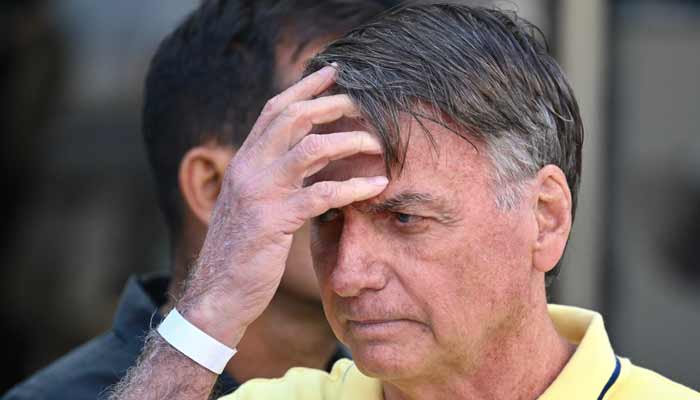
His incarceration is nearing a deadline, as an appeal last week was denied. His lawyers have announced plans to file additional appeals by Monday and requested that Bolsonaro serve his sentence under house arrest, citing health concerns and risks to his safety. They argued his health, already compromised by a stabbing in 2018 and multiple surgeries, deteriorates further with each hospital visit—Bolsonaro has been hospitalized three times since his house arrest, suffering from conditions such as gastritis, severe sleep apnea requiring a CPAP, and persistent hiccups that cause shortness of breath and fainting.
In a comparison, Bolsonaro’s lawyers referenced that former President Fernando Collor de Mello was allowed to serve his nearly nine-year corruption sentence at home due to health issues.
As the possibility of imprisonment approaches, Bolsonaro’s family has expressed concern over his health publicly. His son Flavio called supporters to rally for the country, while Bolsonaro’s wife, Michelle, wrote on Instagram, “I trust in God’s justice. Human justice, as we have seen, no longer holds. But I know the Lord will provide a way out.”
A court hearing on Bolsonaro’s custody is scheduled to happen via video on Sunday, and Moraes ordered a doctor to be present with Bolsonaro at all times.
 ChatGPT
 Perplexity
 Gemini AI
 Grok AI