Select Language:
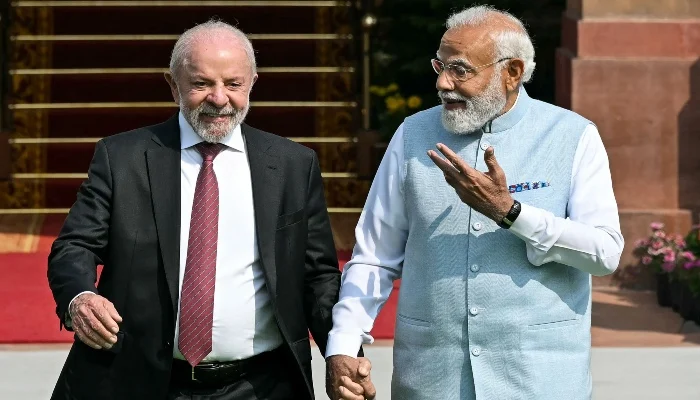
India’s Prime Minister Narendra Modi (on the right) walks hand-in-hand with Brazil’s President Luiz Inacio Lula da Silva during their pre-meeting walk at Hyderabad House in New Delhi on February 21, 2026. — AFP
Modi and Lula are engaged in discussions in New Delhi focused on cooperation around critical minerals. An agreement is anticipated as the supply chains for rare earth elements diversify, with India actively seeking alternatives to China for these resources.
Brazil holds the world’s second-largest reserves of critical minerals, essential for building electric vehicles, solar panels, smartphones, jet engines, and missile technology. India, aiming to reduce reliance on China as its primary supplier, has been expanding its domestic extraction and recycling capabilities while exploring new sourcing options.
Lula, leading a delegation including over a dozen ministers and business executives, arrived in New Delhi earlier this week for a global summit. After a ceremonial reception and paying homage to Mahatma Gandhi, India’s independence leader, the leaders proceeded to their bilateral talks.
Officials indicate that Modi and Lula plan to sign a memorandum on critical minerals and discuss ways to strengthen trade relations. Currently, India is the 10th largest market for Brazilian exports, with bilateral trade exceeding $15 billion in 2025. Both nations aim to reach a trade volume of $20 billion by 2030.
Amid China’s near-monopoly on rare earth production, countries like India are looking for alternative sources. Rishabh Jain from the Delhi-based Council on Energy, Environment and Water stated that India’s cooperation with Brazil complements recent supply chain efforts involving the U.S., France, and the EU. These partnerships not only provide India with advanced technologies and financing but also help secure diversified resource access through South-South alliances, which shape the future of global trade.
Modi and Lula are also expected to discuss global economic challenges and issues within multilateral trade systems, especially after both countries faced U.S. sanctions in 2025. These issues have prompted calls for increased collaboration. Washington recently announced plans to lift tariffs on Indian goods as part of a trade deal.
A Brazilian diplomat, Susan Kleebank, emphasized that the leaders would exchange views on improving multilateralism and international trade. Brazil is India’s largest partner in Latin America, exporting sugar, crude oil, vegetable oils, cotton, and iron ore. The rising demand for iron ore in India is driven by rapid infrastructure development, as the country is on track to become the world’s fourth-largest economy.
India’s Foreign Minister Subrahmanyam Jaishankar expressed confidence that Lula’s discussions with Modi would inject renewed momentum into their relationship, praising Lula’s warmth and strategic guidance. Additionally, Brazilian companies, such as Embraer and the Adani Group, are expanding operations in India, with plans announced last month to produce aircraft locally.
Lula also addressed the AI Impact Summit in Delhi, advocating for a multilateral, inclusive framework for global AI governance. Following Delhi, he is scheduled to meet South Korean President Lee Jae Myung and participate in a business forum.
 ChatGPT
 Perplexity
 Gemini AI
 Grok AI