Select Language:
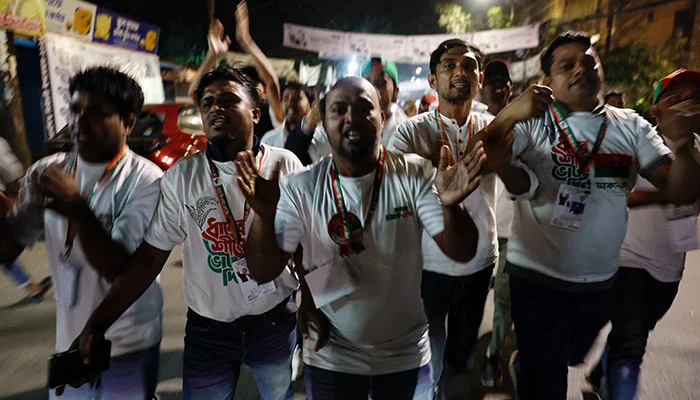
Supporters of the Bangladesh Nationalist Party (BNP) chant slogans as they celebrate unofficial news of Tarique Rahman’s victory in his constituency during the 13th general election near the party’s Gulshan office in Dhaka, Bangladesh, February 12, 2026. — Reuters
– BNP coalition secures 209 seats in a sweeping victory.
– Jamaat-e-Islami pledges to serve as a constructive opposition.
– Former Prime Minister Hasina condemns the election as a sham and calls for its cancellation.
DHAKA: The Bangladesh Nationalist Party achieved a decisive victory in Friday’s parliamentary elections, according to reports from local TV stations. The result provides a strong mandate believed to stabilize the nation’s political landscape.
This election on Thursday marked Bangladesh’s first vote since the 2024 Gen Z-driven protests that ousted longtime Prime Minister Sheikh Hasina. A clear outcome was deemed vital for maintaining stability in the Muslim-majority country, which has been shaken by months of violent unrest targeting Hasina’s government, disrupting daily life and affecting key industries like the apparel sector, a major contributor to the nation’s economy.
The polls also represented the first national contest following recent youth-led protests across the broader region. Nepal is scheduled to hold its own election next month.
BNP Claims Victory
Polls had indicated BNP was favored, and real-time results matched those expectations. The coalition, led by BNP, won 209 seats out of 300, earning a substantial two-thirds majority in the Jatiya Sangsad (National Parliament), as reported by Jamuna TV.
Immediately after their victory was projected, the BNP congratulated the nation and urged citizens to pray for the country’s well-being on Friday. The party stated, “Despite our landslide victory, BNP will not hold celebratory rallies. We encourage people to pray across mosques, temples, churches, and pagodas nationwide.”
The BNP is led by Tarique Rahman, a prominent prime ministerial candidate, and son of former Prime Minister Khaleda Zia and ex-President Ziaur Rahman. Their platform included promises of financial support for impoverished families, limiting each person to serve a maximum of ten years as Prime Minister, attracting foreign investments, and promoting anti-corruption measures.
Jamaat-eh-Islami Vows Constructive Opposition
The Islamist party Jamaat-e-Islami’s leader, Shafiqur Rahman, acknowledged defeat, with his alliance capturing only 68 seats. Rahman emphasized that Jamaat intended to pursue “positive politics” rather than opposition for opposition’s sake.
Meanwhile, the National Citizen Party, led by youth activists who played a crucial role in Toppling Hasina and part of the Jamaat alliance, only secured five out of the 30 seats it contested.
The election was notable as Bangladesh’s first genuinely competitive vote in recent years. Sheikh Hasina’s ruling Awami League was barred from participation, having ruled the country for more than 15 years before her ousting.
Voter turnout was projected to surpass the 42% recorded in 2024, with reports indicating over 60% of registered voters cast ballots. A total of more than 2,000 candidates, including many independents, competed in the election, which featured a record 50 political parties. Voting was postponed in one constituency following the death of a candidate.
Alongside the elections, a referendum was held on constitutional reforms—proposals to establish a neutral interim government during elections, create a bicameral parliament, increase women’s representation, bolster judicial independence, and set term limits for the prime minister.
Initial reports suggest that approximately 73% of nearly 296,000 votes cast in the referendum supported these amendments.
Hasina Denounces Election
Currently in exile in India—an ally whose relationship with Bangladesh has become strained—Hasina criticized the election, calling it a “carefully orchestrated farce” conducted without her party’s participation and claiming voter turnout was artificially suppressed. She demanded the cancellation of the results and the restoration of fair voting rights under a neutral caretaker government.
Opposition critics argue that elections under her leadership have historically been plagued by boycotts and intimidation, raising concerns over the legitimacy of these recent polls.
 ChatGPT
 Perplexity
 Gemini AI
 Grok AI