Select Language:
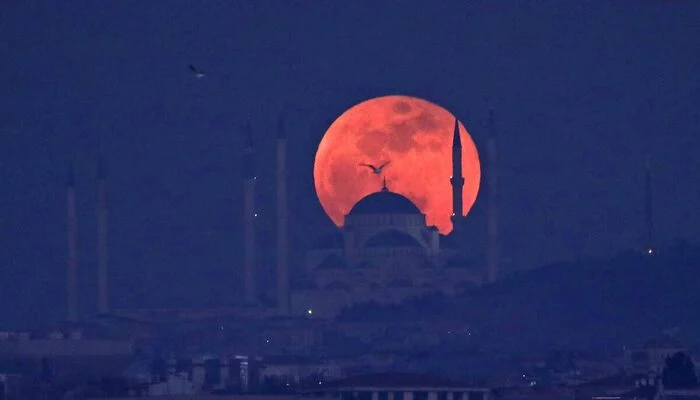
On March 3, 2026, skywatchers worldwide will have the opportunity to observe the first total lunar eclipse of the year, during which the full Moon will gradually darken and take on a deep reddish hue. This celestial event occurs when Earth passes directly between the Sun and the Moon, causing the Moon to turn a reddish-orange color, often called the “Blood Moon.”
The event will be widely visible across many regions, providing an impressive view of the lunar eclipse. NASA explains that during a full Moon eclipse, Earth’s shadow falls on the lunar surface. As sunlight filters through Earth’s atmosphere, shorter wavelengths scatter away, leaving red and orange light to illuminate the Moon, giving it its signature coppery tone during totality.
The Pakistan Meteorological Department (PMD) reports the eclipse will start at 1:44 p.m. Pakistan time with the penumbral phase as the Moon enters Earth’s outer shadow, causing a slight dimming. The partial phase begins at 2:50 p.m., followed by the onset of totality at 4:05 p.m. The peak will occur at 4:34 p.m., with totality ending at 5:03 p.m. The eclipse will conclude completely by 7:23 p.m.
Since much of the eclipse overlaps with daylight hours in Pakistan, it might not be fully visible locally. However, viewers could catch the later stages in the evening, depending on moonrise times and weather conditions. The PMD notes that parts of the eclipse will be visible from different Pakistani cities.
Globally, the total eclipse will be observable in the evening across eastern Asia and Australia, throughout the night over the Pacific region, and in the early morning in North and Central America, as well as parts of western South America. In contrast, the eclipse will appear partial from central Asia and much of South America. It will not be visible from Africa or Europe.
Astronomers emphasize that a lunar eclipse can be watched with the naked eye if the sky is clear and the Moon is in view. Using binoculars or a telescope can enhance the experience, especially from dark locations away from city lights.
 ChatGPT
 Perplexity
 Gemini AI
 Grok AI