Select Language:
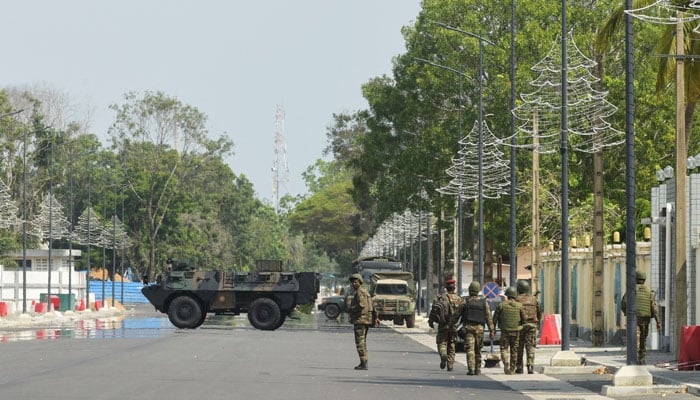
Benin’s President Patrice Talon announced on Sunday that the country’s government and military forces successfully thwarted a coup attempt by a group of soldiers. He vowed to hold those responsible accountable. His statement came roughly 12 hours after gunfire erupted in several neighborhoods in Cotonou, the capital and economic center, with soldiers appearing on national TV claiming they had overthrown Talon.
Talon’s forces remained resolute, retaking control of key positions and eliminating the remaining pockets of resistance. He expressed confidence that the treachery would not go unpunished and extended his thoughts to the victims and people detained by the mutineers, though details remain unverified regarding casualties or hostages.
This incident marks a rare breach of stability in Benin, where the last successful coup occurred in 1972. A government spokesperson confirmed that 14 individuals had been detained in connection with the attempt, without providing specifics. Nigeria responded by deploying fighter jets and ground troops to support Benin in dispersing the insurgents from critical sites like the state TV station and a military camp.
Regional bodies such as ECOWAS and the African Union condemned the coup attempt. ECOWAS swiftly ordered the deployment of its standby force, including troops from Nigeria, Sierra Leone, Ivory Coast, and Ghana, to support Benin’s government.
Early on Sunday, armed soldiers, led by Colonel Tigri Pascal, announced the dissolution of national institutions, suspension of the constitution, and closure of borders, citing deteriorating security especially in the north and neglect of fallen comrades. Their statement promised to forge a new era rooted in fraternity, justice, and work.
Although President Talon is credited with economic revival since taking office in 2016, the country has faced increasing jihadist attacks paralleling neighboring Mali and Burkina Faso. The security crisis may have influenced the soldiers’ actions, coinciding with an upcoming presidential election scheduled for April—an election that could extend Talon’s tenure under recent constitutional changes favoring a longer term and a new Senate.
Security tensions are heightened by recent militant operations in northern Benin, making the country more vulnerable in the region layered with coups and unrest in recent years. Despite these pressures, Benin’s largely peaceful political history over the past 50 years remains notable.
 ChatGPT
 Perplexity
 Gemini AI
 Grok AI