Select Language:
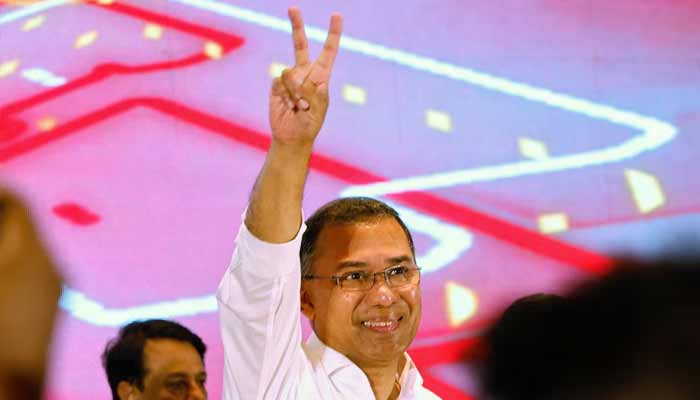
Tarique Rahman, leader of Bangladesh’s Nationalist Party (BNP), flashed a victory gesture during a press conference after BNP secured a win in the 13th general election in Dhaka, February 14, 2026—Reuters.
- JI pledges to act as a “vigilant, principled, peaceful opposition.”
- The BNP coalition claimed 212 seats, while JI’s alliance garnered 77.
- The European Union described Friday’s elections as “credible.”
Prime Minister-elect Tarique Rahman of Bangladesh paid tribute to those who “sacrificed for democracy” on Saturday, vowing to foster unity following the nation’s first elections since a deadly uprising in 2024.
At 60, Rahman, an heir to a powerful political dynasty, is poised to lead Bangladesh, a nation of 170 million, after Thursday’s sweeping electoral victory.
“This victory belongs to Bangladesh and democracy,” Rahman declared in his inaugural speech post-vote. “It is a triumph for the people who aspire to and have sacrificed for democracy.”
He will assume leadership from an interim government that has guided Bangladesh since the student-led protests ended Sheikh Hasina’s strict rule in August 2024.
Rahman’s victory signals a significant comeback for a man who only returned from 17 years in exile in Britain last December, away from Dhaka’s political turmoil.
The BNP-led coalition secured 212 seats, outpacing the 77 seats won by the Jamaat-e-Islami-led alliance, according to the Electoral Commission.
Calling for Unity
Jamaat leader Shafiqur Rahman, aged 67, initially alleged “irregularities and fabrications” in the voting process but later conceded defeat.
He committed to serving as a “vigilant, principled, and peaceful opposition.” Rahman emphasized that his Islamist party, which faced suppression under Hasina, had doubled its parliamentary seats from previous levels, considering this a foundation for future growth.
Hasina’s Awami League was disqualified from participating. The 78-year-old former Prime Minister, sentenced to death in absentia for crimes against humanity, issued a statement from hiding in India condemning the election as “illegal and unconstitutional.”
Rahman urged cooperation across political lines, emphasizing the need for national unity amid political upheaval.
A Pro-Democracy Victory
Rahman’s father, President Ziaur Rahman, was assassinated in 1981, while his mother, Khaleda Zia, served three terms as prime minister and wielded significant influence in Bangladesh’s politics for decades.
“The people of a freedom-loving, pro-democracy Bangladesh have once again delivered victory to the BNP,” Rahman stated, initially in English before switching to Bengali.
Nobel laureate Muhammad Yunus, the former interim leader, earlier stated that Rahman would help steer the country toward stability, inclusion, and progress.
The U.S. embassy congratulated Rahman and the BNP on their “historic victory,” while neighboring India commended his “decisive win,” marking a shift after years of tense relations.
China and Pakistan, both strengthening ties with Bangladesh since the 2024 uprising and amid cooling relations with India, also sent their congratulations.
International observers praised the elections, with the European Union calling them “credible.” Turnout was approximately 59% across 299 of 300 voting districts.
Only seven women secured seats outright; however, 50 more parliamentary seats reserved for women will be filled through party lists.
Voters also supported in a referendum a broad democratic reform charter, advocated by Yunus, aimed at overhauling Bangladesh’s “completely broken” governance system and preventing a return to single-party dominance. Proposed reforms include prime ministerial term limits, a new upper house of parliament, enhanced presidential authority, and increased judicial independence.
Rahman acknowledged that the new administration faces serious hurdles, citing a fragile economy, weakened institutions, and law and order issues left by an authoritarian past.
“We are about to begin our journey amid economic instability, fragile institutions, and law and order challenges,” he said.
 ChatGPT
 Perplexity
 Gemini AI
 Grok AI