Select Language:
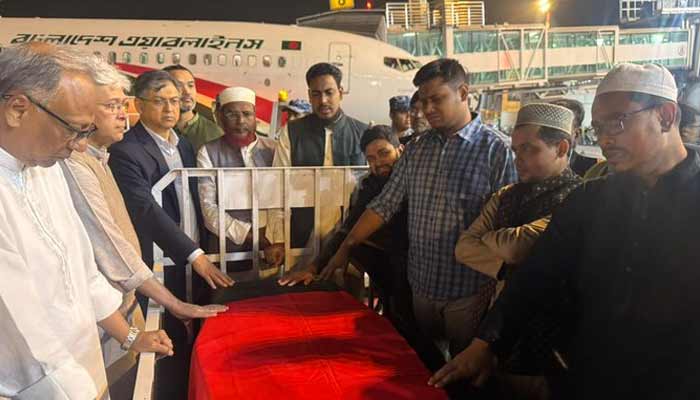
The body of Osman Hadi, a well-known student leader in Bangladesh, arrives at Hazrat Shahjalal International Airport in Dhaka on December 19, 2025. The funeral procession has sparked nationwide protests, with clashes erupting between demonstrators and authorities. The interim government announced that Hadi’s remains arrived on a Biman Bangladesh Airlines flight from Singapore, where he was receiving medical care after being shot in the head during a campaign event last week.
Authorities have called on the public to oppose violence, as security forces expand their presence in Dhaka and other cities amid the unrest. The country’s upcoming parliamentary elections, set for less than two months away, have been overshadowed by violence and political turmoil. Many hope the elections will mark a turning point toward stability and economic recovery after nearly two years of instability.
Despite this, tensions persist, fueled by violent protests and political discord among various factions, including hardliners. Last August, massive student-led protests led to the ousting of Prime Minister Sheikh Hasina, but the current unrest has dampened the initial optimism.
Experts criticize the interim government led by Nobel laureate Muhammad Yunus, suggesting it struggles to maintain control amid the crisis. Additionally, Hasina’s party, the Awami League, which has been barred from participating in the upcoming vote, has warned of potential unrest that could threaten the electoral process.
Hadi, 32, was shot by unidentified masked attackers while campaigning. He served as a spokesperson for the Platform for Revolution and was known for his criticism of India. He was initially treated in Bangladesh before being flown to Singapore, where he died after six days on life support.
In the days following his death, violence has intensified, with reports of media offices being vandalized and fires set. Protesters also targeted the Indian High Commission and other diplomatic missions, reflecting ongoing tensions between Bangladesh and India, worsened by recent anti-India demonstrations in the country.
The government has denounced attacks on media outlets, including fires at the offices of prominent newspapers like Prothom Alo and The Daily Star. Security forces responded with deployed troops and rescue efforts for trapped journalists. A lynching of a Hindu man accused of blasphemy in Mymensingh has further heightened concerns, with authorities vowing to bring those responsible to justice.
Rights groups warn that these incidents signal an alarming rise in extremist and violent ideologies, which threaten democracy and human rights across Bangladesh. If justice is not served and institutions remain vulnerable, the crisis could have long-lasting repercussions for the nation’s future stability.
 ChatGPT
 Perplexity
 Gemini AI
 Grok AI