Select Language:
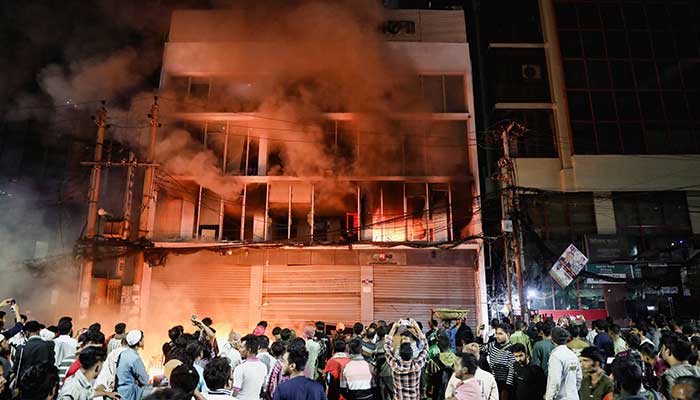
A group of individuals set fire to the Prothom Alo newspaper office in Karwan Bazar after the death of Sharif Osman Hadi, a student leader who had been treated in Singapore following a headshot injury, in Dhaka, Bangladesh, December 19, 2025. — Reuters
Thousands march through Dhaka calling for the arrest of Hadi’s killers.
Fires have broken out in major newspaper buildings, with staff trapped inside.
Authorities have launched a manhunt, offering a reward for information leading to the suspects behind the assassination.
Early Friday morning, violence erupted in Bangladesh’s capital following the death of Hadi, a youth leader involved in last year’s pro-democracy movement. He was injured in an assassination attempt and died in a Singapore hospital.
Protesters flooded the streets of Dhaka to demand justice, with several buildings, including the nation’s two biggest newspapers, torched—trapping employees inside.
Hadi played a significant role in the uprising that ousted Prime Minister Sheikh Hasina’s autocratic government last year, prompting her to seek refuge in India. He was also a candidate for a parliamentary seat in the upcoming February 2026 elections.
On December 12, Hadi was shot by masked assailants outside a mosque in Dhaka. He was evacuated to Singapore for medical care and passed away there on Thursday.
Following his death, at least three cases of arson were reported across Dhaka, including fires at The Daily Star and Prothom Alo newspaper headquarters, according to a Fire Brigade spokesperson. The protestors accused these outlets of being aligned with India, where Hasina is in exile.
A journalist from The Daily Star, Zyma Islam, revealed she was trapped inside the burning building, sharing on Facebook, “I can’t breathe anymore. There’s too much smoke. I am inside. You are killing me.”
Firefighters managed to control the blaze at The Daily Star headquarters by 1:40 a.m. local time, but 27 employees remained inside. An employee, Ahmed Deepto, said, “We hid behind the building’s rear, hearing chants from the protesters.”
Additionally, the home of Bangladesh’s deputy ambassador to India was surrounded by demonstrators attempting to stage a sit-in. Police deployed tear gas to disperse the crowd amid ongoing unrest.
Footage showed protesters blocking a key highway from Dhaka and attacking a former minister’s residence in Chittagong. Other sites targeted included Dhaka’s Chhayanaut cultural center.
Earlier that day, Singapore authorities announced Hadi’s death. The country’s foreign ministry stated, “Despite the best efforts of medical teams, Mr. Hadi succumbed to his injuries,” and that assistance was being provided for the repatriation of his body.
In Dhaka, Nobel laureate Muhammad Yunus, now heading the interim government, called Hadi’s passing an “irreparable loss to the nation” in a televised statement.
He added, “Our march toward democracy cannot be stopped with fear, terror, or bloodshed.”
The government has scheduled special prayers in mosques and declared a half-day of mourning on Saturday.
Hadi, a prominent leader of the Inqilab Moncha student group, was a vocal critic of India, where Hasina remains in voluntary exile.
Meanwhile, police are actively searching for Hadi’s shooters. They’ve released images of two prime suspects and are offering a bounty of five million taka (roughly $42,000) for tips that lead to arrests.
Opposition figure and Nobel Peace Prize winner Muhammad Yunus believes the shooting was a premeditated attack orchestrated by a powerful network aiming to derail the upcoming elections.
Bangladesh, a Muslim-majority country with a population of 170 million, will directly elect 300 parliament members, with 50 additional seats reserved for women. The elections scheduled for January 2024 previously gave Sheikh Hasina a fourth consecutive term, but opposition parties dismissed those results as illegitimate.
The Bangladesh Nationalist Party (BNP), led by Khaleda Zia—who served three terms as prime minister—is favored to win the upcoming vote. Zia is currently in intensive care in Dhaka, while her son and political heir, Tarique Rahman, is expected to return from exile in Britain on December 25 after 17 years abroad.
 ChatGPT
 Perplexity
 Gemini AI
 Grok AI