Select Language:
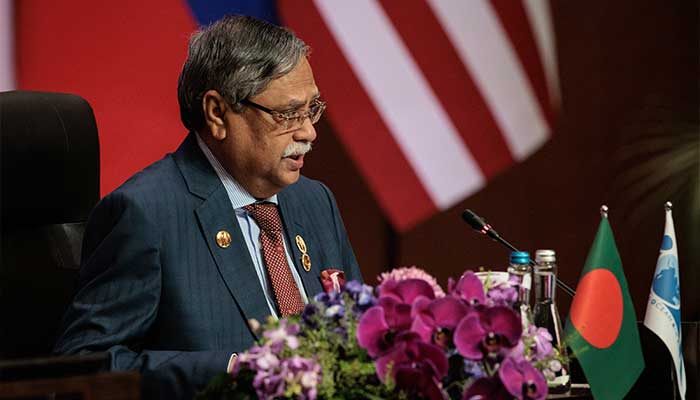
Bangladeshi President Mohammed Shahabuddin announced on Thursday his intention to resign midway through his term after the parliamentary elections in February. He conveyed to Reuters that he has felt disrespected by the interim government, which is led by Nobel laureate Muhammad Yunus.
While officially serving as the head of state, Shahabuddin’s role is mostly symbolic, with real executive authority delegated to the prime minister and cabinet in the predominantly Muslim nation of 173 million people. His prominence increased when a student-led uprising in August 2024 forced Prime Minister Sheikh Hasina to flee to New Delhi, leaving Shahabuddin as the sole remaining constitutional authority after parliament was dissolved.
Elected unopposed in 2023 for a five-year term, Shahabuddin was a candidate supported by Hasina’s Awami League, which has been barred from participating in the February 12 election.
In his first media interview since assuming office, Shahabuddin shared via WhatsApp from his official residence in Dhaka, “I want to leave. I am interested in stepping down. Until the elections take place, I believe I should continue to serve because of my constitutional role as president.” Later, he added that despite his personal wish to resign, the decision would ultimately be left to the incoming government. “If they decide to elect their own president, I will step aside,” he stated late Thursday.
Polls indicate that the Bangladesh Nationalist Party (BNP), led by former Prime Minister Khaleda Zia, and Jamaat-e-Islami are likely to be the main contenders to form the next government. They were part of a coalition that governed from 2001 to 2006.
Shahabuddin revealed that Yunus had not met him for nearly seven months, and his portraits had been removed from Bangladeshi embassies worldwide in September. “There was the portrait of the president, the image of the president at all consulates, embassies, and high commissions — and suddenly, all of this was removed overnight,” he said. “It sent a wrong message to the people, implying the president might be eliminated. I felt very humiliated.”
He mentioned that he had written to Yunus about the portrait removals, but no action was taken. “My voice has been silenced,” Shahabuddin added. Yunus’ press team did not respond immediately to requests for comment.
The president said he remains in regular contact with Army Chief General Waker-uz-Zaman, who, during the protests against Hasina in August 2024, kept his troops out of conflict, which was a pivotal moment for the veteran politician’s future. Shahabuddin emphasized that Zaman has no intention of seizing power and has expressed a desire for a return to democracy.
Although some student protesters initially called for his resignation, Shahabuddin stated that no political parties have asked him to step down in recent months. When asked if Hasina, who governed for two decades, attempted to reach out after fleeing the country, he declined to comment, saying he has maintained independence since becoming president and is not affiliated with any political party.
 ChatGPT
 Perplexity
 Gemini AI
 Grok AI