Select Language:
Gopalganj: Bangladesh is gearing up for its first election since the overthrow of Sheikh Hasina, but supporters of her banned Awami League (AL) are uncertain whether to shift their loyalty.
In Gopalganj, located south of Dhaka and known as a stronghold of Hasina’s ironclad rule, residents are facing an election without the party that has shaped their political experience for decades.
“Sheikh Hasina may have made mistakes — she and her allies — but what about the millions of Awami League supporters?” asked 68-year-old tricycle delivery driver Mohammad Shahjahan Fakir, who stated he wouldn’t vote.
“Why isn’t the ‘boat’ symbol on the ballot paper anymore?” he wondered, referencing AL’s former election icon.
The Muslim-majority country of 170 million people will hold elections on February 12 — its first since the protests earlier this year.
Hasina, who suppressed opposition parties during her tenure and won every election in Gopalganj since 1991, was ousted in August 2024 after a failed attempt to cling to power and a brutal crackdown on demonstrators. She fled to India.
She was sentenced in absentia to death in November for crimes against humanity by a Dhaka court, and her former ruling party, once the nation’s most popular, has been declared illegal. Human Rights Watch has condemned the ban as “draconian.”
“There’s so much confusion right now,” said 46-year-old Mohammad Shafayet Biswas, a banana and betel leaf vendor in Gopalganj.
“Several candidates are running from this constituency — I don’t even know who they are.” A crowd gathered, with one man shouting, “Who’s going to the polls? We don’t even have our candidates this time.”
Hasina’s father, Sheikh Mujibur Rahman, the founding leader of Bangladesh, was born in Gopalganj and is buried there. Statues of Rahman have been taken down across the country, but murals and statues in Gopalganj remain well-maintained.
Since Hasina’s removal, clashes have erupted during campaign events, including one in July 2025 between police and AL supporters, resulting in over 8,000 cases filed against residents.
University professor Sazzad Siddiqui predicts voter turnout in Gopalganj could be among the lowest nationwide. “Many people still refuse to accept that Sheikh Hasina did anything wrong,” he explained, having served on a government commission formed after the unrest. “Meanwhile, the government continues to try to dehumanize them.”
Candidates from the Bangladesh Nationalist Party (BNP) and Jamaat-e-Islami, rivals of Hasina, are now leading the campaigns with hopes of power.
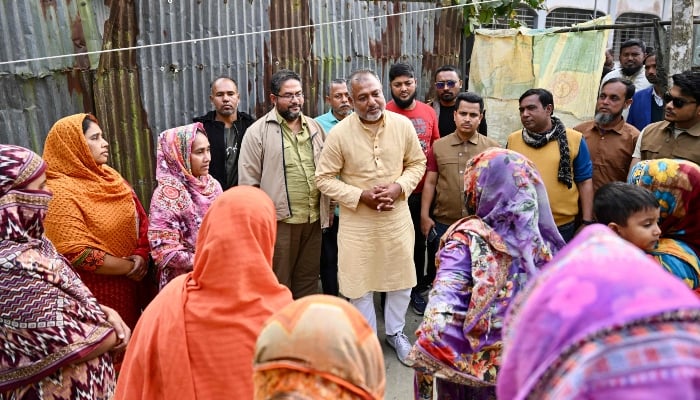
“People want a change in leadership,” said 57-year-old BNP candidate SM Zilany, who is actively knocking on doors. “I am visiting homes, and many voters have never had a candidate approach them before. I promise I will stand by them.”
Zilany has previously faced 34 legal cases, which he claims were politically motivated, after running against Hasina twice. He believes there’s an ongoing effort to discourage voters from turning out this time.
Jamaat’s candidate, MM Rezaul Karim, 53, noted that under Hasina, their party had been driven underground. “People are craving new leadership,” he said, expressing openness to voters of all backgrounds. “We believe in coexistence; those involved in crimes should be punished, but others should be spared.” Many former supporters of Hasina now appear disillusioned.
Some residents admit they’ve abandoned the AL but are unsure who to support instead. “I’m not voting,” said one woman who requested anonymity. “Who else can I turn to except Hasina? She’s like a sister to me.”
 ChatGPT
 Perplexity
 Gemini AI
 Grok AI