Select Language:
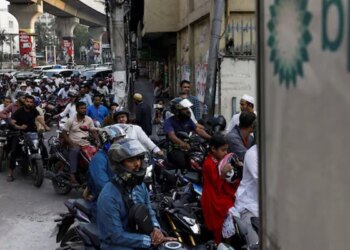
Supporters of Bangladesh Jamaat-e-Islami participated in a protest rally with a five-point demand, including a call for free and fair elections by February 2026, near the Baitul Mukarram National Mosque in Dhaka on September 18, 2025. — Reuters
- Jamaat-e-Islami reports it has engaged in discussions with other groups.
- The party’s leader emphasizes that anti-corruption initiatives should be a common goal.
- Rahman states the party will determine its candidate for prime minister.
Jamaat-e-Islami, a once-banned party in Bangladesh, is gearing up for its most significant electoral performance in February’s parliamentary elections and is open to forming a unity government. The party has initiated talks with multiple political entities, according to its leader. Polls indicate that JI could narrowly place second behind the Bangladesh Nationalist Party (BNP) in the election, marking its return to mainstream politics after nearly 17 years. The party previously held power from 2001 to 2006 as a junior coalition partner with BNP and is willing to collaborate again.
“We aim for a stable country for at least five years. If the parties unite, we’re prepared to govern together,” said JI President Shafiqur Rahman during an interview at his Dhaka office, shortly after the party formed an alliance with a youth-oriented party.
Focus on Anti-Corruption Measures
Rahman stressed that combating corruption should be a shared objective for any coalition government. He added that the prime minister would be selected from the party with the most seats in the February 12 election. If JI secures the highest number of seats, it will decide whether Rahman himself would be a candidate.
This political resurgence follows the ousting of long-time Prime Minister Sheikh Hasina in an August 2024 youth-led uprising. Her party, the Awami League, is currently barred from participating in the election. Hasina was a vocal critic of JI; during her leadership, several of its members were sentenced to death.
Jamaat-e-Islami had been prohibited from participating in elections since 2013, after a court declared its charter unconstitutional under the country’s secular constitution. However, an interim government led by Nobel laureate Muhammad Yunus lifted all restrictions in August 2024.
Relations with India and Pakistan
Rahman expressed concern over Hasina’s continued stay in India after her departure from Dhaka, noting that relations between the neighboring countries have reached their lowest point in decades since her removal. The party’s leader confirmed a meeting with an Indian diplomat earlier this year after he underwent bypass surgery. Unlike diplomats from other countries who visited him openly, the Indian official requested confidentiality.
“Why? Many diplomats have visited me publicly. What’s the problem?” Rahman questioned. “We need transparency and openness to build better ties among nations.”
The Indian Foreign Ministry did not immediately comment on Rahman’s account. An Indian government source confirmed contacts with various Bangladeshi parties. Additionally, India’s foreign minister visited Dhaka on Wednesday to offer condolences on the death of BNP leader and former Prime Minister Khaleda Zia.
Regarding JI’s historical ties with Pakistan, Rahman stated: “We maintain balanced relations with all countries. We are not inclined to favor any one nation but respect all and seek equitable relationships.”
He added that any government involving JI would not be favorable towards President Mohammed Shahabuddin, who was elected unopposed in 2023 with backing from the Awami League. Shahabuddin has indicated a willingness to step down halfway through his term. When asked about Rahman’s stance, the president declined to comment further, citing a desire to avoid complicating matters.
 ChatGPT
 Perplexity
 Gemini AI
 Grok AI