Select Language:
A headscarf ban for girls under 14 in Austria has sparked widespread concern, outrage, and fears of increased discrimination against Muslims within the European Union country.
In December, Austrian legislators approved the new regulation, scheduled to go into effect at the start of the upcoming school year in September. Given the prevailing anti-immigrant attitudes, the conservative-led government asserts that the law aims to shield young girls from “oppression.” However, advocacy groups and experts argue that it is unjust, could deepen societal divisions, and may even be unconstitutional.
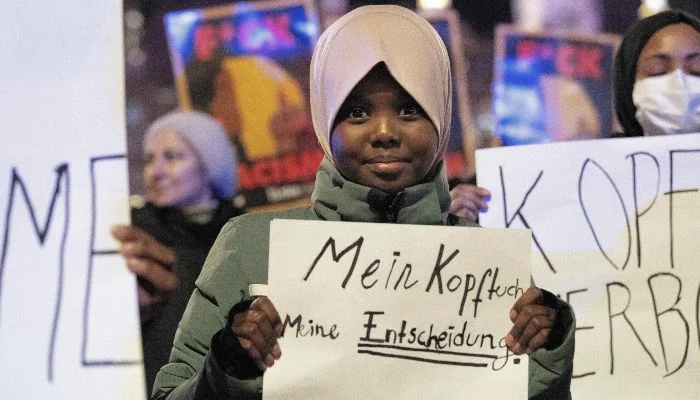
A 12-year-old protesting the ban in Vienna last month stated, “It’s my choice… Nobody can force me to wear a headscarf, and nobody can make me take it off,” choosing to remain anonymous.
The government estimates approximately 12,000 girls could be impacted by this law, although some critics believe this figure may be inflated. According to 2021 government data, around 8% of Austria’s nine million residents are Muslim. The education department has circulated guidelines to schools detailing enforcement of the law, including illustrations of various Islamic head coverings. Schools are instructed that any teacher observing a student with a headscarf must ask for its removal and report non-compliance immediately. This process involves a meeting with the student and her guardians, and repeated violations could lead to fines between €150 and €800 ($175–$930). The instructions also warn that failure by teachers or school officials to report violations could result in legal repercussions.
An anonymous teacher in Vienna shared with AFP that she does not intend to enforce the law, calling it a “populist measure” that overlooks deeper issues, like domestic violence or psychological abuse by parents.
Last month, hundreds gathered in central Vienna to protest the ban, marching to the chancellery. Malika Mataeva, co-founder of the Muslim Women Network, condemned what she called “years of deeply ingrained racism” in Austria, adding, “This is just another step that makes us say, ‘Enough is enough,'” and emphasizing that basic freedoms are not being upheld.
Austria has a history of accepting immigrants and asylum seekers fleeing conflict, yet anti-immigration rhetoric remains strong. In the 2024 elections, the far-right Freedom Party achieved its first victory, even before forming a government. According to a report from Europe’s FRA rights agency in 2024, Muslims in Austria face the highest levels of racism and discrimination within the EU.
The Austrian Islamic Community Organization plans to challenge the headscarf ban in court. In 2019, Austria briefly attempted to ban headscarves in primary schools, but the constitutional court struck down that law, deeming it unconstitutional because it targeted a specific religious garment.
During the recent Vienna protest, an 11-year-old girl named Hadiya explained she is the only girl in her class of 27 who wears a headscarf, expressing frustration: “I’m angry… I see no reason for this ban.” A mother of two daughters aged 11 and 13 shared that the law has placed heavy emotional strain on her family, with her daughters feeling distressed about removing their headscarves, despite believing it’s for their protection. She said, “It’s supposed to keep them safe, but they’ve been suffering and feeling worried for months now.”
 ChatGPT
 Perplexity
 Gemini AI
 Grok AI