
Select Language:
A supernova, the explosive end of a massive star’s life cycle, is among the brightest phenomena in the universe—typically shining about a billion times brighter than our sun. However, a select few exceed this brightness significantly, by a factor of 10 to 100, and are classified as superluminous supernovas.
The reason behind this extreme luminosity has long puzzled astrophysicists. Now, observations of a superluminous supernova originating from a massive star in a galaxy approximately one billion light-years away are shedding light on the mystery. To clarify, a light-year is the distance that light travels in one year—about 5.9 trillion miles or 9.5 trillion kilometers.
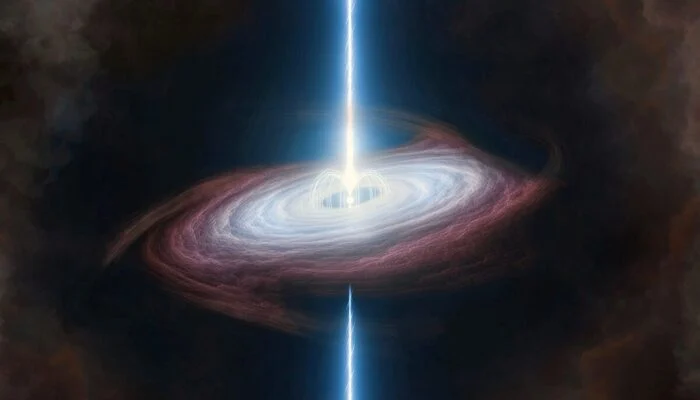
Discovered in December 2024, this supernova was extensively examined using the Las Cumbres Observatory in California and the ATLAS telescope in Chile. The findings suggest that its extraordinary brightness was powered by a magnetar—a highly dense, rapidly spinning stellar remnant with an incredibly strong magnetic field. As it spun hundreds of times per second, the magnetar captured charged particles, accelerating and flinging them into the expanding cloud of gas and dust ejected during the explosion, thereby boosting the supernova’s luminosity.
A magnetar is a specific type of neutron star—the collapsed core of a massive star that has gone supernova. According to Joseph Farah, an astrophysics doctoral student at Las Cumbres Observatory and UC Santa Barbara who led the study, “When a massive star burns out its nuclear fuel, it can no longer withstand the crushing pull of gravity. The core compresses under its own weight, forcing protons and electrons to merge into neutrons. If the core’s mass is sufficiently large, it collapses into a black hole. Otherwise, a neutron star, or magnetar, may form and survive.”
The magnetar resides deep within the supernova, causing its intense brightness from within. The concept that magnetars could energize such luminous stellar explosions was proposed back in 2010, and Andy Howell of Las Cumbres Observatory, a co-author of the new study, posits that these recent results validate that theory.
While typical supernovas follow a predictable pattern of brightening and fading, some superluminous variants— including this one—exhibit fluctuations or ripples in brightness over several months, with these variations gradually diminishing over time. Scientists attribute this behavior to Lense-Thirring precession, a relativistic effect where the intense gravitational and rotational forces of the magnetar twist the surrounding spacetime and the accretion disk—the disk of infalling material orbiting the magnetar—causing it to wobble.
This wobbling influences how energy is transferred from the magnetar to the supernova’s expanding material, resulting in the observed brightness oscillations. While the exact size of the pre-supernova star remains uncertain, Farah estimates it was likely a very massive star—many times the size of the sun and vastly more luminous.
Estimating supernova brightness underscores its magnitude: Farah notes, “It’s a stark comparison—asking what would be brighter: the sun going supernova at 93 million miles (150 million km) away, or a hydrogen bomb detonating right next to your eye? The answer is the supernova—by about nine orders of magnitude.” Moreover, the luminosity of this superluminous supernova surpassed the combined light output of the entire Milky Way galaxy.
 ChatGPT
 Perplexity
 Gemini AI
 Grok AI