
Select Language:
Astronomers have spotted a planetary system that defies existing theories of planet formation. It features a rocky planet that formed outside the orbits of its gaseous neighboring planets, possibly after much of the planet-forming material had already been consumed.
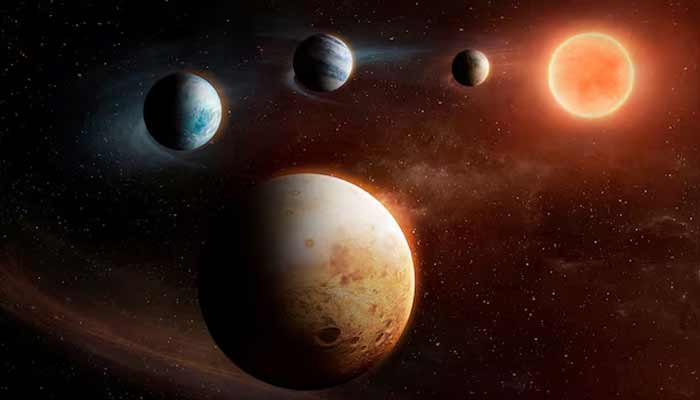
Using the European Space Agency’s Cheops space telescope, scientists observed four planets orbiting a small, faint star called a red dwarf, located approximately 117 light-years away in the direction of the Lynx constellation. One light-year is the distance light travels in a year, roughly 5.9 trillion miles (9.5 trillion kilometers).
The star, designated LHS 1903, has about half the mass and only 5% of the brightness of our Sun.
What caught scientists’ attention was the arrangement of the planets. The closest planet is rocky, followed by two gaseous planets, with the fourth planet, which should be gaseous according to current models, unexpectedly being rocky.
Thomas Wilson, an astronomer from the University of Warwick and the lead author of the study published in Science, explained, “The standard planet formation model suggests that planets close to their star tend to be small and rocky because the environment is too hot for significant gas or ice to exist, and any atmospheres they develop are often stripped away by stellar radiation. Farther out, planets form in colder regions rich in gas and ice, resulting in larger, gas-rich worlds. This system, however, presents a rocky planet beyond gas giants, challenging this view.”
Wilson described it as “a system built inside-out.”
In our solar system, the inner four planets are rocky, and the outer four are gaseous, with distant dwarf planets like Pluto being much smaller than the planets. Since the 1990s, astronomers have discovered around 6,100 exoplanets beyond our solar system.
All four planets in this new system are closer to their star than Mercury is to the Sun. Notably, the outermost planet’s orbit is only about 40% of Mercury’s distance from the Sun. This compact arrangement is typical for planets around red dwarf stars, which are significantly less luminous than the Sun.
The two rocky planets are classified as super-Earths—rocky planets with two to ten times Earth’s mass. The two gaseous planets, called mini-Neptunes, are smaller than Neptune but larger than Earth.
The researchers believe these planets did not all form simultaneously in a massive, swirling disk of gas and dust. Instead, they likely formed sequentially, with the gas that could have made up the fourth planet’s atmosphere being exhausted or consumed by the earlier-forming planets before it could coalesce.
Wilson suggested the fourth planet might have been a “late bloomer,” forming later in a gas-poor environment due to limited material. Alternatively, it could have initially had a thick atmosphere that was later stripped away by some catastrophic event, leaving only its rocky core.
Andrew Cameron of the University of St Andrews, a co-author of the study, added, “Did the fourth planet just arrive as the gas was running out? Or was its atmosphere removed by a collision? The latter is plausible—Earth’s Moon originated from a giant impact, after all.”
 ChatGPT
 Perplexity
 Gemini AI
 Grok AI