
Select Language:
- Four astronauts traveled farther from Earth than any before.
- This mission was the first manned trip near the Moon in over 50 years.
- The atmospheric re-entry was a crucial test of the spacecraft’s heat shield.
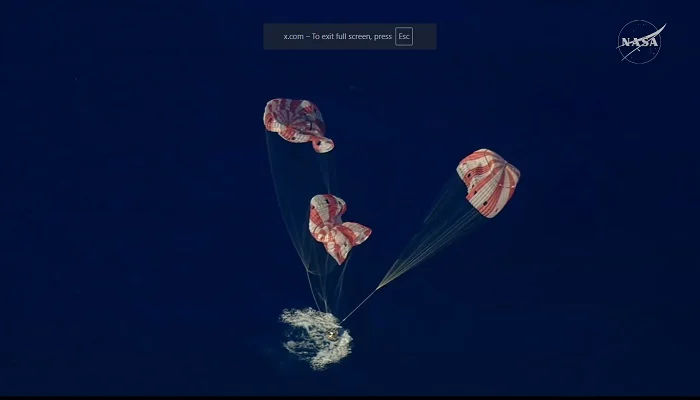
The Artemis II spacecraft and its four crew members re-entered Earth’s atmosphere and safely splashed down in the Pacific Ocean Friday after almost 10 days in space. This marked the first crewed journey close to the Moon in over half a century.
The Orion capsule, named Integrity and shaped like a gumdrop, gently parachuted into the sea off Southern California shortly after 5 p.m. PT, ending a mission that sent astronauts farther into space than ever before.
During Artemis II, the crew traveled a total of 694,392 miles (1,117,515 km), including two Earth orbits and a lunar flyby about 252,000 miles away. It was the first crewed test flight in a series of Artemis missions planned to return humans to the Moon starting around 2028.
The splashdown was broadcast live via NASA’s webcast, happening about two hours before sunset. Recovery teams were ready to secure the spacecraft and retrieve the astronauts—Reid Wiseman (50), Victor Glover (49), Christina Koch (47), and Canadian Jeremy Hansen (50).
This successful return confirmed that the Lockheed Martin-built Orion spacecraft can withstand the intense forces of re-entry from a lunar trajectory.
The re-entry included a fiery, 13-minute plunge through Earth’s atmosphere, reaching exterior temperatures near 5,000°F (2,760°C). During this process, a glowing sheath of ionized gas, or plasma, temporarily cut off communications with the crew, as expected.
The capsule re-emerged from the plasma sheath, and parachutes deployed from its nose, slowing descent to around 15 mph (25 kph) before it splashed into the water.
It’s estimated that NASA and Navy teams will need about an hour to secure the capsule and help the astronauts out for medical checks and transport to a nearby recovery vessel.
Gateway Toward Mars
Launching from Cape Canaveral, Florida, on April 1, the crew was lifted into an initial Earth orbit by NASA’s powerful Space Launch System rocket, then traveled around the far side of the Moon.
Never before have astronauts flown this close to Earth’s only natural satellite since the Apollo program in the 1960s and ’70s. Notably, Glover, Koch, and Hansen also achieved historic firsts as the first Black astronaut, first woman, and first non-U.S. citizen to participate in a lunar mission.
At the flight’s peak, the crew reached a point over 252,700 miles from Earth, surpassing the previous record of roughly 248,000 miles set during Apollo 13 in 1970.
Following the 2022 uncrewed Artemis I mission around the Moon, Artemis II served as an essential rehearsal before future moon landings slated for the late 2020s, the first since Apollo 17 in 1972.
The broader Artemis program aims to establish a sustainable presence on the Moon as a stepping stone to future crewed missions to Mars.
In a historical echo of the Cold War space race, Artemis unfolds amid global political and social tensions, including an ongoing conflict that has faced U.S. military disapproval.
Unlike the Apollo era, driven by the U.S.-Soviet competition, today’s Artemis ambitions are partly motivated by the desire to surpass China’s space efforts.
For audiences worldwide, the mission demonstrates scientific and technological prowess at a time of growing skepticism regarding big tech. Public opinion polls suggest broad support for its goals.
The re-entry tested the capsule’s heat shield after the 2022 test revealed higher-than-expected heat and stress levels. NASA engineers adjusted Artemis II’s descent path to reduce heat buildup and prevent damage.
This launch marked a significant milestone for the SLS rocket, validating a system over a decade in development, and showcasing its capability to safely transport humans into space, with key contractors Boeing and Northrop Grumman playing central roles.
 ChatGPT
 Perplexity
 Gemini AI
 Grok AI