
Select Language:
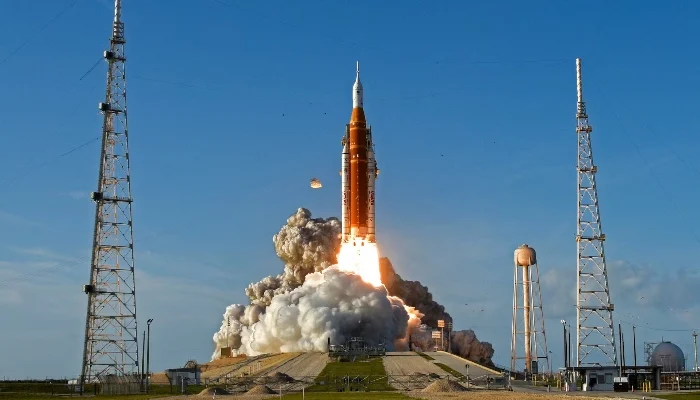
NASA’s Artemis II mission, featuring the Space Launch System (SLS) rocket paired with the Orion crew capsule, successfully launched from Kennedy Space Center in Cape Canaveral, Florida, on April 1, 2026, as reported by Reuters. The Orion capsule, carrying four astronauts, completed a critical thruster burn on Thursday that propelled it out of Earth’s orbit and set it on course toward the moon. This maneuver commits the crew to travel the farthest distance humans have ever traveled in space.
The maneuver placed the spacecraft within the moon’s gravitational influence by Sunday morning, aiming to surpass the distance record set by Apollo 13 in 1970. Canadian astronaut Jeremy Hansen described the view shortly after the thruster firing, saying, “We are getting just a beautiful view of the dark side of Earth illuminated by the moon right now. Phenomenal.”
Since their launch from Florida 26 hours earlier, the astronauts spent their initial day in space testing cameras, navigating the Orion spacecraft, and resolving minor issues with the onboard toilet and email system, which were later addressed. They initially orbited Earth in a highly elliptical path, reaching as far as 43,000 miles (64,000 km) away and as close as 100 miles, before executing the translunar injection burn—an essential maneuver marking the exit from Earth’s orbit and initiation of their journey to the moon, scheduled at 7:49 p.m. ET (2349 GMT).
This burn set the spacecraft on a figure-eight trajectory toward the moon, with the Orion capsule primarily influenced by orbital mechanics for the remainder of the mission. Commander Reid Wiseman, monitoring cameras during the spacecraft’s departure from Earth, reflected on how difficult it was to adjust exposure settings, comparing the view to taking a photo of the moon from his backyard. Earlier, Wiseman also resolved a minor technical issue involving email access.
Throughout the mission, the crew is documented using various devices, including GoPro action cameras, iPhones—introduced under NASA Administrator Jared Isaacman’s directive—and professional Nikon cameras, which have a history of use on the International Space Station. NASA has yet to release any photos captured thus far but anticipates showcasing significant moments, including a forthcoming “Earthrise” shot reminiscent of the iconic 1968 image taken during Apollo 8.
By day six, the crew is expected to be approximately 252,000 miles from Earth—the farthest humans have ever traveled—placing Earth as a tiny dot beyond the moon’s shadowed far side.
Shortly after launch, astronaut Christina Koch notified mission control of a red blinking light indicating a problem with Orion’s toilet, housed within a small cabin slightly larger than a minivan. Mission engineers quickly implemented a fix after testing. Spacecraft toilets, often challenging to use, are vital on long missions. The Orion crew uses the $24 million Universal Waste Management System, which employs suction to collect waste, recycles urine into water, and seals solid waste in bags for eventual disposal. The design features a shape-shifting funnel and hose for urine, along with a seat for bowel movements, accommodating feedback from female astronauts.
Compared to the rudimentary bags used during the Apollo era—attached directly to astronauts and stored onboard or left on the lunar surface—Orion’s toilet resembles a conventional setup, enclosed behind a small door for privacy. Orbiting the moon is a significant milestone, as the astronauts are expected to reach their most distant point—about 252,000 miles from Earth—where Earth will appear as a tiny basketball-sized dot on the planet’s far side.
 ChatGPT
 Perplexity
 Gemini AI
 Grok AI