Select Language:
Australia’s Qantas Airways, Scandinavian Airlines (SAS), and Air New Zealand have announced fare increases on Tuesday, attributing the rise to a sudden surge in fuel costs driven by the ongoing Middle East conflict.
Jet fuel prices, which hovered around $85 to $90 per barrel before U.S.-Israeli strikes on Iran, have skyrocketed to between $150 and $200 per barrel in recent days, according to Air New Zealand, which also announced it would suspend its financial forecast for 2026 due to the uncertainty surrounding the conflict.
The warfare has disrupted shipping along one of the world’s most critical oil export routes, causing a sharp increase in oil prices. This upheaval has impacted global travel, with airline tickets on some routes reaching unprecedented levels and concerns mounting about a prolonged slump in travel demand that could lead to widespread flight cancellations.
“Increases of this size necessitate a response to maintain stable and dependable operations,” an SAS representative told Reuters, noting the airline has implemented a “temporary price adjustment.” Last year, SAS temporarily modified its fuel hedging policy due to market volatility, with no fuel hedged for the upcoming 12 months.
While several Asian and European carriers, such as Lufthansa and Ryanair, have hedged part of their fuel needs at fixed prices, Finnair cautioned that fuel availability could become problematic if the conflict persists. Kuwait, a significant exporter of jet fuel to northwestern Europe, has reported production cuts.
“A prolonged crisis could influence not only the price but also the availability of fuel, at least for a period,” a Finnair spokesperson stated, adding that the airline had hedged over 80% of its fuel needs for the first quarter, though the situation remains fluid.
### Airspace Disruptions in the Middle East
Highlighting ongoing airspace chaos, flights arriving in Dubai were briefly held in a holding pattern Tuesday due to potential missile threats, according to flight tracking service Flightradar24 on X. The aircraft eventually landed safely.
Qantas mentioned that, along with raising international fares, it is considering redeploying capacity to Europe as airlines and travelers seek to avoid Middle Eastern disruption, where drone and missile fire have curtailed flight operations.
Fares on Asia-Europe routes have surged because of airspace closures and capacity constraints. Hong Kong’s Cathay Pacific announced it would add additional flights to London and Zurich in March.
Air New Zealand reported increases in domestic and international fares, raising one-way economy prices by NZ$10 ($6) domestically, NZ$20 on short-haul international flights, and NZ$90 on long-haul routes. More adjustments could follow if fuel costs remain high.
Hong Kong Airlines announced it would hike fuel surcharges by up to 35.2% starting Thursday, with the steepest increases on flights connecting Hong Kong with the Maldives, Bangladesh, and Nepal.
### Market Reactions and Oil Prices
Some airline stocks gained momentum, and oil prices fell to about $90 per barrel on Tuesday after U.S. President Donald Trump suggested the conflict might conclude soon, easing some investor concerns. European airline stocks rose between 4% and 7% as markets opened, while Asian carriers showed signs of recovery, with Qantas up 0.5%, Korean Air Lines up 3%, and Cathay Pacific up 3.6%, following Monday’s sharp declines.
Fuel costs are a major expense for airlines, typically comprising 20% to 25% of operating costs, making the fluctuation in oil prices highly impactful.
### Reduced Airspace and Industry Challenges
Beyond rising fuel prices, restricted airspace due to the conflict is further threatening the aviation industry. Airlines are rerouting to avoid Middle Eastern conflict zones, leading to increased congestion on key routes.
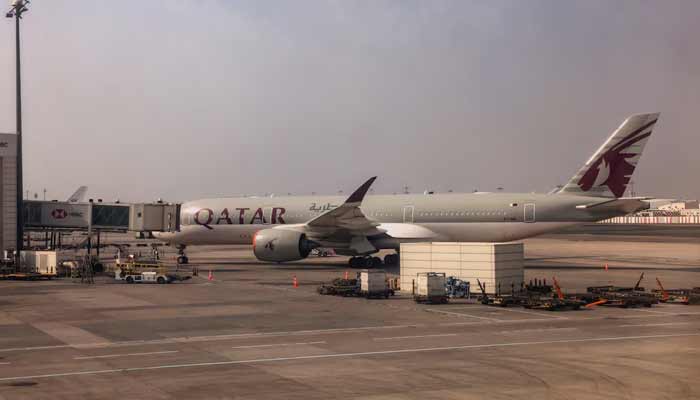
Emirates, Qatar Airways, and Etihad together account for roughly one-third of passenger traffic between Europe and Asia and operate over half of all flights connecting Europe to Australia, New Zealand, and Pacific Islands, according to Cirium.
European carriers, already strained by restrictions caused by the Ukraine war—such as avoiding Russian airspace and flying longer routes—are now facing additional hurdles as available airspace diminishes, complicating their operations further.
 ChatGPT
 Perplexity
 Gemini AI
 Grok AI