Select Language:
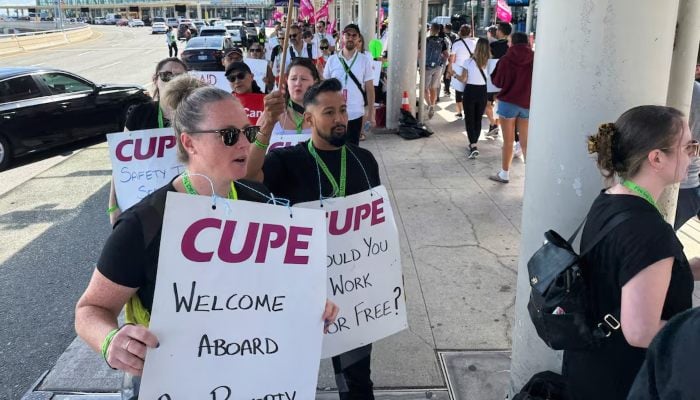
On August 17, 2025, demonstrators at Toronto Pearson International Airport in Mississauga, Ontario, held signs as Air Canada flight attendants declared they would stay on strike and oppose a government-ordered return to work they deemed unconstitutional. This defiance occurred despite a federal mandate aimed at compelling them back to their duties.
Air Canada has announced that restoring normal operations could take a week or longer. The Jobs Minister has promised an investigation into claims of unpaid work, while the union reports that mediation with the airline has concluded.
The unionized flight attendants of Air Canada reached an agreement Tuesday with the airline, ending a strike that was the first in four decades and had disrupted travel for hundreds of thousands of passengers. The nearly four-day strike prompted the airline—serving approximately 130,000 people daily—to withdraw its guidance for third-quarter and full-year earnings.
Shares of Air Canada rose 4% in early trading, although they have declined 14% this year. The airline indicated it will gradually restart flights, with a complete return expected to take more than a week. The union confirmed the mediation process with the airline and its low-cost subsidiary, Air Canada Rouge, has ended.
The airline noted that some flights would be canceled over the next one to two weeks until schedules stabilize. Affected customers can opt for a refund, travel credit, or rebooking on other airlines. The flight attendants walked out after contract negotiations failed. Their primary concern was receiving pay for tasks like passenger boarding.
While specific negotiation details haven’t been disclosed, the union states that unpaid work has been addressed. The Canadian Union of Public Employees (CUPE), representing 10,400 flight attendants, sought gains related to unpaid tasks beyond recent improvements achieved by counterparts at U.S. airlines such as American Airlines.
In a rare act of defiance, the union stayed on strike even after the Canada Industrial Relations Board declared their actions unlawful. Their refusal to obey the federal labor board’s order to return to work created a three-party standoff involving the company, the workers, and the government.
Jobs Minister Patty Hajdu urged both sides to consider government-mediated solutions and announced plans to investigate allegations of unpaid work within the airline sector. Over the past two years, unions across aerospace, construction, aviation, and rail industries have pressed employers for higher wages, better conditions, and improved benefits amid a tight labor market.
For months, Air Canada’s flight attendants have argued that new contracts should include pay for ground tasks such as passenger boarding. The airline’s CEO, in a Monday interview with Reuters, declined to detail plans to resolve the deadlock but defended a 38% increase in total compensation for flight attendants.
Despite many customers expressing support, frustration grew due to ongoing cancellations. Retiree Klaus Hickman missed a flight to Toronto earlier in the week. He rebooked through another airline but remained concerned about timely connections to Germany for his return trip to Calgary.
Hickman sympathizes with the employees’ demands for better pay but worries about his own health and travel difficulties. “They want more money to get by, just like everyone else,” he said.
Air Canada, the country’s largest carrier, typically transports 130,000 passengers daily and is part of the Star Alliance. James Numfor, 38, from Regina, Saskatchewan, was stranded in Toronto for two nights after returning from Cameroon for his brother’s funeral. He claims the airline provided only one night in a hotel for his family before leaving them without further support, forcing him to sleep at the airport with his family.
 ChatGPT
 Perplexity
 Gemini AI
 Grok AI