
Select Language:
On Mahmood Nawaz Shah’s farm in Tando Allah Yar, Sindh, two six-foot-tall poles stand silently—one in the mango orchard, the other among banana plants. These seemingly lifeless structures are actually busy sensors constantly transmitting real-time data on soil health to a laboratory in Karachi. Powered by small solar panels and hidden GSM SIM cards, they monitor moisture, phosphate, and nitrogen levels, ensuring detailed insights without surface disturbance.
This is just a snapshot of Shah’s tech-enabled farm. Satellites orbiting high above silently observe changes in soil, temperature, and vegetation across his 600-acre land, which also produces sugarcane, cabbage, and cauliflower. Drones provide a bird’s-eye view, helping him monitor areas that might be underperforming but are hard to see from the ground.
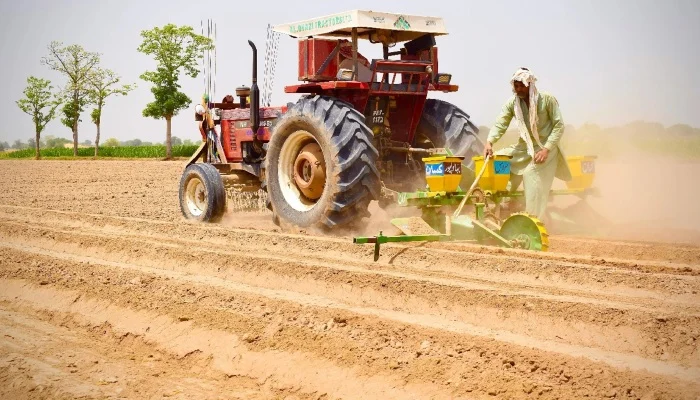
All these technological tools assist Shah’s farm manager in identifying patches that may need attention, increasing efficiency through precise detection of problems that might go unnoticed otherwise. Across Pakistan, many farmers are integrating such innovations for precise farming, crop monitoring, and pest control. Some are even experimenting with robotic machinery for planting and harvesting, says Dr. Shehzad Nahiyoon, a researcher at the Chinese Academy of Agricultural Sciences in Beijing.
However, unlike other Asian countries, where livestock health is also tracked digitally, Pakistan’s focus remains primarily on crops and fruit cultivation. The scope of agritech here is still limited, providing only partial solutions for sustainable agriculture.
“Agritech isn’t a miracle cure,” Shah emphasizes. “These tools help my farm manager—act as his eyes and ears—but they don’t replace him entirely.” Still, Shah has relied on these tools like Crop2X, an AI-based agricultural tech startup founded by Dr. Muhammad Khurram, for over eight years. Crop2X offers data-driven crop monitoring, bringing together scientists, software developers, hardware engineers, and agronomists to provide soil, land, and weather insights.
“By merging AI with agriculture-specific tools, Crop2X helps farmers understand soil conditions and weather, empowering them to boost yields and reduce costs,” says Dr. Khurram. Yet, Shah remains skeptical about direct yield improvements, noting, “Service providers tend to oversell the benefits of tech,” even though he continues to use Crop2X’s services.
Despite doubts, such solutions are gaining traction, especially as landowners in the West realize that younger farmers often hesitate to do backbreaking manual labor. Shah admits, “We might also need to think along those lines.”
Meanwhile, startup Farmdar aims to eliminate guesswork and manual field work, promising smarter, more data-driven farming practices. Co-founder Manghi explains that over the last four years, the company has worked indirectly through partnerships with sugar mills, food processors, and fertilizer companies, educating farmers that knowledge about soil health and irrigation patterns—rather than sheer effort—is key to profitability.
Yet, adopting new technology isn’t simple. Farmers need tangible results before trusting these tools. “It usually takes about two crop cycles—around two years—for farmers to see real savings, like avoiding unnecessary irrigation or over-fertilization,” Manghi notes. When farmers realize they’re not wasting diesel or excess chemicals, the value becomes clear.
From precise land measurements to early weather warning systems based on predictive data, such innovations can trigger a chain reaction of improvements throughout the agricultural supply chain. Shah uses these tools to access a full history of sowing and harvesting schedules, along with fertilizer and pesticide applications. While useful, Shah seeks more advanced technology—tools that can identify pests crawling on leaves and assess infestations in real time.
This need is shared across farming communities facing unpredictable weather and emerging pest threats. Experts, like Dr. Nahiyoon, confirm that advanced plant protection tools—such as remote sensing and drones—are already available. Dr. Khurram prefers drones over satellites for crop inspection, citing their ability to fly closer to crops, capturing sharper images that detect early signs of pests or diseases.
Yet, these technologies come with costs. Shah recalls that, eight years ago, each sensor node cost him Rs 45,000, with an annual subscription of Rs 35,000. Today, prices have likely soared. Many small farmers, already burdened by high input costs and skeptical of returns, may find investing in such tools prohibitive.
In China, cooperative models allow small farmers to share drone technology or rent equipment, supported by government subsidies. In Pakistan, however, regulatory uncertainties—like unclear drone licensing processes—hinder widespread adoption, despite farmers’ willingness to embrace innovation.
Dr. Nahiyoon urges the government to intervene, streamline regulations, and recognize the vital role that these technologies could play in boosting productivity. “We need policies that encourage adoption and facilitate import and operation of advanced equipment,” he insists.
Recent devastating floods could serve as a catalyst, pushing Pakistan to leapfrog slow incremental progress and deploy scalable technological solutions. Heavy monsoon rains, water releases from upstream dams in India, and climate change have caused unprecedented flooding, displacing over three million people and damaging vast swaths of farmland across Punjab.
Satellite estimates reveal around 220,000 hectares of rice flooded and a 35% loss in cotton crops. The floods have also claimed thousands of livestock and caused sharp rises in food prices—wheat and flour prices in major cities have surged by about 40%. Damaged storage facilities have disrupted markets, exacerbating food insecurity.
In response, the National Disaster Management Authority (NDMA) has proposed a comprehensive resilience plan, including upgrades to flood monitoring systems, regional forecast centers, and advanced models to predict climate-induced floods. The implementation of this plan depends heavily on collaboration with agritech startups equipped to provide the necessary technological innovations.
“Pakistan’s farmland alone in Punjab contains enough land to pay off our national debt within a decade,” Manghi states confidently. “Despite the destruction caused by recent floods, this land is also our key to recovery. The government must realize that agriculture is our most vital resource.”
Dr. Khurram emphasizes that this critical moment offers an opportunity: “The floods underscore the need for soil health assessments, which can determine whether land remains viable for cultivation after inundation—by measuring salinity, micronutrients, and moisture levels, for example. This data will help shape the next season’s planting decisions.”
While these areas of work involve costs, both startups and researchers are ready to support government efforts with precise, reliable data. Sadly, they often wait for the government to seek their assistance. Both Crop2X and Farmdar have turned to Pakistan’s National Incubation Centre (NIC), established at Karachi’s NED University with support from government and industry leaders, which provides mentorship, funding, and resources for startups.
“Joining NIC helped me find my community and gain valuable insights,” says Dr. Khurram. “It’s a place to learn how to scale, connect with experts, and avoid pitfalls like overspending early on.” Similarly, Manghi highlights that the NIC’s guidance on business fundamentals and industry connections has been invaluable, especially for startups navigating uncharted waters.
As Pakistan faces unprecedented weather challenges, embracing innovation and leveraging local startup talent appears essential. The floods have revealed vulnerabilities but also underscored the urgency of digital solutions to rebuild resilient, sustainable agriculture—if policymakers are willing to act.
 ChatGPT
 Perplexity
 Gemini AI
 Grok AI