Select Language:
A recent report indicates that approximately 17 million Afghans are experiencing severe hunger. The onset of winter has further limited employment opportunities, sharply increasing the number of people in need. The World Food Programme estimates that an additional 3 million individuals are now suffering from acute hunger.
In a makeshift tent on the outskirts of Kabul, Samiullah and his wife Bibi Rehana sit by a single bulb, sharing their only meal of the day—dry bread and tea—with their five children and a three-month-old grandchild. Samiullah, 55, expresses feelings of despair, stating, “We’ve reached a point where we’re resigned to death.” His family, including two older sons aged 18 and 20, and their wives, were deported from Iran and Pakistan within the past year amid widespread displacement.
He recounted that their arrival was abrupt; from a modest home in Iran, they found themselves in a fragile tent made of rocks and debris after Iranian authorities raided and detained them before deportation. They managed to salvage some belongings, but their savings, meant to sustain them through the winter, were mostly exhausted. Efforts to contact Iranian officials for comments have been unsuccessful.
Afghan government spokesperson Zabiullah Mujahid explained that returning migrants receive as much support as possible—covering transportation, housing, healthcare, and food. Despite ongoing reconstruction, he noted that the country’s deep-rooted poverty, born from decades of conflict, cannot be eradicated overnight: “Economic programs take time and don’t have an immediate effect on people’s lives.” Meanwhile, Pakistan and Iran collectively expelled more than 2.5 million Afghans in large-scale repatriation efforts. These measures have heightened amid accusations of harboring militants and spying, with security and resource concerns cited as reasons.
As winter advances, job prospects vanish while the influx of returning Afghans increases the population by around 10%, according to WFP country director John Aylieff. The reduction of aid programs since U.S. President Donald Trump’s return to office has drained the resources of organizations like the WFP, compounding the crisis. Donor countries have scaled back their contributions, risking further hardship across the region. Aylieff warns that last year marked the most significant spike in malnutrition in Afghanistan’s history, and the situation is expected to worsen, with projections indicating that 200,000 more children could suffer severe malnutrition by 2026.
At Bamiyan’s aid distribution center, rice bags and bottles of palm oil are stacked, yet lines of people grow longer, and supplies remain insufficient. Zahra Ahmadi, 50, a widowed mother of eight daughters, receives aid for the first time, saying, “I have to manage through winter with these supplies; sometimes we eat, sometimes we don’t.”
At the Qasaba Clinic in Kabul, mothers comfort their children awaiting medical treatment. Dr. Rabia Rahimi Yadgari reports a doubling of malnutrition cases compared to before the migration crisis. The clinic sees about 30 malnutrition cases daily, but supplements are barely enough to support the families, who relied heavily on WFP aid and hospital care previously. Laila, 30, shares that her son Abdul Rahman is recovering after taking nutritional supplements, but his weight loss recurs over time. She attributes her family’s economic collapse to her husband losing his government job after the Taliban’s return; she remarks, “Life never stays the same.”
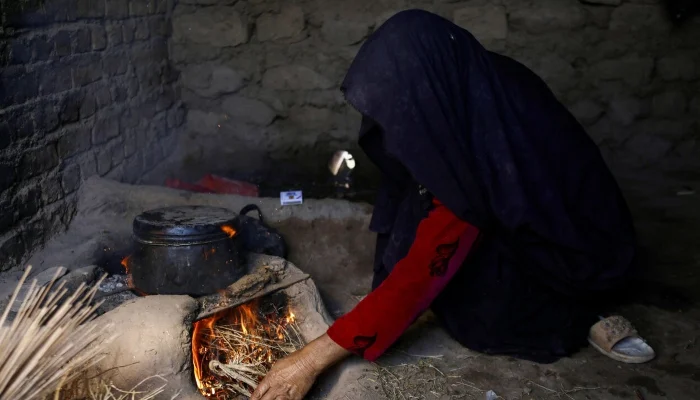
As night falls and temperatures drop, Samiullah gathers firewood while Bibi Rehama lights a stove to keep the family warm. “At night, when it’s very cold, my children say, ‘Father, I’m cold, I’m freezing.’ I hold them close and say, ‘It’s okay.’ What choice do we have?” Samiullah laments. “When I worked in Iran, I could at least provide a proper meal. Now, there’s no work, no livelihood.”
 ChatGPT
 Perplexity
 Gemini AI
 Grok AI