
Select Language:
Parker Solar Probe Captures Unprecedented Images of the Sun
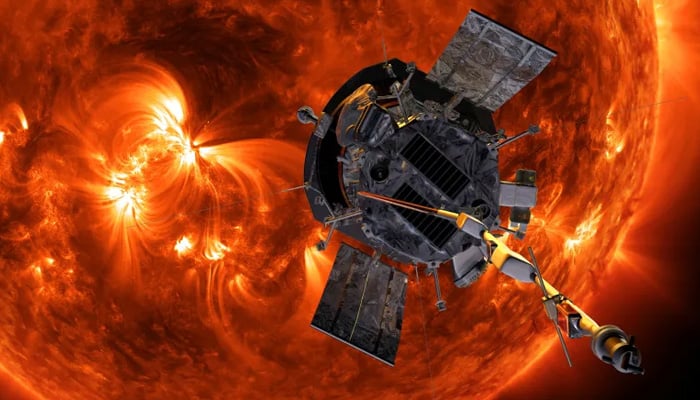
This illustration depicts the Parker Solar Probe as it approaches the sun’s corona, aiming to deepen our understanding of our solar system’s star. — Reuters/File
NASA’s Parker Solar Probe has accomplished a groundbreaking feat by capturing striking images of the sun from a mere 3.8 million miles (6.1 million kilometers) away. These images offer crucial insights into the solar wind’s origins and its effects on Earth.
According to Live Science, the stunning photographs, taken during a flyby on December 24, 2024, are helping scientists get a better grasp on the solar wind—a continuous stream of charged particles flowing from the sun’s outer atmosphere, the corona. This stream not only creates breathtaking space weather phenomena like auroras but can also lead to significant disruptions in power grids and pose risks to spacecraft.
The latest findings are especially important for addressing a longstanding puzzle regarding the slow solar wind, which is denser and more erratic than its faster counterpart. Researchers have faced challenges in deciphering how this solar wind forms and how it escapes the sun’s formidable gravitational forces.
“The biggest mystery has been how the solar wind is created and how it manages to break free from the Sun’s powerful gravity,” remarked Nour Rawafi, the project scientist for the Parker Solar Probe at Johns Hopkins Applied Physics Laboratory. “Understanding this continuous flow of particles, particularly the slow solar wind, is a substantial challenge.”
The recent data collected during the probe’s latest pass has validated a key theory: the slow solar wind comprises two distinct types—Alfvénic and non-Alfvénic. These images are aiding scientists in identifying the sources of these winds, indicating that Alfvénic streams may emerge from cooler regions known as coronal holes, while non-Alfvénic winds could originate from hotter magnetic structures called helmet streamers.
“We haven’t reached a final consensus yet, but we have acquired a wealth of new, intriguing data,” stated Adam Szabo, mission scientist for the Parker Solar Probe at NASA’s Goddard Space Flight Center in Greenbelt, Maryland.
Launched in 2018, the Parker Solar Probe is the first spacecraft to venture into the sun’s corona. It is equipped with sophisticated scientific instruments, including the Wide Field Imager for Solar Probe (WISPR), and withstands extreme temperatures and radiation to collect data effectively.
The probe will continue its mission and is set to pass its perihelion—the point closest to the sun’s surface—on September 15.
 ChatGPT
 Perplexity
 Gemini AI
 Grok AI