Select Language:
Kimia’s Journey: A Tale of Hope and Uncertainty
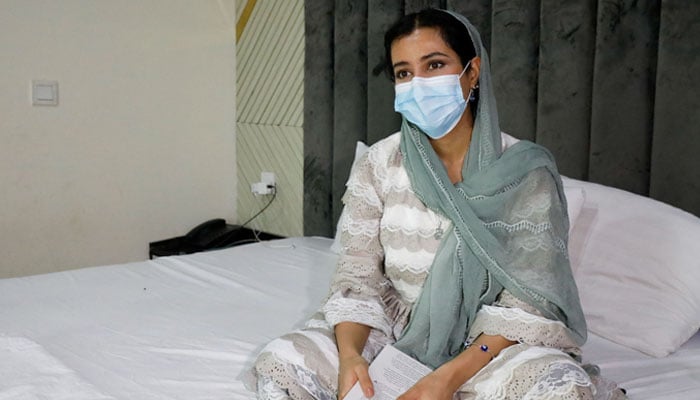
ISLAMABAD/BERLIN: In a small guesthouse in Pakistan’s capital, 25-year-old Kimia spends her days creating sketches of women—dancing, playing, and standing strong. These drawings encapsulate her remaining hopes and dreams.
Kimia, a visual artist and advocate for women’s rights, fled Afghanistan in 2024 after qualifying for a German humanitarian admission program designed to help Afghans deemed at risk under Taliban rule. Unfortunately, one year later, she finds herself caught in a state of uncertainty.
Meanwhile, thousands of miles away in Germany, a February election focused heavily on migration issues led to a new government taking power in May, which has initiated the gradual suspension of the program designed to assist vulnerable Afghans. The center-right coalition now aims to terminate the initiative entirely.
Kimia’s hopes rested on an interview scheduled at the German embassy that was abruptly canceled in April, leaving her in a precarious situation. Germany currently covers her living expenses, including her room and medical care.
“This interview represents everything to me,” she shared with Reuters, hesitating to reveal her real name out of fear of repercussions. “We just seek a place that is safe and peaceful,” she added, speaking about herself and other women in the guesthouse.
The humanitarian admission program started in October 2022 with the goal of relocating up to 1,000 high-risk Afghans each month to Germany, focusing on individuals working in human rights, education, and other vital sectors, as well as those persecuted for their gender or beliefs. Yet, as of now, only about 1,600 people have arrived over a span of two years, hindered by logistical delays and canceled flights.
Currently, around 2,400 Afghans are awaiting their chance to travel to Germany, but the future remains unclear. NGOs report that an additional 17,000 Afghans are still in the initial stages of applying for this now-inactive program.
The German foreign ministry has announced that admissions through this program will remain suspended as the government reviews its procedures, stating they will ensure care for those already within the program. However, they have not provided clarification on the number of canceled interviews or the duration of the suspension.
Interviews with Afghans living in both Pakistan and Germany reveal a broader trend of tightening asylum regulations in Germany, with many feeling that Sunni men, in particular, are seen as less at risk under Taliban rule.
Although the German government denies any formal policy aimed at limiting Afghan migration, approval rates for Afghan asylum applicants fell to 52% in early 2025, down from 74% in 2024, according to the Federal Migration Office (BAMF).
Change in Political Landscape
The Taliban took control of Kabul in August 2021. Since then, Germany has accepted approximately 36,500 at-risk Afghans through various channels, including former local staff.
Thorsten Frei, chief of staff to Germany’s current Chancellor, Friedrich Merz, stated that the scale of humanitarian migration has reached a point that “overwhelms the society’s ability to integrate.”
“As long as irregular migration continues, we cannot effectively implement voluntary admission programs,” he emphasized.
With several Afghans challenging the government’s suspension of admissions in court, lawyer Matthias Lehnert stated that the government cannot simply halt admissions without circumstances that eliminate the danger these individuals face.
Public sentiment in Germany has shifted since former Chancellor Angela Merkel opened the borders to over a million refugees in 2015, partly due to various violent incidents involving asylum seekers. The far-right Alternative for Germany party (AfD) gained significant traction in February’s elections, capitalizing on growing anti-migrant sentiment.
Afghans who spoke to Reuters expressed concerns over being unfairly linked to these incidents, fearing for their lives should they be forced to return to Afghanistan.
“I feel terrible for those who have suffered or lost their lives… but we are not to blame,” Kimia remarked.
Mohammad Mojib Rezayee, a 30-year-old Afghan refugee, arrived in Germany from Cyprus in March, having waited for a year with other displaced individuals. At risk for openly criticizing the Taliban, he found his application for asylum denied just two weeks after arriving in Berlin.
“To be denied protection in such circumstances is absurd,” he lamented. Legal advisor Nicolas Chevreux noted that Afghan asylum claims have been treated with increased scrutiny since a mass stabbing incident in Mannheim in mid-2024, where an Afghan asylum seeker was charged.
A Life on Pause
More often than not, Kimia finds herself confined to her room, surrounded by learning materials in English and German. Returning to Afghanistan seems unthinkable for her, as she fears that her art could make her a target.
“If I go back, I can’t pursue my dreams. I can’t work, I can’t study. It’s like existing without truly living,” she explained.
Under Taliban governance, women are largely excluded from public life, face harassment from morality police if not accompanied by a male guardian, and must adhere to stringent dress codes, including face coverings. Kimia recalls moments of panic when security forces invaded homes, compelling her to hide her artistic creations.
The Taliban, for their part, claim that they respect women’s rights according to their interpretation of Islamic law and local customs, insisting they are not targeting former opponents.
Hasseina, a 35-year-old journalist from Kabul, also fled to Pakistan and is among those accepted into the German program. Divorced and facing threats from both the Taliban and her ex-husband’s family, she feels there is no option for her to return home.
Marina, aged 25, left Afghanistan after being separated from her family. Her mother, a human rights lawyer, managed to reach Germany, while Marina has been awaiting her chance to join her for nearly two years in Pakistan, now with her baby.
“My life is on hold. I want to go to Germany, to work, to contribute. Here, I feel completely useless,” she expressed.
 ChatGPT
 Perplexity
 Gemini AI
 Grok AI