
Select Language:
Sure! Here’s a rewritten version of the content in American English, making it unique and human-readable:
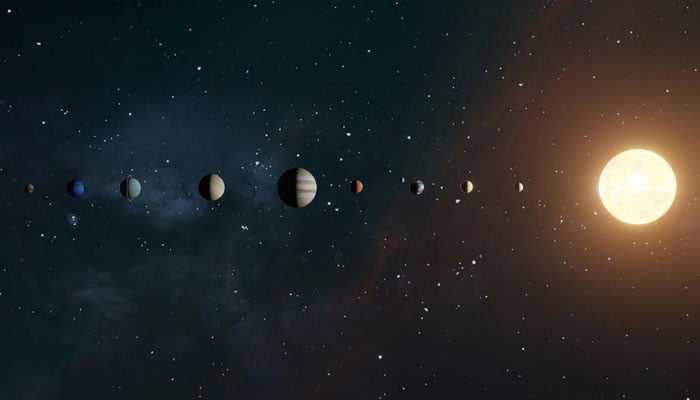
Astronomers have announced the discovery of a third interstellar object racing through our solar system: a massive comet named 3I/Atlas. This might be the largest interstellar comet ever found.
This icy traveler provides an exceptional opportunity to examine the materials from other star systems.
Initially detected on Tuesday by the ATLAS survey in Hawaii, which is funded by NASA, the object was soon confirmed to be interstellar by the International Astronomical Union’s Minor Planet Center, according to Science Alert.
Its fuzzy appearance suggests that it is mainly made of ice, rather than rock, as noted by Jonathan McDowell, an astronomer with the Harvard-Smithsonian Center for Astrophysics.
The good news for those on Earth is that 3I/Atlas poses no danger to our planet.
Richard Moissl, head of planetary defense at the European Space Agency, confirmed that the comet will “soar deep through the solar system, skimming just inside the orbit of Mars” without colliding with any of our neighboring planets.
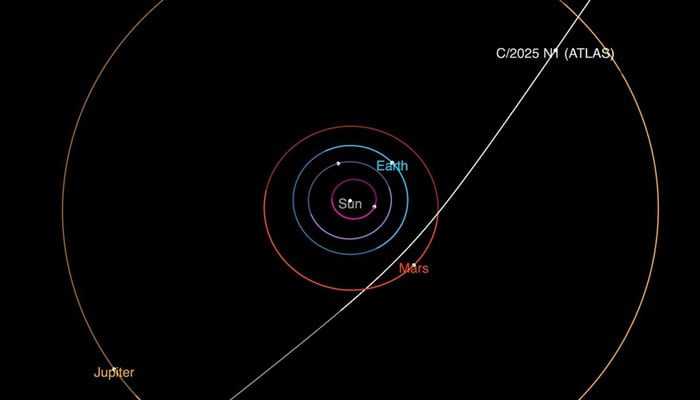
Excitement is growing among scientists as they refine their calculations, indicating that the comet is traveling at speeds exceeding 60 kilometers (37 miles) per second. This remarkable velocity confirms that it is on an unbound path, meaning it is not orbiting our Sun but speeding through interstellar space on its way to who knows where.
“We believe these icy bodies are formed in connection with star systems,” McDowell explained. “Then, as another star approaches, it tugs on the ice body, releasing it. It becomes a rogue comet, wandering through the galaxy, and now this one is passing by us.”
Astronomers, both professional and amateur, have been sifting through past telescope data, tracking the comet’s trajectory back to at least June 14.
Current size estimates suggest it could be about 10 to 20 kilometers wide, potentially making it the largest interstellar visitor discovered to date. Its icy nature might also cause it to reflect more light, making it appear larger.
The comet is likely to brighten and come closer to the Sun until late October, remaining visible through telescopes until next year, Moissl added.
This marks the third occasion when humanity has detected an object entering our solar system from beyond.
The first, ‘Oumuamua, was found in 2017 and sparked theories about alien origins before being reclassified. The second, 2I/Borisov, was recorded in 2019.
Mark Norris, an astronomer at the University of Central Lancashire in the UK, noted that 3I/Atlas appears to be “moving significantly faster than the previous two interstellar objects we’ve discovered.”
As of now, the comet is approximately the distance from Earth to Jupiter, and it is only observable from the Southern Hemisphere.
While a mission to intercept 3I/Atlas is currently not feasible, these rare cosmic visitors give scientists an unmatched opportunity to study materials from outside our solar system.
 ChatGPT
 Perplexity
 Gemini AI
 Grok AI