
Select Language:
Sure! Here’s a rewritten version of the content in American English, making it unique and ensuring it’s plagiarism-free:
—
More than 14 million of the world’s most at-risk individuals, including a significant number of young children, may face death due to the Trump administration’s cuts to US foreign aid, according to a study released on Tuesday.
This research, published in the esteemed Lancet journal, coincided with a gathering of global leaders and business executives at a UN conference in Spain this week, aiming to revitalize the struggling aid sector.
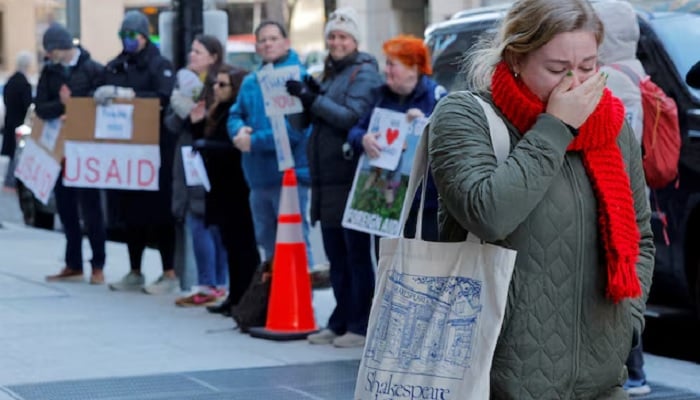
The U.S. Agency for International Development (USAID) was responsible for over 40% of global humanitarian funding prior to Donald Trump’s return to the presidency in January. Shortly thereafter, Trump’s close advisor and the world’s wealthiest individual, Elon Musk, claimed to have severely undermined the agency.
The funding reductions “threaten to abruptly halt—and potentially reverse—two decades of health improvements for vulnerable populations,” cautioned Davide Rasella, a co-author of the study and researcher at the Barcelona Institute for Global Health (ISGlobal).
“For many low- and middle-income nations, the shock from these cuts would be comparable to a global pandemic or a significant military conflict,” he stated.
Analyzing data from 133 countries, the international research team concluded that USAID funding had averted 91 million deaths in developing nations between 2001 and 2021. Their models indicated that an 83% reduction in funding—announced by the U.S. government earlier this year—could notably increase death rates.
According to their projections, over 14 million preventable deaths could occur by 2030 as a result. This alarming figure includes more than 4.5 million children under the age of five, translating to around 700,000 child deaths annually.
For context, an estimated 10 million soldiers lost their lives during World War I.
Programs funded by USAID were found to be associated with a 15% drop in overall mortality rates; however, for children under five, the decline was even more pronounced at 32%.
Specifically, USAID funding was notably effective in preventing deaths from diseases. The study revealed that there were 65% fewer deaths from HIV/AIDS in countries that received substantial USAID support compared to those with minimal or no assistance. Deaths from malaria and neglected tropical diseases were similarly halved.
Time for an Increase
Following the significant cuts to USAID, several other major donors, including Germany, the UK, and France, announced similar reductions to their foreign aid budgets.
These reductions, particularly within the European Union, could lead to “even more preventable deaths in the years to come,” stated study co-author Caterina Monti from ISGlobal.
However, researchers emphasized that the grim projections regarding mortality are based on current aid commitments, so they might improve if conditions change.
This week, dozens of international leaders are convening in Seville, Spain for the largest aid conference in a decade. Notably, the U.S. government will not be participating.
“This is the moment to increase funding—not cut it back,” Rasella urged.
Prior to funding reductions, USAID comprised only 0.3% of total U.S. federal spending.
“American citizens contribute approximately 17 cents a day to USAID, totaling around $64 each year,” noted study co-author James Macinko from the University of California, Los Angeles. “I believe most people would support continued funding for USAID if they understood just how impactful such a small investment can be in saving lives.”
 ChatGPT
 Perplexity
 Gemini AI
 Grok AI