
Select Language:
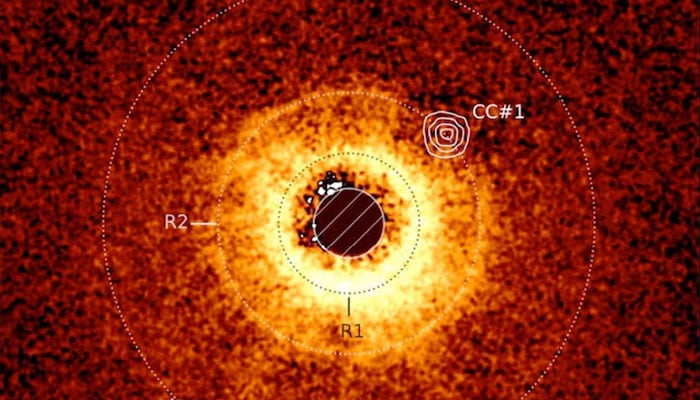
Since its launch in 2021, the James Webb Space Telescope has not only shed light on the early universe but has also provided invaluable insights into various known exoplanets—planets outside our solar system. For the first time, Webb has successfully identified an exoplanet previously unknown to scientists.
This newly discovered planet is a young gas giant, approximately the size of Saturn—the second-largest planet in our solar system. It orbits a star that is smaller than the sun, situated around 110 light-years from Earth in the constellation Antlia. To put it in perspective, a light-year is the distance that light travels in a year, which amounts to about 5.9 trillion miles (9.5 trillion kilometers).
Out of nearly 5,900 exoplanets detected since the 1990s, the majority have been identified through indirect methods, such as observing the slight dimming of a star’s light when a planet transits in front of it. Direct imaging, like what Webb accomplished with this new planet, represents less than 2% of those discoveries.
Although this planet is large relative to our solar system, it is actually the least massive exoplanet ever captured through direct imaging, being ten times less massive than the previous lightweight champion. This remarkable finding highlights the sensitivity of Webb’s instruments.
This groundbreaking observation was made using a coronagraph developed in France, which blocks the bright light of the star, and is part of Webb’s Mid-Infrared Instrument (MIRI).
“Webb opens up possibilities—both in terms of planetary mass and the distances they orbit from their stars—of exoplanets that were previously unreachable for observation. This is crucial for exploring the diversity of planetary systems and understanding their formation and evolution,” stated astronomer Anne-Marie Lagrange from the French research agency CNRS and LIRA/Observatoire de Paris, who is the lead author of a study published in the journal Nature.
The new planet orbits its host star, known as TWA 7, from a distance approximately 52 times that of Earth’s distance from the sun. By comparison, Neptune, the furthest planet in our solar system, orbits about 30 times farther from the sun than Earth does. The transit method is particularly effective for identifying planets that are close to their host stars, unlike this newly discovered planet, which orbits at a significant distance.
“While indirect methods provide substantial data for planets near their stars, imaging is essential for accurately detecting and characterizing planets that are farther away—typically at a distance of about 10 times that between the Earth and the sun,” Lagrange explained.
Planetary systems typically form when a large cloud of gas and dust, known as a molecular cloud, collapses under its own gravity, leading to the formation of a central star. The remaining material orbits the star in a protoplanetary disk and ultimately forms planets.
Both the star and the planet in this study are practically newborns, estimated to be around 6 million years old, compared to our sun and solar system, which are approximately 4.5 billion years old.
Due to the angle from which scientists are observing this system—essentially looking at it from above rather than from the side—they were able to discern the structure of the surrounding disk, which has two broad, concentric ring-like formations made of rocky and dusty material, as well as a narrow ring where the planet resides.
Researchers have yet to determine the composition of the planet’s atmosphere, but future observations with Webb could provide more clarity. Additionally, it’s still uncertain whether the young planet is gathering more mass by accreting surrounding material.
Although this planet is the smallest to be directly imaged, it remains significantly more massive than rocky planets like Earth, which are better candidates in the search for extraterrestrial life. Even with its extraordinary capabilities to observe the universe in near-infrared and mid-infrared wavelengths, Webb cannot yet directly image Earth-sized exoplanets.
“Looking ahead, I am hopeful that projects aimed at directly imaging Earth-like planets and searching for potential signs of life will become a reality,” Lagrange concluded.
 ChatGPT
 Perplexity
 Gemini AI
 Grok AI