
Select Language:
Astronomers have made an exciting discovery: they have observed incredibly powerful X-ray jets shooting from two supermassive black holes that are so ancient they still shine in the aftermath of the Big Bang.
"They are turning the universe’s first light into high-energy jets," explained Jaya Maithil, a postdoctoral research fellow at the Harvard and Smithsonian Center for Astrophysics. She shared this information with reporters on June 9 during the 246th meeting of the American Astronomical Society in Anchorage, Alaska, as reported by Space.com.
Utilizing data from NASA’s Chandra X-Ray Observatory and the Karl G. Jansky Very Large Array (VLA), Maithil and her colleagues discovered that each of these jets stretches an incredible 300,000 light-years—almost three times the diameter of our Milky Way galaxy. Both jets stem from actively feeding supermassive black holes, known as quasars, situated approximately 11.6 and 11.7 billion light-years away.
The researchers examined these colossal structures as they existed when the universe was merely 3 billion years old, during a period of rapid growth for galaxies and their central black holes.
"These quasars are like cosmic time capsules," Maithil noted. "Understanding them can help us learn how they influenced the development of their galaxies and the surrounding environment."
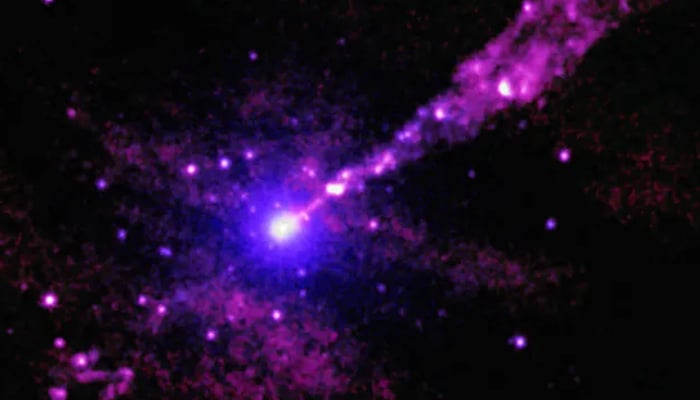
One of the newly identified jets, originating from the quasar J1610+1811, is depicted in the accompanying Chandra image. A thin, faint purple line extends from the quasar’s dazzling white core toward the upper right, ending in a small bright dot. A second, fainter jet appears to flow in the opposite direction, downward and to the left.
"It’s akin to searching for a candlelight close to a powerful flashlight that’s shining directly at us," Maithil added.
What makes these jets particularly remarkable is their visibility across billions of light-years. In a paper accepted for publication in The Astrophysical Journal, Maithil and her team proposed that the jets emit X-rays by interacting with the cosmic microwave background (CMB)—the faint residual radiation from the Big Bang, which remains after the universe cooled enough for starlight to travel freely, marking the conclusion of the "cosmic dark ages."
 ChatGPT
 Perplexity
 Gemini AI
 Grok AI