
Select Language:
Sure! Here’s a rewritten version of the content you provided:
—
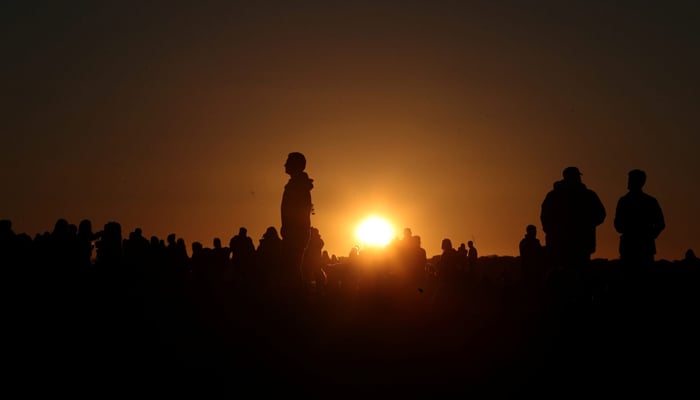
This year, the summer solstice, known as the longest day of the year in the Northern Hemisphere, will take place on June 20 in North America.
Stonehenge in England has long been a traditional site for festive gatherings to welcome the summer solstice, with revelers staying awake to watch the sunrise on this day, according to Live Science.
However, 2025 presents an interesting twist: the summer solstice in England will occur on a different day than in North America, which is due to time zone differences.
In 2025, the summer solstice will officially happen at 2:42 AM UTC on Saturday, June 21, translating to 10:42 PM Eastern Daylight Time on Friday, June 20, and 3:42 AM British Summer Time on Saturday, June 21.
The term “solstice” comes from the Latin words “sol,” meaning “sun,” and “stice,” which means “to stand still,” aptly describing how the sun appears to reach its highest and lowest points on the horizon twice a year: around December 21 to December 22, and again from June 20 to June 22.
Astronomically, the sun is at its peak height in the sky during midday on the summer solstice in the Northern Hemisphere. This indicates that on this day, the sun rises at its most northeastern point and sets at its most northwestern point.
In contrast, the June solstice signifies the winter solstice in the Southern Hemisphere. Thus, when the sun is at its highest point in the Northern Hemisphere, it is at its lowest point in the Southern Hemisphere.
This pattern flips during the December solstice, which marks the longest day and shortest night for those in the Southern Hemisphere. During the equinoxes, which take place from March 19 to March 21 and September 21 to September 24, the sun rises and sets precisely in the east and west across the globe.
The occurrence of solstices and equinoxes is due to the Earth’s axial tilt of 23.5 degrees in relation to its orbit around the sun, leading to seasonal changes.
Durring the summer solstice, the Northern Hemisphere is tilted toward the sun, resulting in an extended period of daylight that characterizes the longest day of the year.
Even though one might assume that the summer solstice is also the hottest day of the year, a slight seasonal lag can occur. This is due to the time it takes for Earth’s primarily water-based surface to absorb and release heat, as noted by the Royal Meteorological Society.
At the North Pole, continuous daylight occurs during the summer solstice, while the South Pole experiences constant darkness.
—
Let me know if you need any more adjustments or additional information!
 ChatGPT
 Perplexity
 Gemini AI
 Grok AI