
Select Language:
Sure! Here’s a rewritten version of the content in American English, made unique and free of plagiarism:
—
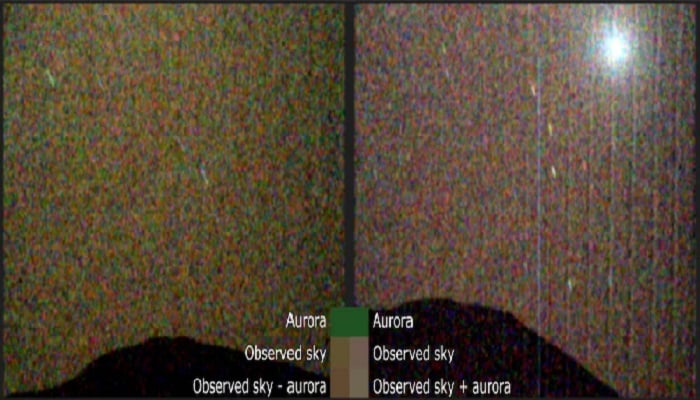
NASA’s Perseverance rover has for the first time captured a visible-light image of an aurora on Mars, revealing a softly glowing green hue in the Martian sky—a first for any planetary surface beyond Earth.
This aurora, observed on March 18, 2024, was triggered by highly energetic solar particles colliding with the Martian atmosphere, resulting in a faint luminescence that shaded the entire night sky. While satellites have previously detected auroras on Mars in ultraviolet wavelengths, this is the first time it was seen in visible light.
Three days prior to the aurora, the sun erupted with a solar flare and a significant coronal mass ejection, a massive explosion of gas and magnetic energy that propelled numerous solar energetic particles through the solar system. Mars, being the fourth planet from the sun after Mercury, Venus, and Earth, was affected by this wave of energy.
Researchers had anticipated this event and equipped the rover’s instruments accordingly. Perseverance is fitted with two devices that can detect visible wavelengths. The rover’s SuperCam spectrometer identified the specific wavelength responsible for the green glow, while its Mastcam-Z camera captured an image of the gently illuminated sky.
Auroras on Mars form similarly to those on Earth—charged particles collide with atmospheric atoms and molecules, exciting them and causing electrons to emit light particles known as photons.
“On Earth, the planet’s global magnetic field channels these charged particles into polar regions,” explained Elise Wright Knutsen, a postdoctoral researcher at the University of Oslo’s Center for Space Sensors and Systems, and the lead author of a study published this week in Science Advances. “However, Mars lacks a global magnetic field, so these particles bombard the entire planet simultaneously, producing a widespread aurora.”
The green hue is the result of solar particles interacting with oxygen in Mars’s atmosphere. While Earth often showcases striking auroras, the one observed on Mars was quite subtle.
“The aurora we noticed on March 18th was too dim for the human eye to detect directly. However, a more intense solar storm could make it bright enough for future astronauts to see clearly. Using a camera, like an iPhone, an astronaut would capture the aurora much brighter than visible to the naked eye, similar to how we experience auroras on Earth,” Knutsen mentioned.
This specific aurora posed no threat to Earth.
Every planet in our solar system with an atmosphere experiences auroras.
Knutsen added, “Previous observations from orbiting satellites have detected various types and shapes of auroras on Mars, all in ultraviolet light, ranging from global and diffuse displays to distinct arcs and patches near crustal magnetic fields in the southern regions.”
If astronauts from Earth establish a presence on Mars, they might witness spectacular nighttime light shows.
“During a more intense solar storm that generates a brighter aurora, a glowing green sky stretching from horizon to horizon would be eerily beautiful,” Knutsen stated. “The aurora would manifest as a soft green glow, although dust in the lower atmosphere could obscure some light near the horizon. Looking straight up would also yield a fainter appearance since an angle view allows deeper atmospheric layers to emit the glow.”
—
Let me know if you need any more modifications!
 ChatGPT
 Perplexity
 Gemini AI
 Grok AI