
Select Language:
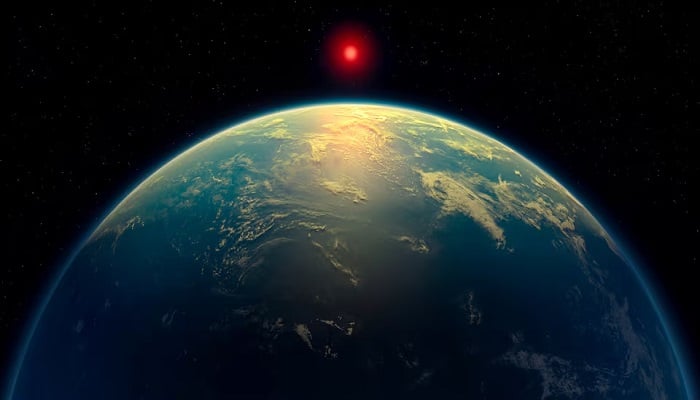
- The planet, named K2-18 b, has a mass 8.6 times that of Earth.
- It is situated approximately 124 light-years from our planet.
- Scientists did not declare the discovery of actual extraterrestrial life.
In a potentially groundbreaking revelation, scientists utilizing the James Webb Space Telescope report having detected what they describe as the most compelling evidence yet of possible life beyond our solar system. They observed chemical markers indicative of biological processes in the atmosphere of an alien planet.
The two gases—dimethyl sulfide (DMS) and dimethyl disulfide (DMDS)—were detected in the atmosphere of the planet known as K2-18 b. On Earth, these compounds are primarily produced by living organisms, notably microorganisms such as marine phytoplankton (algae).
This finding raises the possibility that K2-18 b may harbor microbial life, according to the researchers. However, they emphasized that they are not claiming to have found living organisms but rather a potential biosignature, a sign of biological activity, which requires further verification through additional observations.
Despite this, there is considerable excitement in the scientific community. “These are the first clues suggesting that an alien world may be inhabited,” remarked astrophysicist Nikku Madhusudhan from the University of Cambridge’s Institute of Astronomy, who is the lead author of the research published in the Astrophysical Journal Letters.
“This marks a transformative moment in our search for life beyond the solar system, demonstrating that current technology can detect biosignatures in potentially habitable planets. We are entering a new era of observational astrobiology,” Madhusudhan stated.
He pointed out that numerous initiatives are ongoing in the search for signs of life within our solar system, including investigations into potentially habitable conditions on Mars, Venus, and various icy moons.
K2-18 b is 8.6 times heavier than Earth and has a diameter about 2.6 times greater than our planet. It orbits within the “habitable zone”—a distance from its star that allows liquid water, an essential ingredient for life, to exist on the planet’s surface—around a smaller, dimmer red dwarf star located 124 light-years away in the Leo constellation. Another planet has also been found orbiting this star.
A ‘Hycean World’
Since the 1990s, astronomers have discovered around 5,800 exoplanets, or planets outside our solar system. Scientists have proposed the existence of “hycean worlds,” which are characterized by oceans of liquid water that could support microorganisms and possess hydrogen-rich atmospheres.
Earlier findings by Webb, which launched in 2021 and commenced operations in 2022, had detected methane and carbon dioxide in K2-18 b’s atmosphere, marking the first instance of carbon-based molecules identified in the atmosphere of an exoplanet within a star’s habitable zone.
“The only interpretation that currently aligns with all the data collected by the JWST so far, including previous and current observations, is that K2-18 b is a hycean world likely brimming with life,” said Madhusudhan. “However, we must remain open-minded and continue to explore other possibilities.”
Madhusudhan added that if hycean worlds exist, “we would likely be discussing microbial life, akin to what we observe in Earth’s oceans.” It is theorized that their oceans could be warmer than those on Earth. When asked about the possibility of multicellular or intelligent life, he remarked, “We cannot address that question at this stage. The baseline assumption is of basic microbial life.”
DMS and DMDS, both members of the same chemical family, have been identified as significant biosignatures for exoplanets. Webb’s observations indicated the presence of one or both gases in the planet’s atmosphere with 99.7% certainty, meaning there remains a 0.3% chance that this finding could be a statistical anomaly.
The gases were found in concentrations exceeding 10 parts per million by volume, which is substantially higher—thousands of times higher—than their levels in Earth’s atmosphere, a phenomenon that cannot be explained by existing knowledge without invoking biological activity, explained Madhusudhan.
Other scientists not involved in the study urged caution. “The wealth of data from K2-18 b makes it an intriguing world,” noted Christopher Glein, a principal scientist at the Space Science Division of the Southwest Research Institute in Texas. “These latest findings contribute significantly to our understanding. However, we must approach these data with care and thoroughly validate them. I am eager to see independent analyses of these observations in the near future.”
Transit Method
K2-18 b belongs to the “sub-Neptune” category of planets, with a diameter larger than Earth’s but smaller than Neptune, the smallest gas giant in our solar system.
Astronomers determine the chemical makeup of an exoplanet’s atmosphere by analyzing the light from its host star as the planet transits in front of it from Earth’s point of view, a technique known as the transit method. During this transit, Webb detects a decrease in the brightness of the star and a portion of starlight passing through the planetary atmosphere before it reaches the telescope. This allows scientists to identify the gases present in the atmosphere.
Webb’s previous studies of K2-18 b hinted at DMS, while the newer observations employed different instruments and light wavelengths for analysis.
Madhusudhan stated that the ultimate goal in exoplanet research is to uncover signs of life on Earth-like planets outside our solar system. He emphasized that humanity has pondered the question of “are we alone” in the universe for millennia, and we may be just a few years away from detecting potential alien life on a hycean world.
Nevertheless, he urged for caution. “Initially, we need to repeat these observations two to three times to ensure the signal we’re observing is reliable and to elevate the significance of the detection,” Madhusudhan explained, “to a point where the likelihood of it being a statistical anomaly is below one in a million.” He added, “We also need further theoretical and experimental research to assess whether another non-biological mechanism could account for DMS or DMDS in an atmosphere similar to that of K2-18 b. Although prior studies have labeled them as strong biosignatures for K2-18 b, we must remain open to exploring other explanations.”
Thus, the findings represent “a significant uncertainty” regarding whether the observations indicate life, and Madhusudhan emphasized that it is not in anyone’s interest to prematurely claim the detection of life.
 ChatGPT
 Perplexity
 Gemini AI
 Grok AI