
Select Language:
A Potential Breakthrough in the Search for Extraterrestrial Life
In an exciting development, researchers utilizing the James Webb Space Telescope have reported compelling evidence suggesting the possibility of life beyond our solar system. They’ve detected in the atmosphere of an exoplanet the distinctive chemical signatures of gases associated with biological processes on Earth.
The two gases identified—dimethyl sulfide (DMS) and dimethyl disulfide (DMDS)—are primarily produced by microorganisms, particularly marine phytoplankton, on our planet. This discovery points to the possibility that the planet, designated K2-18 b, could host an abundance of microbial life. However, the scientists emphasized that they are not claiming to have discovered living organisms but rather biosignatures, which are indicators that a biological process may be occurring. They caution that further observations are necessary to confirm these findings.
Astrophysicist Nikku Madhusudhan from the University of Cambridge’s Institute of Astronomy, who led the study published in the Astrophysical Journal Letters, expressed enthusiasm about the implications of this discovery. "This marks a transformative moment in our search for life beyond the solar system. We’ve demonstrated that it’s possible to detect biosignatures on potentially habitable planets using current technology." He added that we have now stepped into the realm of observational astrobiology.
Madhusudhan also acknowledged ongoing efforts to find signs of life within our own solar system, particularly in environments that might support life, such as Mars, Venus, and some icy moons.
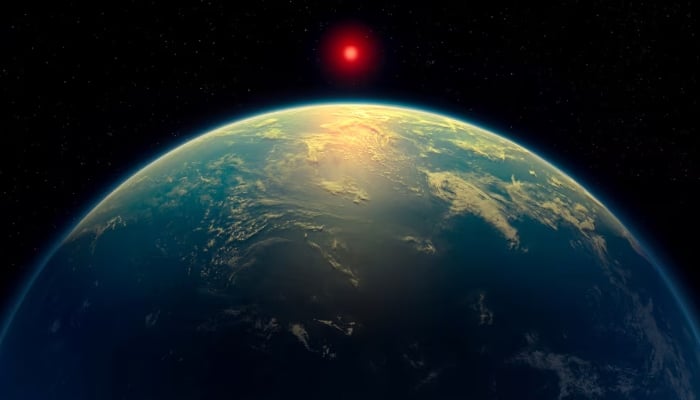
K2-18 b is notably larger than Earth; it possesses a mass 8.6 times greater and a diameter 2.6 times larger than our planet. This exoplanet orbits within the "habitable zone" of a red dwarf star, situated approximately 124 light-years away from Earth in the constellation Leo. This zone is critical because it is the distance at which liquid water—essential for life—can exist on a planet’s surface.
What is a Hycean World?
Since the 1990s, scientists have discovered about 5,800 exoplanets. Among these, a new category known as "hycean worlds" has been theorized, characterized by oceans of liquid water and hydrogen-rich atmospheres that could potentially harbor microbial life.
Previously, the Webb Space Telescope, which was launched in 2021 and became operational in 2022, found methane and carbon dioxide in K2-18 b’s atmosphere. This marked the first discovery of carbon-based molecules in the atmosphere of a planet located within a star’s habitable zone.
Madhusudhan explained that the only current explanation that fits all the collected data from JWST, both past and present, is that K2-18 b is likely a hycean world brimming with life. "However, it’s important to keep an open mind and explore alternative scenarios," he said.
If hycean worlds exist, he posited that the life forms present would likely be microbial, similar to organisms found in Earth’s oceans. He noted that these extraterrestrial oceans might be warmer than ours, but when asked about the possibility of more complex organisms or intelligent life, he maintained caution, stating, "At this stage, we can only assume that simple microbial life could exist."
The gases DMS and DMDS from the same chemical family have been predicted to act as significant biosignatures for exoplanets. Webb detected one or both of these gases in the atmosphere of K2-18 b with a confidence level of 99.7%, indicating a minimal chance (0.3%) that the findings could be due to statistical anomalies.
The gases were found at concentrations exceeding 10 parts per million by volume, which, according to Madhusudhan, is thousands of times higher than their levels in Earth’s atmosphere and cannot be explained by non-biological processes based on current scientific understanding.
Scientists not involved in the research advised caution in interpreting these findings. "The comprehensive data from K2-18 b present an intriguing case," said Christopher Glein, a principal scientist at the Space Science Division of the Southwest Research Institute in Texas. "While these latest observations significantly enhance our knowledge, it’s crucial to thoroughly analyze the data. I look forward to seeing further independent analyses next week."
The Transit Method of Observation
K2-18 b belongs to the "sub-Neptune" class of planets, characterized by a size less than Neptune—our solar system’s smallest gas giant—and greater than Earth.
To determine the chemical makeup of an exoplanet’s atmosphere, astronomers use the transit method, which involves analyzing light from the planet’s host star as the planet moves in front of it from our vantage point. During this transit, the brightness of the star diminishes slightly, and a fraction of the starlight passes through the planet’s atmosphere, allowing scientists to identify the constituent gases.
Earlier observations by Webb hinted at the presence of DMS. The latest discoveries leveraged different instruments and light wavelengths to gain more insight.
Madhusudhan called the search for life on Earth-like planets the "Holy Grail" of exoplanet science. He remarked on humanity’s long-standing curiosity about our place in the universe, suggesting we may soon have the means to detect life on a hycean world.
Nevertheless, he stressed the importance of caution moving forward. "First, we must repeat these observations two to three times to ensure our findings are reliable. Second, we need to conduct more theoretical and experimental studies to explore whether there are non-biological processes that could account for the presence of DMS or DMDS in a planet’s atmosphere like K2-18 b. While previous studies suggest they are robust biosignatures for this planet, it’s essential to remain open to all possibilities," Madhusudhan emphasized.
Therefore, while these findings indicate a significant step forward in understanding the potential for life, the question of whether the observations are due to biological activity remains open, and it is vital not to prematurely announce the detection of life.
 ChatGPT
 Perplexity
 Gemini AI
 Grok AI