
Select Language:
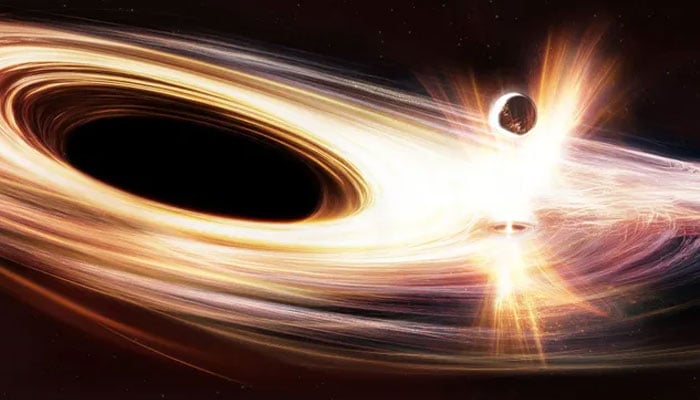
At the center of the galaxy SDSS1335+0728, situated approximately 300 million light-years away, a supermassive black hole that had been dormant is now emitting the most intense and sustained X-ray flares ever observed from such a cosmic giant.
This new active phase is characterized by the black hole consuming matter surrounding it and producing brief but powerful outbursts known as quasiperiodic eruptions (QPEs), according to a report by Space.com.
The black hole is associated with a region in its galaxy referred to as an “active galactic nucleus,” or “AGN.”
The research team has named this AGN “Ansky.”
The first signs of Ansky’s awakening were detected in late 2019, prompting astronomers to observe the phenomenon further using NASA’s Swift X-ray space telescope.
By February 2024, astronomers noted that the black hole fueling Ansky was emitting flares at relatively consistent intervals.
“The X-ray bursts from Ansky are ten times longer and ten times brighter than those observed from typical QPEs,” said Joheen Chakraborty, a team member from the Massachusetts Institute of Technology (MIT).
“Each of these eruptions releases a hundred times more energy than anything we have previously documented. Furthermore, Ansky’s eruptions exhibit the longest interval ever recorded, approximately 4.5 days. This challenges our current models and understanding of how these X-ray bursts are produced,” Chakraborty added.
The team’s observations of the QPEs were greatly aided by contributions from the European Space Agency’s XMM-Newton mission, NASA’s NICE and Chandra missions, along with archived data from eROSITA.
 ChatGPT
 Perplexity
 Gemini AI
 Grok AI