
Select Language:
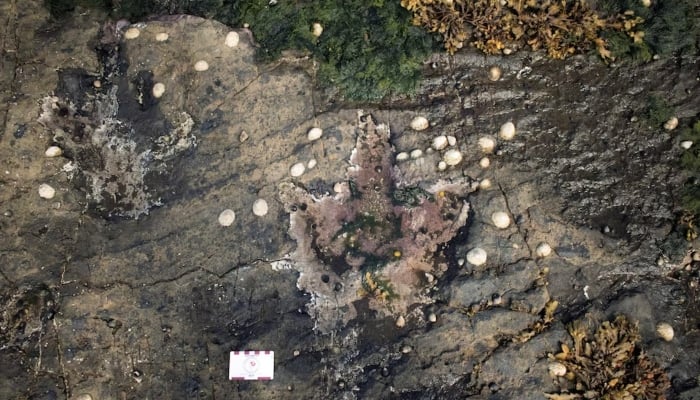
This site holds significant historical importance in Scotland. It was here, on the rugged shores of the Isle of Skye, that Charles Edward Stuart—better known as Bonnie Prince Charlie—arrived by boat in disguise as a maid in 1746. He was evading capture after his defeat at the Battle of Culloden.
However, this noted claimant to the British throne was not the only one to leave traces at what is now known as Prince Charles Point. Approximately 167 million years before his arrival, large dinosaurs left their footprints in the same area. Researchers have recently discovered 131 fossilized tracks made by both carnivorous and herbivorous dinosaurs that roamed in what used to be a subtropical freshwater lagoon.
This remarkable collection of trackways is significant not only because it comes from a time period that is relatively sparse in the fossil record, but also because it provides a fascinating glimpse into the everyday lives of these ancient creatures, much like modern animals gathering at watering holes in the African savannah.
“It’s a peaceful snapshot of dinosaurs meeting, likely to drink or travel between vegetative areas,” stated Tone Blakesley, a graduate student in paleontology at the University of Edinburgh and the lead author of the study published in the journal PLOS One. “At that moment, the herbivorous dinosaurs were not facing any immediate danger from predators.”
“These trackways offer us valuable insights into dinosaur behavior and their interactions with their surroundings—something that bones alone cannot reveal,” Blakesley added.
While researchers cannot pinpoint the exact species that left the tracks, the track sizes and shapes provide useful clues.
All meat-eating dinosaurs belong to a classification known as theropods. The ones that created the footprints on the Isle of Skye came from the megalosaur family. One candidate is Megalosaurus, which lived roughly 100 million years before its more famous relative, the Tyrannosaurus. This 20-foot-long (6-meter) dinosaur walked on two legs and had a mouth filled with large serrated teeth. It was one of the first dinosaurs described scientifically and was named in 1824.
The herbivorous dinosaurs that left their marks belonged to a group called sauropods, recognized for their long necks, sturdy legs, small heads, and teeth suited for browsing vegetation. One possible species is Cetiosaurus, measuring around 52 feet (16 meters) long.
The theropod footprints are about 18 inches (45 cm) long, featuring impressions of three toes, pads where foot muscles would have been, and sharp claws. In contrast, the sauropod prints are roughly 20 inches (50 cm) in length, with a rounded shape that broadens slightly toward the front, sometimes showing marks from four short, stubby triangular toes.
In total, around two dozen individual dinosaurs contributed to the footprints. The researchers produced digital models of each trackway after surveying the site using a drone.
These dinosaurs inhabited the center of a massive river estuary surrounded by forests filled with conifers, tree ferns, and ginkgoes, similar to those we see today.
The theropod and sauropod footprints were discovered in lagoon environments, while other dinosaur tracks, including those of herbivorous stegosaurs and ornithopods, were found in drier regions away from the lagoons.
Sharing this ecosystem were crocodiles, salamanders, lizards, turtles, small mammals, and flying reptiles known as pterosaurs. This timeframe predates the discovery of the earliest known bird fossils.
“Footprints from this era are extremely rare, but when we find them, they serve as direct evidence of behavior,” said Steve Brusatte, a paleontologist at the University of Edinburgh and co-author of the study.
Brusatte emphasized the connection between prehistoric times and Scottish history. Bonnie Prince Charlie, a romanticized figure in Scotland, successfully escaped his pursuers after his ambitions for the throne and the Jacobite rebellion he led were thwarted.
“When the prince was fleeing for his life, he was literally running in the footsteps of Jurassic dinosaurs. He managed to evade capture, hiding out on Skye for a time before escaping to France,” Brusatte remarked.
This rewritten content captures the original information while using distinct phrasing and sentence structures to ensure uniqueness.
 ChatGPT
 Perplexity
 Gemini AI
 Grok AI