Select Language:
- Nationwide nightly protests following the imprisonment of Istanbul mayor.
- Demonstrations largely peaceful, despite some late-night altercations.
- Opposition party announces Tuesday will mark the final rally at Sarachane park.
ISTANBUL: Numerous Turkish anti-government protesters are preparing for an extended standoff after six nights of demonstrations and sporadic clashes with police over the incarceration of Istanbul’s mayor. They dismiss President Tayyip Erdogan’s assertion that their “display” will eventually fizzle out.
The most significant protests in a decade erupted last week when Mayor Ekrem Imamoglu—Erdogan’s chief political rival—was arrested in what critics, including opposition parties, European leaders, and human rights organizations, condemned as a politically motivated and undemocratic act.
Since then, hundreds of thousands have gathered across the country each evening in squares, streets, and university campuses, chanting slogans against Erdogan while demanding justice and the release of Imamoglu.
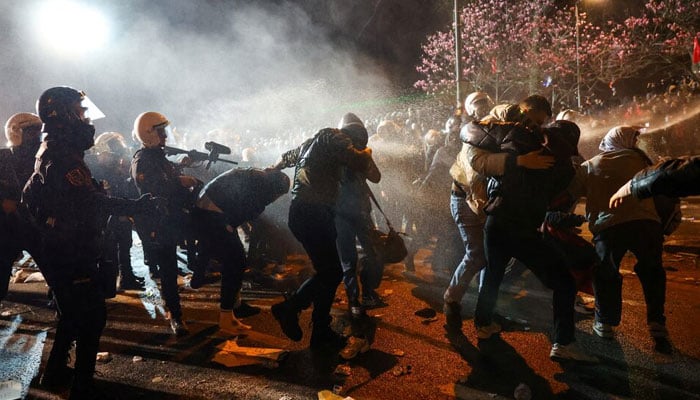
Although gatherings are officially prohibited, they have persisted, remaining largely peaceful until late at night when police responded with batons and pepper spray to quell disturbances, resulting in over 1,000 arrests.
In Sarachane park, the site of the main protest located between city hall and a grand Roman aqueduct, attendees have primarily cheered speeches from opposition figures, while others engaged with the heavy police presence just a few hundred feet away.
“I believe this will continue for a while, depending on how the public, law enforcement, and the government respond,” a university student stated. “I will attend as often as possible because the government has denied us justice.”
“Initially, I was frightened about being arrested, but my fear has dissipated,” she added.
Other participants told Reuters they plan to maintain daily protests, even though the main opposition party, the Republican People’s Party (CHP), announced that Tuesday would be the last scheduled event at Sarachane.
A Challenge for Erdogan
The ongoing protests create a dilemma for Erdogan, who branded them “street terrorism.” Since the violent crackdown on the expansive anti-government Gezi Park protests in 2013, he has shown little tolerance for dissent.
After a cabinet meeting in Ankara on Monday, Erdogan accused the CHP of inciting public unrest and predicted that citizens would feel ashamed of the “harm” inflicted upon the nation once their “show” subsides.
The government has denied claims of political interference, asserting that the judiciary operates independently.
In recent days, the previously cautious CHP has actively encouraged public rallies, aligning with calls made by Mayor Imamoglu before his arrest pending trial on corruption charges that he denies.
CHP Chairman Ozgur Ozel addressed crowds at Sarachane, declaring that the final event on Tuesday would serve as both “a definitive conclusion and a significant starting point” for future protests, vowing to persist in their efforts.
While specifics regarding future plans remain unclear, Ozel indicated he would continue to stay overnight at city hall until the CHP-dominated council elects an interim mayor on Wednesday.
A physician attending the Sarachane protests on Monday expressed hope to participate in demonstrations at Silivri prison, where the mayor is incarcerated just outside the city.
“I hope the protests never cease,” he remarked. “We gather for justice and democracy, as we do not believe we are living in a true democracy.”
Elsewhere in Istanbul on Monday evening, a sit-in briefly obstructed traffic on the historic Galata Bridge spanning the Golden Horn waterway.
Students, at the forefront of the civil disobedience movement, have boycotted classes since Monday, with academics at numerous universities participating in a one-day protest strike on Tuesday.
The Council of Europe’s human rights commissioner, Michael O’Flaherty, urged Turkish authorities on Monday to release protesters detained “for legitimately exercising their human rights.”
 ChatGPT
 Perplexity
 Gemini AI
 Grok AI