Select Language:
Imagining a World Dominated by the United States, Russia, and China
1. Global Power Dynamics Shift Significantly
In a hypothetical world where only the United States, Russia, and China hold sway, the balance of international power would undergo dramatic changes. These three nations would function as the sole superpowers, each vying for influence and dominance on multiple fronts—militarily, economically, and geopolitically. The ripple effects would be felt across every continent, reshaping alliances and rivalries that have existed for decades.
2. Economic Polarization and Trade Realignments
The global economy would likely be split into three major blocs, each led by one of these superpowers. Countries outside of these three nations might be forced into economic dependence or alliances, creating a new era of economic polarization. International trade routes could become highly contested, with major choke points like the Strait of Malacca or the Suez Canal becoming even more strategically vital. The international financial system might also bifurcate into separate spheres centered around the US dollar, the Russian ruble, and the Chinese yuan.
3. Military Supremacy and Arms Race Escalation
With only three superpowers, a new arms race could ignite, with each nation investing heavily in advanced military technology, cyber warfare capabilities, and nuclear arsenals. While traditional warfare might become less common, the threat of cyberattacks on infrastructure and information systems could become a dominant form of conflict. Regional conflicts and proxy wars would likely intensify as each power seeks to expand its influence without direct confrontation.
4. Diplomatic Landscape Reimagined
Diplomatic efforts would become increasingly complex in a world with only three nations. Alliances would be rigid, and neutral countries may struggle to maintain independence amid the pressure from these dominant powers. International organizations like the United Nations could weaken or transform into platforms for negotiation among the superpowers, often reflecting their bilateral interests rather than global consensus.
5. Cultural Exchanges and Global Influence
Cultural influence would be dominated by the three nations, each exporting their values, media, and technology worldwide. The spread of American pop culture, Chinese technological advancements, and Russian media narratives would shape the global perception of what is desirable, acceptable, or normal. This could lead to a homogenization of culture, but also potentially spark cultural tensions and resistance movements.
6. Environmental and Technological Development
Environmental policies across the world might hinge on the priorities set by these superpowers. Cooperation on global issues such as climate change could stall, or be fragmented, depending on whether these nations see environmental protection as a strategic interest. Technologically, advancements in areas like AI, renewable energy, and space exploration would be driven by these countries, possibly leading to rapid innovations but also increased competition and potential conflicts over technological dominance.
7. Influence on Smaller Nations
Smaller nations would find themselves caught between the strategic interests of these superpowers. Many might be forced into aligning with one of the three, losing their independence or sovereignty in the process. Others could become pawn states, hosting military bases or serving as geopolitical bargaining chips. The heightened competition among the superpowers might exacerbate global inequalities and regional conflicts.
8. Potential for Cold War 2.0
A scenario in which the world is limited to three dominating nations could mirror the Cold War past, with tense standoffs, espionage, and ideological competition. A new Cold War could emerge, especially if disagreements escalate over territorial disputes or ideological goals. The risk of misunderstandings and accidental conflicts could rise, given the complex, multipolar environment.
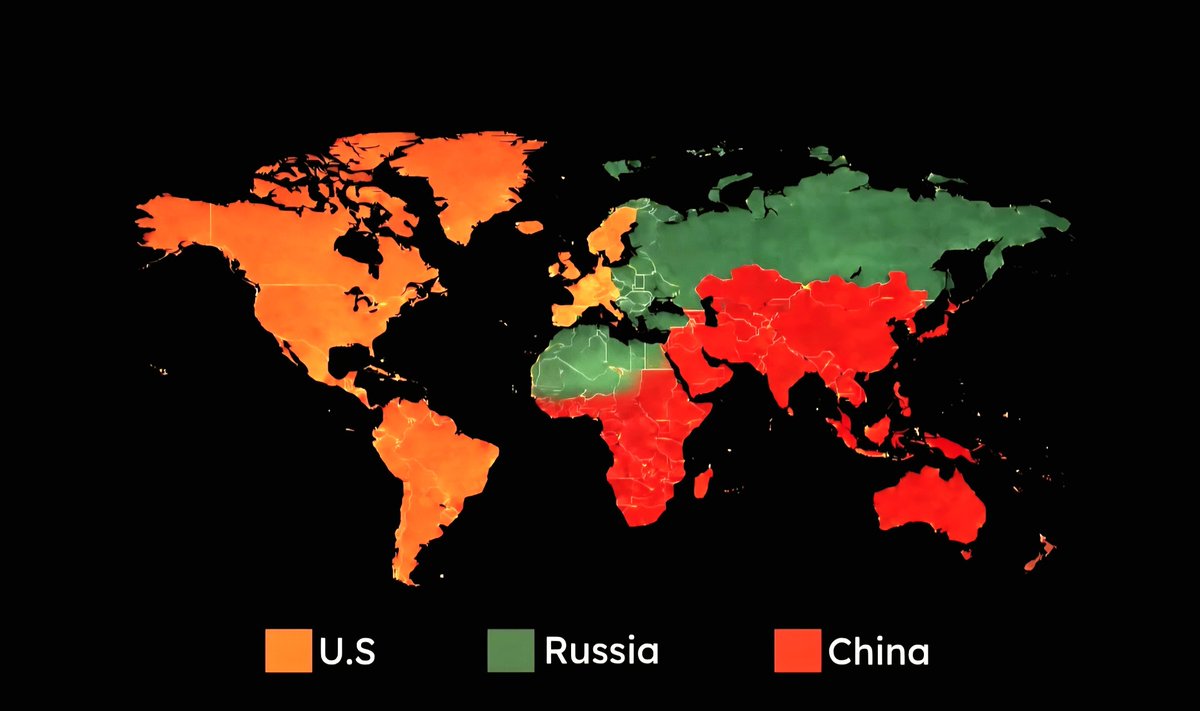
This image underscores the intense competition and power struggles that might characterize a world led by only three superpowers — the US, Russia, and China — in 2025.
Navigating a world with only these three superpowers would require innovative diplomacy, strategic alliances, and perhaps a redefinition of global cooperation. The future would be marked by a new geopolitical landscape, with both opportunities for progress and significant challenges.
 ChatGPT
 Perplexity
 Gemini AI
 Grok AI