Select Language:
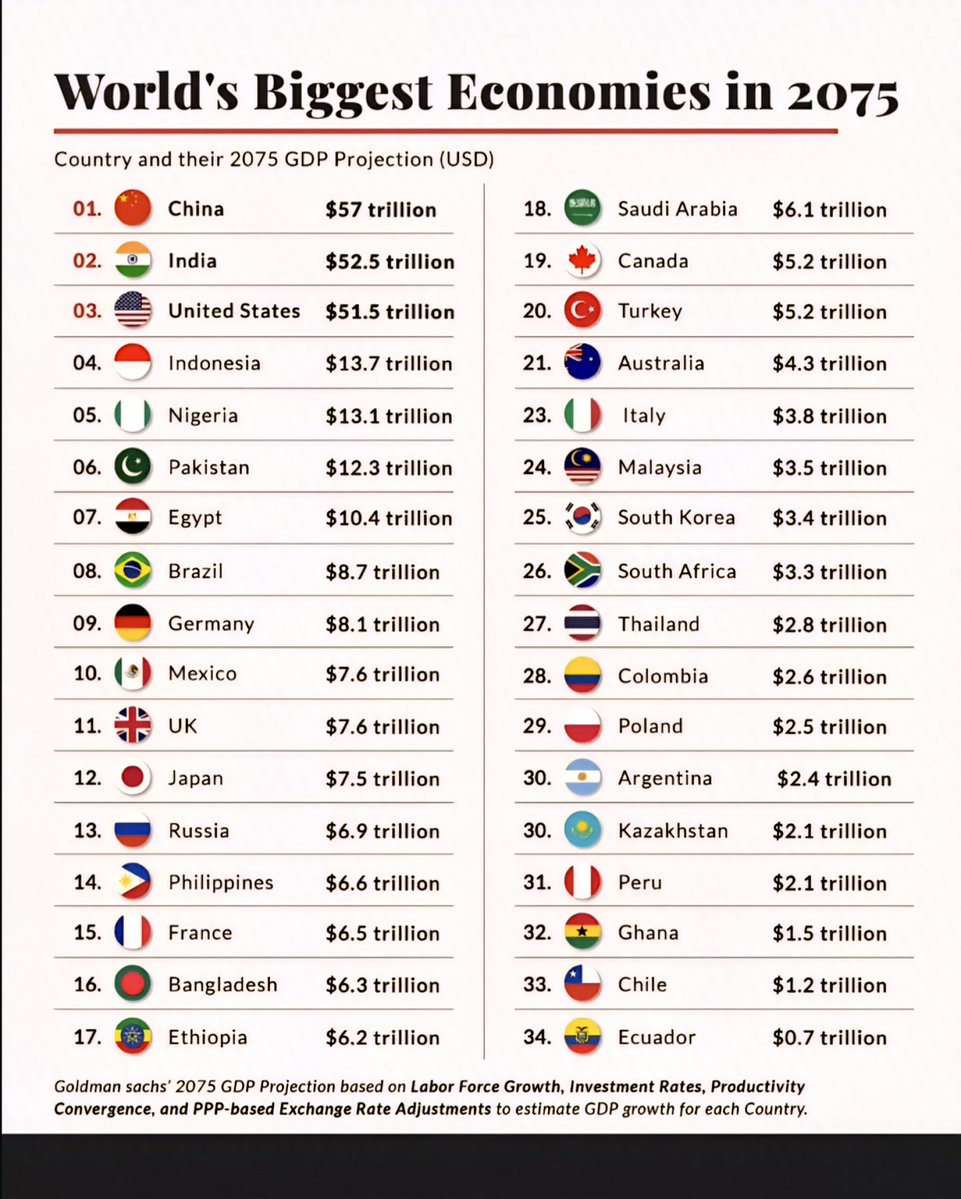
Global Economic Powerhouses of 2075: Top 10 in the World
1. China Dominates with an Unmatched $57 Trillion GDP
By 2075, China has solidified its position as the world’s economic titan, surpassing all others with a staggering $57 trillion. This remarkable growth reflects decades of sustained investment in infrastructure, technology, and manufacturing sectors. China’s impressive economic climb has been supported by expanding consumer markets and technological innovation, enabling it to lead the world comfortably.
2. India’s Rapid Rise to $52.5 Trillion
Trailing closely behind China, India’s economy has ballooned to $52.5 trillion. This growth stems from relentless urbanization, a burgeoning middle class, and advancements in information technology and services. India’s demographic dividend and strategic investments have played pivotal roles in catapulting it into the global economic spotlight.
3. The United States’ Steady Position at $51.5 Trillion
Despite emerging economies taking giant leaps, the U.S. maintains its economic stature with a GDP of $51.5 trillion. Its resilience is anchored in innovative industries, a robust financial system, and a dynamic labor market. Continued leadership in technology, aerospace, and entertainment sectors sustains the country’s economic prominence.
4. Indonesia’s Remarkable Leap to $13.7 Trillion
Indonesia’s economy has experienced extraordinary growth, reaching $13.7 trillion. Its natural resources, combined with technological adoption and infrastructure modernization, have fueled this surge. Indonesia’s strategic location also enhances its regional influence and economic influence.
5. Nigeria Emerges as Africa’s Largest Economy at $13.1 Trillion
Nigeria has transformed into Africa’s economic powerhouse with a GDP of $13.1 trillion. Catalyzed by investments in oil, agriculture, and expanding technology sectors, Nigeria’s youthful population drives economic productivity and innovation, positioning it as a key player on the global scene.
6. Pakistan’s Rapid Development to $12.3 Trillion
Pakistan has experienced swift economic growth, reaching $12.3 trillion. Investments in renewable energy, manufacturing, and digital infrastructure have played crucial roles. Improved geopolitical stability and integration into global supply chains have further turbocharged Pakistan’s economy.
7. Egypt’s Strategic Growth to $10.4 Trillion
Egypt has solidified its economic status with a GDP of $10.4 trillion. Its strategic location, combined with diversification into manufacturing, tourism, and digital services, has boosted growth. Reforms aimed at improving business environments have also contributed significantly.
8. Brazil’s Bounce Back at $8.7 Trillion
Brazil’s economy has rebounded robustly to $8.7 trillion, buoyed by recovery in agriculture, technology, and renewable energy sectors. Its vast natural resources and expanding consumer base have helped restore its position among the top 10 global economies.
9. Germany Maintains Strength with an $8.1 Trillion GDP
Germany remains Europe’s economic leader, with a GDP of $8.1 trillion. Its advanced manufacturing, automotive industry, and green technologies continue to drive growth, solidifying its dominance in the European Union and worldwide.
10. The United Kingdom Settles into a $7.6 Trillion Mark
The UK’s economy stood resilient at $7.6 trillion, primarily supported by financial services, technology, and creative industries. Post-Brexit adjustments and continued innovation have kept the UK at the forefront of global economies.
Overall, these projections draw from Goldman Sachs’ latest nominal GDP estimates for 2075, revealing an evolving landscape where emerging markets notably Indonesia and Nigeria have surged ahead. The competition remains fierce, shaping a future where economic influence is more distributed than ever.
Note: The landscape of global economies in 2075 underscores the importance of technological innovation, infrastructure development, and strategic geopolitical positioning in determining future economic rankings.
 ChatGPT
 Perplexity
 Gemini AI
 Grok AI