Select Language:
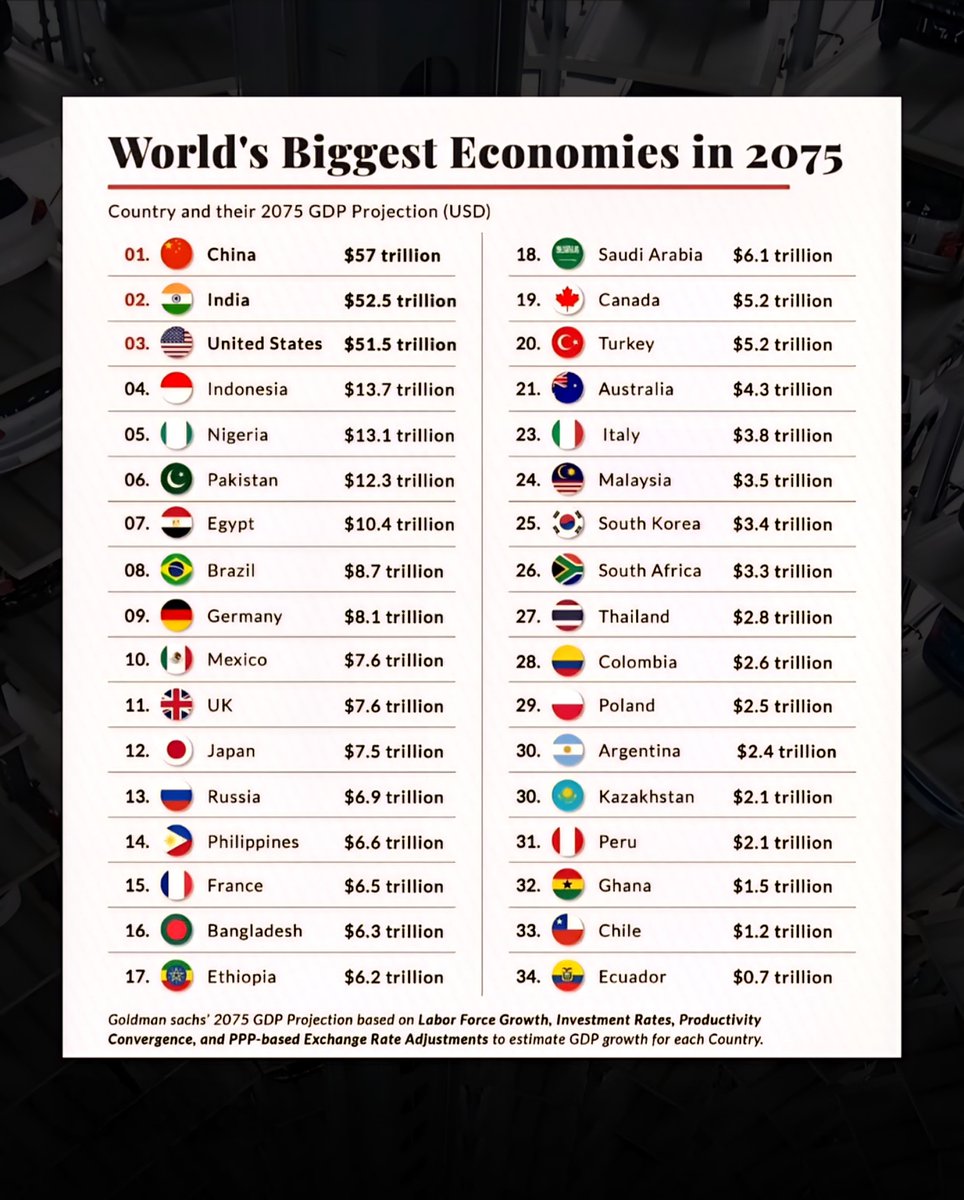
109 Countries Set to Dominate the Global Economy by 2075
-
China Continues Its Economic Rise, Surpassing Expectations
In 2075, China is projected to hold the top spot among the world’s largest economies, with a staggering gross domestic product of $57 trillion. Over the past five decades, China has maintained its momentum, transforming into a global economic powerhouse. This growth has been driven by technological innovation, a burgeoning middle class, and strategic investments in infrastructure. China’s ascendancy reflects its ability to adapt to new markets and sustain industrial growth despite global economic shifts. -
India Emerges as a Global Economic Leader
India’s economy is poised to reach $52.5 trillion, showcasing rapid growth fueled by demographic advantages, technological adoption, and increased manufacturing capabilities. Its expanding urban centers and technological sectors—particularly information technology and renewable energy—are major contributors. India’s rise underscores its transition from a developing nation to a global leader, competing closely with China for economic dominance.ADVERTISEMENT -
The United States Maintains Its Position as a Major Power
The USA is expected to secure the third spot, with an economy valued at $51.5 trillion. Despite facing competition, the US retains a robust innovation ecosystem, leading in finance, tech, and healthcare. Continued investments in AI, space exploration, and clean energy will sustain the US’s economic stature, making it an influential member of the world’s economic hierarchy in 2075. -
Indonesia’s Economy Surges to Over $13 Trillion
Indonesia’s strategic location, natural resources, and expanding digital economy propel it to rank fourth. With a GDP of $13.7 trillion, Indonesia represents Southeast Asia’s economic leader, bolstered by infrastructure development and increasing global trade integration. The nation’s commitment to renewable energy and sustainable development positions it as a rising global economy. -
Nigeria Breaks into the Top Five
Nigeria, Africa’s largest economy, climbs to $13.1 trillion. Driven by its rich oil reserves, expanding technology sectors, and demographic dividend, Nigeria has diversified its economy significantly. Continued growth hinges on infrastructure modernization and political stability. Its emergence signals Africa’s rising influence in global economic affairs. -
Pakistan’s Economy Expands to $12.3 Trillion
Pakistan’s economic trajectory see-saws upward, reaching $12.3 trillion. Key drivers include technological innovation, agriculture, and infrastructure projects. Its strategic geographic position opens doors for regional trade, fostering growth and attracting foreign investment. -
Egypt Becomes a Middle Eastern Economic Powerhouse
With a GDP of $10.4 trillion, Egypt leverages its geographic location and tourism sector. Advances in renewable energy, such as solar and wind farms, and major infrastructure projects contribute to its rise as a regional economic hub. -
Brazil Sets Its Sights on Economic Recovery
Brazil’s economy, valued at $8.7 trillion, reflects resilience amid global uncertainties. Investment in agribusiness, technology, and natural resources fuels growth. Brazil’s expanding middle class and urbanization continue to bolster economic output. -
Germany Maintains Its Leading European Position
Germany’s economy stands at $8.1 trillion, driven by high-tech manufacturing, automotive innovation, and sustainable energy initiatives. Its strong industrial base and export focus sustain its economic relevance in Europe and beyond. -
The UK and Mexico Tie for Tenth Place
The UK maintains a $7.6 trillion economy, maintaining its financial and technological prowess post-Brexit. Mexico matches this figure, with strong manufacturing, technology, and a rapidly growing digital economy, positioning both nations as key players in regional and global markets.
Image Caption: Global economies projected as of 2075 highlight ongoing shifts in economic power.
[Source: Goldman Sachs Projections (Nominal GDP), 2025]
Note: As updated projections extend into 2075, these figures reflect trends in demographic shifts, technological advancements, policy changes, and global cooperation, shaping the new world economic landscape.
 ChatGPT
 Perplexity
 Gemini AI
 Grok AI