Select Language:
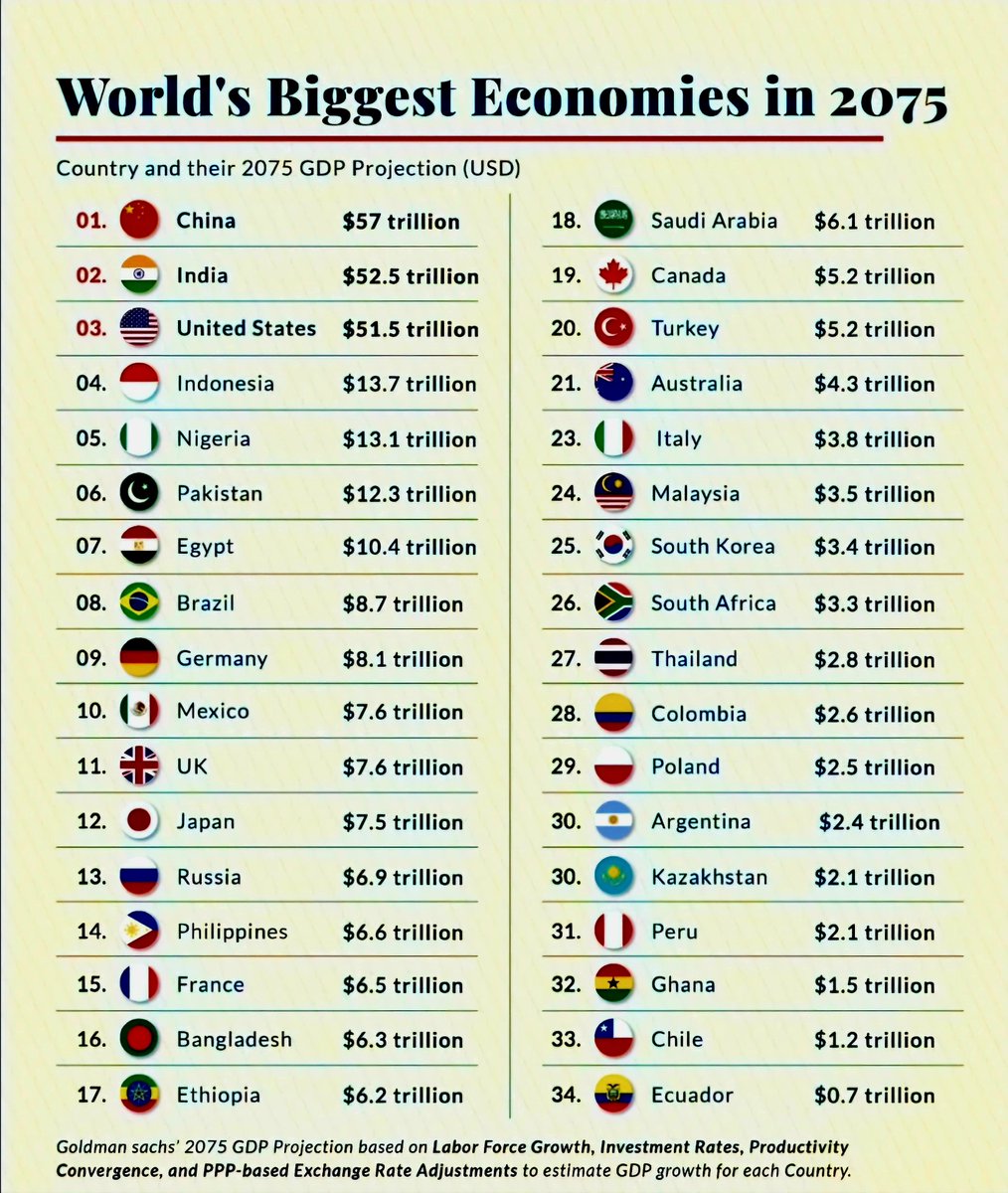
Top 34 Economies Projected for 2075: Who Will Lead the Global Market?
China Dominates with a $57 Trillion Economy
By 2075, China is expected to maintain its position as the world’s largest economy, with an incredible projected worth of $57 trillion. This growth underscores China’s expanding influence across global commerce, technological innovation, and industrial development. The nation’s rapid urbanization, advancements in infrastructure, and continuous investment in technology sectors could continue fueling its economic growth. As the leader in the world’s economy, China’s economic strategies and policies will majorly shape global trends and investments.
India’s Rapid Ascent to a $52.5 Trillion Powerhouse
Following closely is India, projected to grow into a $52.5 trillion economy—surpassing many traditional powers. With its large, youthful population and ongoing technological boom, India’s economy is expected to diversify and become more integrated globally. Innovations in sectors like information technology, manufacturing, and renewable energy are likely to propel India into the top tier of the global economy, making it a key player on the world stage.
The Growing Influence of the United States
While the U.S. economy is forecasted at $51.5 trillion, slightly behind India, its influence remains substantial. The United States will continue to be at the forefront of technological innovations, financial services, and multinational corporations. Its resilient economy, coupled with advancements in AI, biotech, and space exploration, will secure its position among the giants, even with emerging competitors.
Emerging Economies Show Strength and Promise
Indonesia: A Rising Power with $13.7 Trillion
Indonesia is predicted to emerge as Southeast Asia’s largest economy by 2075. Its abundant natural resources, large consumer base, and strategic location will play vital roles in its economic ascension. Continued investments in infrastructure and digital innovation could transform the country into a global manufacturing hub.
Nigeria: Africa’s Front-Runner At $13.1 Trillion
Nigeria’s economy could reach $13.1 trillion, driven by its expanding population and resource development, especially in oil, gas, and agriculture. The country’s tech startups and fintech sectors are expected to boom, positioning Nigeria as Africa’s economic leader.
Pakistan and Egypt: Key Players in Emerging Markets
Pakistan’s economy is projected to reach $12.3 trillion, fueled by its expanding workforce and infrastructure projects. Egypt, with $10.4 trillion, will likely capitalize on its strategic geographical location, boosting tourism, logistics, and manufacturing sectors.
Latin America and Europe’s Evolving Economies
Brazil and Mexico: Powerhouses in the Western Hemisphere
Brazil, with an estimated $8.7 trillion, and Mexico at $7.6 trillion, are forecast to remain significant players. Both countries’ rich natural resources, manufacturing, and service sectors will contribute substantially to their growth.
Germany, UK, Japan: Established Global Economies
Germany ($8.1 trillion), the UK ($7.6 trillion), and Japan ($7.5 trillion), though slightly behind, will maintain influential roles through technological innovation, finance, and manufacturing excellence. Japan’s advanced robotics and technology sectors especially will keep it at the forefront of global innovation.
Key Middle Eastern and African Economies
Saudi Arabia: Diversification Beyond Oil
Projected to reach $6.1 trillion, Saudi Arabia’s economy will likely diversify its energy portfolio, focusing on renewable energy, tourism, and technology sectors to sustain growth.
South Africa and Ghana: Rising African Powers
South Africa, with a projected GDP of $3.3 trillion, and Ghana at $1.5 trillion, will continue to be vital regional centers for finance, mining, and technology on the continent.
Large Countries with Steady Growth
Canada and Turkey: Bridges Between Continents
Canada and Turkey are both expected to reach around $5.2 trillion, serving as important connectors for trade and cultural exchange. Their rich natural resources and strategic locations will support persistent growth.
Asia’s Heavyweights China, India, and Southeast Asia
The combined economic might of these regions will shape global supply chains, technological advancements, and geopolitical relations. Countries like South Korea ($3.4 trillion), Malaysia ($3.5 trillion), and Thailand ($2.8 trillion) will further integrate into the globe’s economic fabric.
South American and Central American Contributions
Argentina ($2.4 trillion), Colombia ($2.6 trillion), and Peru ($2.1 trillion) will increasingly tap into their natural resources and expanding middle classes to boost their economies.
Possible Challenges and Opportunities
While projections paint a promising future, geopolitical tensions, climate change, and technological disruptions could impact growth trajectories. Countries investing heavily in sustainable development, digital infrastructure, and innovation are most likely to thrive.
As global economies continue to evolve over the coming decades, these projections from Goldman Sachs for 2075 paint a compelling picture of a dynamic, interconnected world where emerging nations may play increasingly prominent roles.
Source: Goldman Sachs
 ChatGPT
 Perplexity
 Gemini AI
 Grok AI