Select Language:
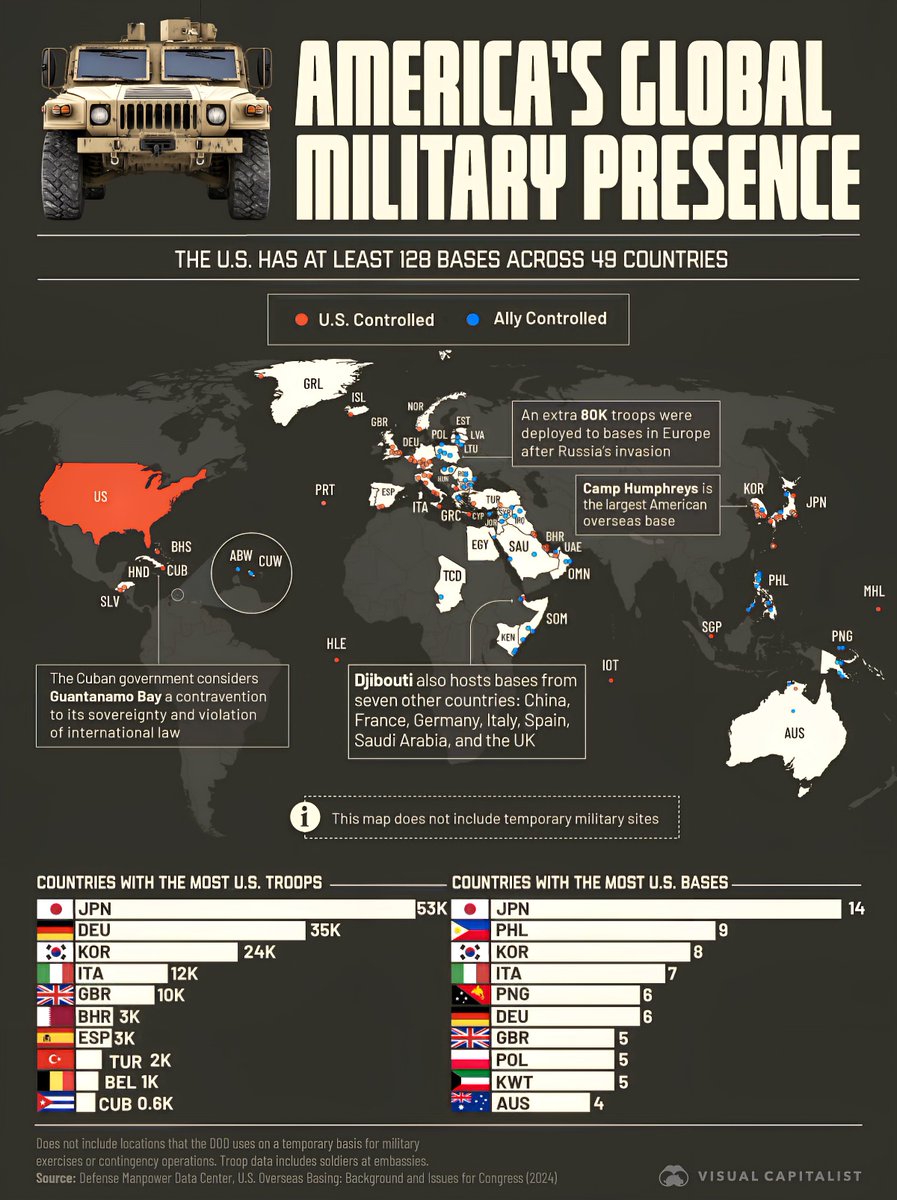
The Most Extensive Map of U.S. Military Overseas Bases in 2025
-
Japan: The U.S. Military’s Stronghold in East Asia
The United States maintains a formidable military presence across Japan, with key bases such as Yokota Air Base, Camp Zama, and Misawa Air Base. These installations serve strategic purposes ranging from air operations to logistical support. Misawa is renowned for its proximity to Asia-Pacific hotspots, while Yokota acts as a crucial command center. Additionally, the USFA Yokosuka and NAF Atsugi provide vital naval and air facilities near Tokyo, reinforcing U.S. commitment to regional stability.
-
South Korea: A Critical Partnership and Defense Hub
South Korea remains a pivotal part of America’s overseas network with bases like Osan Air Base, Camp Humphreys, and Kunsan Air Base ensuring rapid deployment capabilities. USAG Daegu and USAG Yongsan-Casey embody the U.S. commitment to defense, facilitating joint exercises and rapid response readiness amidst ongoing regional tensions. Notably, the Thor missile crisis has underscored the importance of these strategic locations.
-
The Pacific Islands: Remote Outposts with Strategic Significance
The Marshall Islands and Papua New Guinea host key U.S. facilities like USAG Kwajalein Atoll and Lobrum Naval Base. These serve as vital logistical and missile testing sites, ensuring U.S. presence across the Pacific and supporting missions ranging from surveillance to humanitarian aid. Momote Airport in PNG is particularly vital for regional operational agility.
-
The Philippines: Historically Key Allies with Diverse Installations
U.S. bases like Antonio Bautista Air Base, Basa Air Base, and Camp Magsaysay reflect a long-standing partnership. These sites bolster regional security and offer training hubs for joint operations. Notably, NAS Sigonella provides cybersecurity and logistical support, reinforcing the U.S. presence in Southeast Asia.
-
Australia: Strategic Outposts for Indo-Pacific Engagement
Australia’s RAAF bases in Darwin and Tindal serve as advanced operational sites, with NCS Harold E. Holt enhancing naval readiness. These bases are vital for surveillance over the Indian and Pacific Oceans and act as forward-deployment points for regional response.
-
Europe and the Arctic: U.S. Military’s Cold Weather Stronghold
In Greenland, Pituffik Space Base facilitates space and satellite operations. The NATO alliance is reinforced by bases such as NAS Keflavik in Iceland and the UK’s RAF stations, including Menwith Hill and Lakenheath. Norway’s Joint Warfare Center exemplifies collaboration in Arctic defense, vital as climate change expands access to northern zones.
-
Germany: Heart of Central Europe for U.S. Operations
Germany’s Ramstein Air Base and USAG Wiesbaden exemplify the U.S. military’s strategic European hub, supporting NATO operations and coalitions. Spangdahlem AB and USAG Stuttgart provide airpower and logistical support dispersed across the continent.
-
Italy: European Naval and Air Power Centers
Bases like Aviano Air Base, NSA Naples, and Sigonella serve as crucial hubs for air, naval, and special operations. These facilities secure the Mediterranean region, providing rapid response to crises in North Africa and the Middle East.
-
Eastern Europe and the Baltics: The New Frontlines
Countries like Estonia’s Amari Air Base, Latvia’s Lielvarde, and Lithuania’s Siauliai ensure U.S. and NATO military readiness. Poland’s Redzikowo and Powidz Air Base are increasingly vital, showcasing renewed focus on deterrence along the eastern flank.
-
Middle East and North Africa: Strategic Gateways
Key bases including Incirlik Air Base in Turkey, Al Udeid in Qatar, and Camp Lemonnier in Djibouti comprise the U.S. strategic web in the Middle East. These airfields and ports are fundamental for operations in the region, counter-terrorism, and supply chain management. Notably, reports indicate these sites are also being upgraded to support emerging space and cyber warfare capabilities.
-
Southwest Asia: Hotbeds of Ongoing Operations
Iraq’s Al Assad and Erbil Air Bases, along with Jordan’s Muwaffaq Salti Air Base, continue to be pivotal in regional counterterrorism. These bases serve as launching points for missions in Syria, Iraq, and neighboring countries.
-
Indian Ocean and Beyond: Maintaining Maritime Supremacy
From Duqm in Oman to Jebel Ali in the UAE, these strategic points bolster naval mobility and logistics across vital choke points like the Strait of Hormuz.
-
Africa: Expanding Footprint in Emerging Hotspots
Camp Lemonnier, Djibouti, remains a vital hub in Africa, facilitating counter-extremism efforts and regional stabilization missions. Kenya’s Manda Bay and Somalia’s Kismayo provide additional strategic points in East Africa.
-
The Americas: Strategic Strengths in the Western Hemisphere
Guantanamo Bay remains a symbol of U.S. military influence in Cuba, operating as both a detention and intelligence facility. Forward bases across Central America—such as Soto Cano in Honduras—serve as regional support points.
-
Caribbean and Atlantic: Overlooked but Essential
The Atlantic Undersea Test & Evaluation Center in The Bahamas underpins undersea warfare testing, vital for maintaining maritime dominance. Aruba’s Reina Beatrix Airport extends logistical reach into the Caribbean for rapid deployment.
This comprehensive layout of U.S. overseas military installations as of 2025 displays the vast scope and strategic importance of America’s global military footprint. These bases are integral to national security, regional stability, and maintaining technological superiority across multiple domains.
 ChatGPT
 Perplexity
 Gemini AI
 Grok AI