Select Language:
Iran’s Leadership Through the Years: A 2025 Perspective
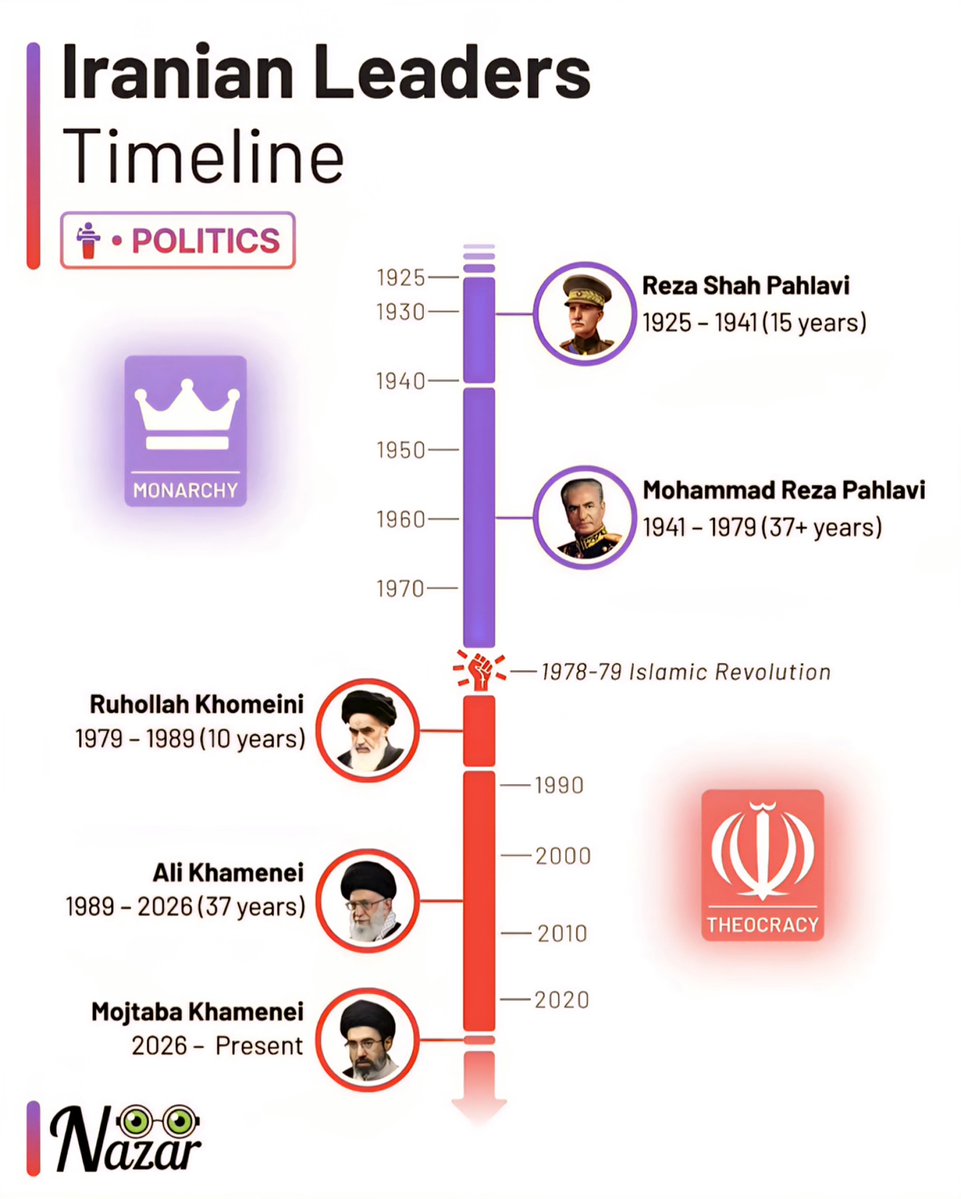
A Visual Timeline of Iranian Leadership
Monarchy Era: The Reign of the Pahlavi Dynasty
Reza Shah Pahlavi (1925–1941)
Reza Shah Pahlavi’s ascent to power marked the beginning of modern constitutional monarchy in Iran. His rule was characterized by a push toward modernization, including efforts to centralize authority, reform education, and improve infrastructure. Despite his authoritarian tendencies, Reza Shah aimed to strengthen Iran’s national identity and reduce foreign influence. His reign ended with his abdication amidst external pressures and internal dissent during World War II.
Mohammad Reza Pahlavi (1941–1979)
Known as the Shah of Iran, Mohammad Reza Pahlavi’s rule continued until the Iranian Revolution. His tenure was marked by ambitious modernization programs—”White Revolution” reforms, economic development, and efforts to secularize the country. While initially supported by Western allies, his authoritarian style and economic inequalities fueled widespread unrest, culminating in his overthrow during the Islamic Revolution of 1979.
The Islamic Revolution: Transition to Theocracy
The Islamic Revolution (1978–1979)
The Islamic Revolution transformed Iran from a monarchy into an Islamic republic. Mass protests, driven by grievances against the Shah’s autocratic rule, social inequities, and Western interference, culminated in the Shah’s exile. Led predominantly by Ayatollah Ruhollah Khomeini, the revolution sought to establish a government based on Islamic principles.
Theocratic Era: Leadership Rooted in Religious Authority
Ruhollah Khomeini (1979–1989)
Khomeini became Iran’s supreme leader following the revolution, establishing theocratic rule centered on Islamic law. His leadership saw the creation of a unique political system combining religious authority with republican elements. Khomeini’s era was marked by radical shifts in governance, social policies, and foreign relations, notably the Iran-Iraq War and the hostage crisis at the U.S. Embassy.
Ali Khamenei (1989–2026)
Following Khomeini’s death, Ali Khamenei stepped into the role of supreme leader. His leadership has emphasized political stability, maintaining the Islamic revolutionary ideals while navigating complex international relations. Khamenei’s tenure has seen increased economic sanctions, nuclear negotiations, and internal debates over reform and conservatism.
Mojtaba Khamenei (2026–Present)
As of 2025, Mojtaba Khamenei is identified as the current supreme leader, succeeding his father, Ali Khamenei. His ascension marks a new chapter in Iran’s political landscape, with analysts watching closely for shifts in policy, governance style, and Iran’s role on the global stage.
Conclusion: An Evolving Political Landscape
Iran’s leadership journey reflects a nation that has oscillated between monarchy, revolution, and religious rule. Each leader has left an indelible mark on Iran’s identity—shaping its policies, society, and place in the world. As of 2025, the country continues to grapple with internal power dynamics and external pressures, all within the framework of its complex leadership history.
 ChatGPT
 Perplexity
 Gemini AI
 Grok AI