Select Language:
Richest Countries by Natural Resource Wealth in 2025: A Closer Look
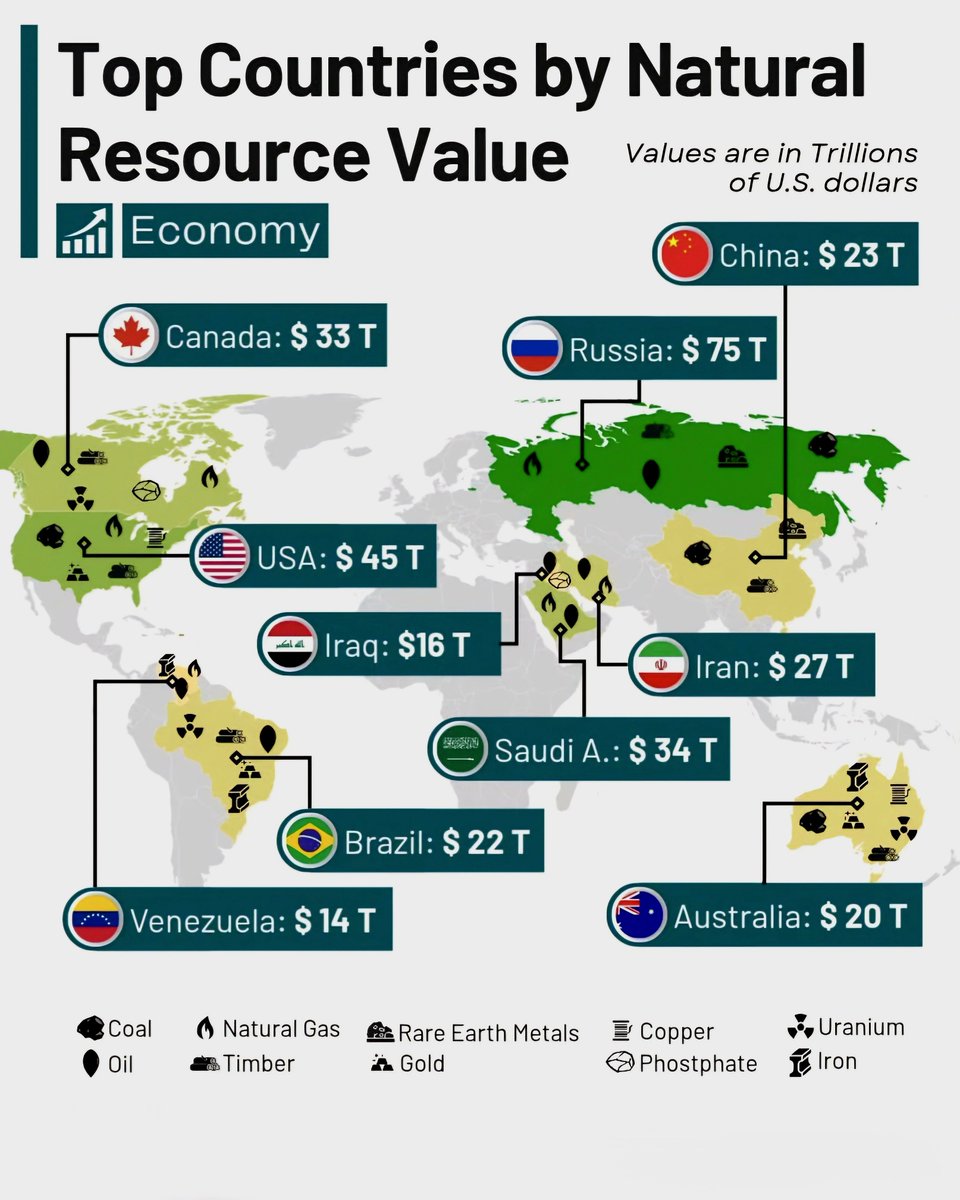
- Russia – $75 Trillion
Topping the list, Russia maintains its position as the nation with the most valuable natural resources, boasting an impressive estimated worth of $75 trillion. Its vast expanse encompasses an extensive range of resources, including oil, natural gas, coal, and mineral deposits. Russia’s rich reserves continue to drive its economy and fuel its global influence, especially in energy markets.
- United States – $45 Trillion
The United States, renowned for its technological innovation and economic strength, also holds a significant share of the world’s natural resource wealth—valued at approximately $45 trillion. Its diverse geography provides for substantial reserves of coal, natural gas, oil, minerals, and rare earth elements vital for modern industries. This resource base underpins U.S. manufacturing, energy, and technological sectors.
- Saudi Arabia – $34 Trillion
Saudi Arabia remains a powerhouse thanks primarily to its vast oil reserves, evaluated at around $34 trillion. Continue reading this economic star’s influence on global oil markets, geopolitical stability, and its ongoing efforts to diversify its economy through Vision 2030 initiatives aiming to reduce reliance on oil revenues.
- Canada – $33 Trillion
Canada’s natural wealth is a cornerstone of its economy, with an estimated resource value of $33 trillion. Rich in oil sands, minerals, timber, and freshwater resources, Canada remains a leading exporter of commodities. The country emphasizes sustainable resource management to balance economic growth with environmental conservation.
- Iran – $27 Trillion
Iran’s strategic position and substantial reserves—estimated at $27 trillion—make it a key player in regional and global energy markets. Its reserves include significant quantities of oil and natural gas, influencing geopolitical relations and economic sanctions that shape its development trajectory.
- China – $23 Trillion
China, the world’s manufacturing hub, holds abundant mineral resources valued at approximately $23 trillion. Its expanding infrastructure projects and technological sectors depend heavily on its internal resource base, fueling efforts to secure supply chains for critical minerals.
- Brazil – $22 Trillion
Rich in biodiversity and natural resources, Brazil’s resource valuation stands around $22 trillion. The nation’s vast forests, mineral deposits, and agricultural potential form the backbone of its economy—especially in exports like iron ore, soy, and oil.
- Australia – $20 Trillion
Australia’s resource sector, valued at roughly $20 trillion, is largely driven by its extensive mineral and energy deposits, including coal, iron ore, lithium, and natural gas. Its robust mining industry positions it as a key global resource supplier.
- Iraq – $16 Trillion
With considerable oil reserves, Iraq’s natural resource valuation stands at about $16 trillion. Political stability and modernization efforts are critical to unlocking the full potential of its resource wealth and diversifying its economy beyond hydrocarbons.
- Venezuela – $14 Trillion
Though politically turbulent, Venezuela boasts substantial oil reserves, estimated at $14 trillion. Its future depends on stabilizing its political landscape and modernizing its energy infrastructure to capitalize on its resource wealth.
Sources: Latest estimates from Statista, 2025.
This overview demonstrates how vast natural resource holdings continue to shape national economies and influence global geopolitics, especially as nations seek sustainable and strategic management of their resources amid environmental and economic changes.
 ChatGPT
 Perplexity
 Gemini AI
 Grok AI