Select Language:
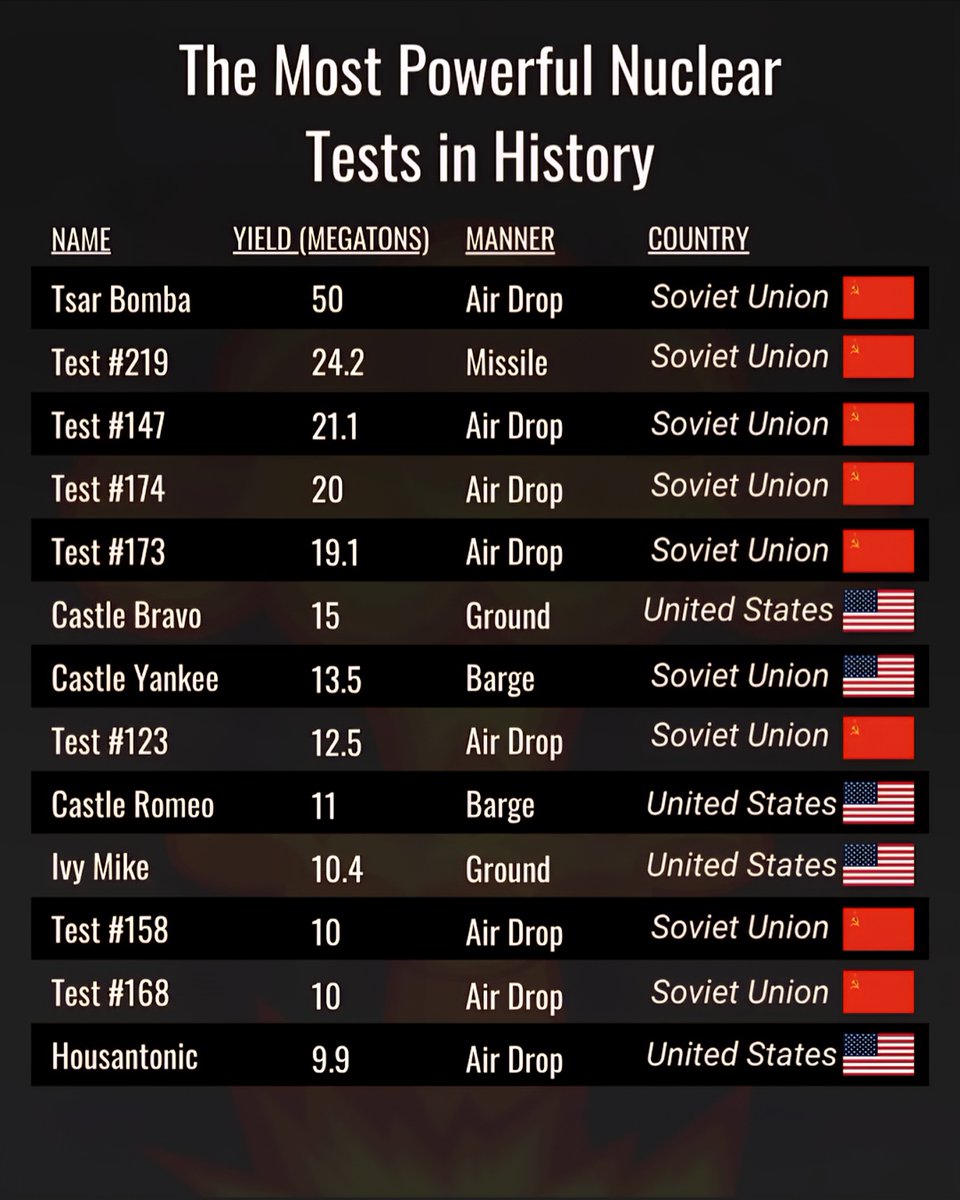
The Most Powerful Nuclear Tests in History
1. Castle Bravo (1954) — The Largest U.S. Nuclear Test
In 1954, the United States conducted Castle Bravo, the most powerful nuclear device ever tested by the U.S. and one of the largest ever detonated in history. The explosion produced an astonishing yield of 15 megatons of TNT, dwarfing earlier tests. The test was part of Operation Castle and took place at Bikini Atoll in the Pacific. Despite precautions, fallout from Castle Bravo unexpectedly spread to neighboring islands, causing severe health issues for local residents and crew members. Its massive power marked a significant escalation in nuclear testing, leading to widespread global concern about nuclear proliferation and environmental impact.
2. Tsar Bomba (1961) — The Most Potent Nuclear Weapon Ever
The Tsar Bomba, developed by the Soviet Union, remains the most powerful nuclear device ever detonated. On October 30, 1961, this hydrogen bomb was tested over Novaya Zemlya in the Arctic Circle with a yield of 50 megatons, five times more powerful than all bombs used in World War II combined. The explosion created a fireball over seven miles wide and a mushroom cloud that reached an altitude of 40 miles. The shockwave circled the Earth three times, and the test served as a stark reminder of nuclear brute force. The Tsar Bomba was primarily a demonstration of Soviet nuclear capability and remains a symbol of Cold War-era armament.
3. Operation Crossroads (1946) — Post-WWII Nuclear Testing
Following World War II, the United States launched Operation Crossroads in 1946, a series of nuclear tests at Bikini Atoll intended to investigate the effects of atomic bombs on naval ships. While not as large in yield as later tests, the series was groundbreaking in assessing nuclear weapon effects and contributed significantly to nuclear defense strategies. The most prominent test, Able, involved an airburst detonation of approximately 21 kilotons. The tests caused extensive radioactive contamination, leading to lengthy cleanup and influencing subsequent nuclear testing policies.
4. Test of RDS-220 (Tsar Bomba) — The Cold War’s Power Play
While the Tsar Bomba is often cited as the biggest ever, it’s worth noting how the Cold War era saw continual development of even more powerful nuclear devices. RDS-220, or Tsar Bomba’s full designation, was a strategic tool designed to demonstrate Soviet strength to the world, with preparations overshadowing actual military utility. The massive yield underscored the destructive potential held by superpowers and intensified fears of nuclear annihilation during the Cold War. The test’s colossal magnitude prompted bans and treaties later aimed at limiting the arms race, emphasizing the importance of nuclear arms control.
5. Operation Dominick I (1962) — Smaller, Yet Significant Tests
In 1962, the United States conducted Operation Dominick I, which included several underwater and atmospheric nuclear tests. Though these tests involved lower yields, they were crucial in understanding nuclear effects in various environments, including different atmospheric conditions and underwater settings. These tests helped shape modern nuclear safety protocols and contributed to advancements in thermonuclear weapon technology. While not as explosive as Castle Bravo or Tsar Bomba, Operation Dominick I marked an important chapter in nuclear test history with long-lasting implications for military strategy and international diplomacy.
6. The End of Limited Testing: The Comprehensive Test Ban Treaty
By the early 2020s, global efforts culminated in the Implementation of the Comprehensive Nuclear-Test-Ban Treaty (CTBT), which bans all nuclear explosions for both civilian and military purposes. Although not yet fully ratified worldwide, it has been a significant step toward preventing the proliferation of nuclear weapons and halting the development of new, more powerful devices. The treaty’s adoption reflects the global awareness of the devastating impact of these tests and the importance of diplomatic efforts to ensure nuclear stability for future generations.
In Summary:
The history of nuclear testing is marked by a series of devastating and awe-inspiring moments, from the massive explosion of Castle Bravo to the unparalleled might of Tsar Bomba. These tests have shaped international policies, prompted treaties, and highlighted the terrifying power humans wield. As the world moves forward in the era of nuclear diplomacy, understanding this history remains crucial in ensuring that such destructive demonstrations stay in the past.
 ChatGPT
 Perplexity
 Gemini AI
 Grok AI