Select Language:
Military Strength Showdown: NATO vs. BRICS in 2025
1. Aircraft Fleet: Who Runs the Skies?
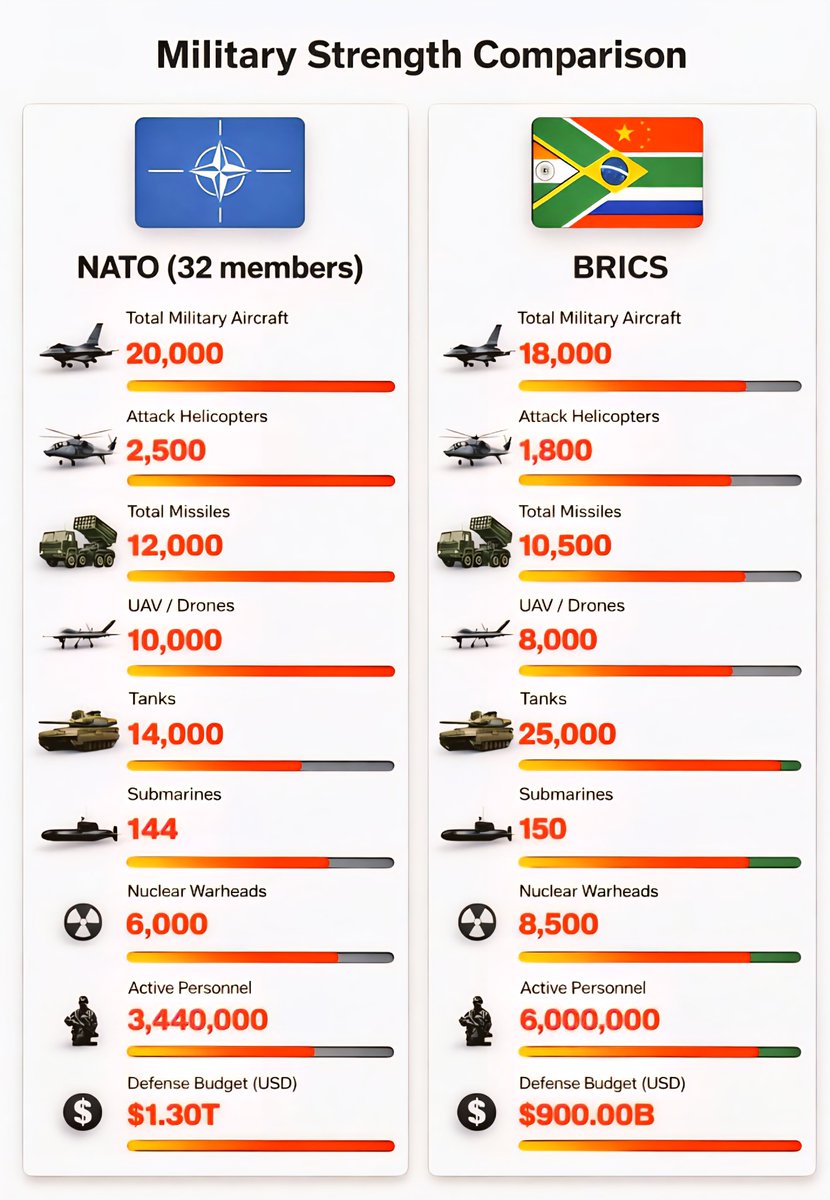
In 2025, NATO maintains a formidable air presence with approximately 20,000 military aircraft. This includes fighter jets, bombers, and support planes critical for modern aerial warfare. Meanwhile, the BRICS alliance commands around 18,000 aircraft, showcasing their significant airpower, though slightly trailing NATO’s sheer numbers. The disparity highlights NATO’s longstanding aerial dominance, but BRICS nations are rapidly modernizing their fleets to close the gap.
2. Attack Helicopters: Power in the Air’s Close Quarters
Attack helicopters remain crucial for tactical battlefield support. NATO possesses roughly 2,500 attack helicopters, serving roles from reconnaissance to close combat. BRICS, on the other hand, operates around 1,800 attack helicopters. Despite the smaller number, BRICS nations are investing heavily to enhance their helicopter arsenals, which are vital for expeditionary warfare and asymmetric engagements.
3. Missile Arsenal: The Precision Strike Force
When it comes to missile capabilities, NATO has an estimated 12,000 missiles at its disposal, including cruise and ballistic missile systems. BRICS holds about 10,000, emphasizing their emphasis on strategic and tactical missile systems. The missile stockpiles serve as deterrents and offensive tools, with both blocs pushing advancements in missile technology to increase range, accuracy, and payload capacity.
4. Unmanned Aerial Vehicles (UAVs): Drones Dominate the Modern Battlefield
Unmanned drones have become a game-changer in conflict zones. NATO controls around 10,000 UAVs, ranging from surveillance to armed drones. BRICS countries operate approximately 8,000 UAVs, with several nations ramping up drone production for both domestic use and export. The proliferation of drones underscores a shift toward remotely operated warfare, offering strategic advantages without risking pilot lives.
5. Tank Numbers: Armor on the Frontlines
While aerial and missile capabilities garner most headlines, land-based armor remains crucial. NATO fields approximately 14,000 tanks, many of which are modern main battle tanks designed for rapid deployment and offense. BRICS, on the other hand, boasts around 25,000 tanks—more than NATO—making their armored forces the largest globally. This advantage could translate into significant ground control in regional conflicts.
6. Submarines: Silent Threats Beneath the Surface
Submarines play a vital role in naval strategy and deterrence. NATO controls about 144 submarines, mainly specialized attack and ballistic missile boats. BRICS members possess approximately 150 submarines, reflecting their strategic emphasis on undersea warfare, particularly with expanding submarine fleets in Russia, China, and India. The undersea balance remains tight, with both blocs investing in stealth and modernization.
7. Nuclear Arsenal: The Ultimate Deterrent
The nuclear capabilities of NATO and BRICS define their strategic deterrence posture. NATO is estimated to have around 6,000 nuclear warheads, mostly ultra-modern, deliverable via land, air, and sea. BRICS boasts an estimated 8,500 nuclear warheads, with China, Russia, India, and others expanding their arsenals. This nuclear parity presents a complex global security landscape marked by mutual deterrence.
8. Troop Strength: The Power of Manpower
In terms of active personnel, NATO commands approximately 3.44 million soldiers worldwide, a reflection of its large, highly trained military forces. BRICS, with roughly 6 million troops, has a significant advantage in raw manpower, enabling sustained campaigns over large geographic areas. This disparity influences strategic planning and potential deployment capabilities.
9. Defense Budgets: The Financial Arms Race
When comparing financial commitments, NATO allocates an estimated $1.3 trillion annually to defense efforts, underpinning its technological edge and readiness. BRICS nations collectively spend around $900 billion, demonstrating their commitment to modernizing forces and expanding military capacity. The gap underscores the historical funding advantage NATO enjoys, though BRICS countries are closing the financial gap rapidly.
Note: These figures represent aggregated estimates from sources like Global Firepower, SIPRI, and official defense reports as of 2025. They serve as broad indicators and do not account for operational readiness, command structure integration, or training quality.
In a rapidly evolving global military landscape, these figures underline the strategic balance and emerging shifts within the NATO and BRICS alliances, shaping international security dynamics in 2025.
 ChatGPT
 Perplexity
 Gemini AI
 Grok AI