Select Language:
The Global Manufacturing Powerhouses of 2025: Top Countries Leading the Industry
China Dominates Global Manufacturing with $4.8 Trillion
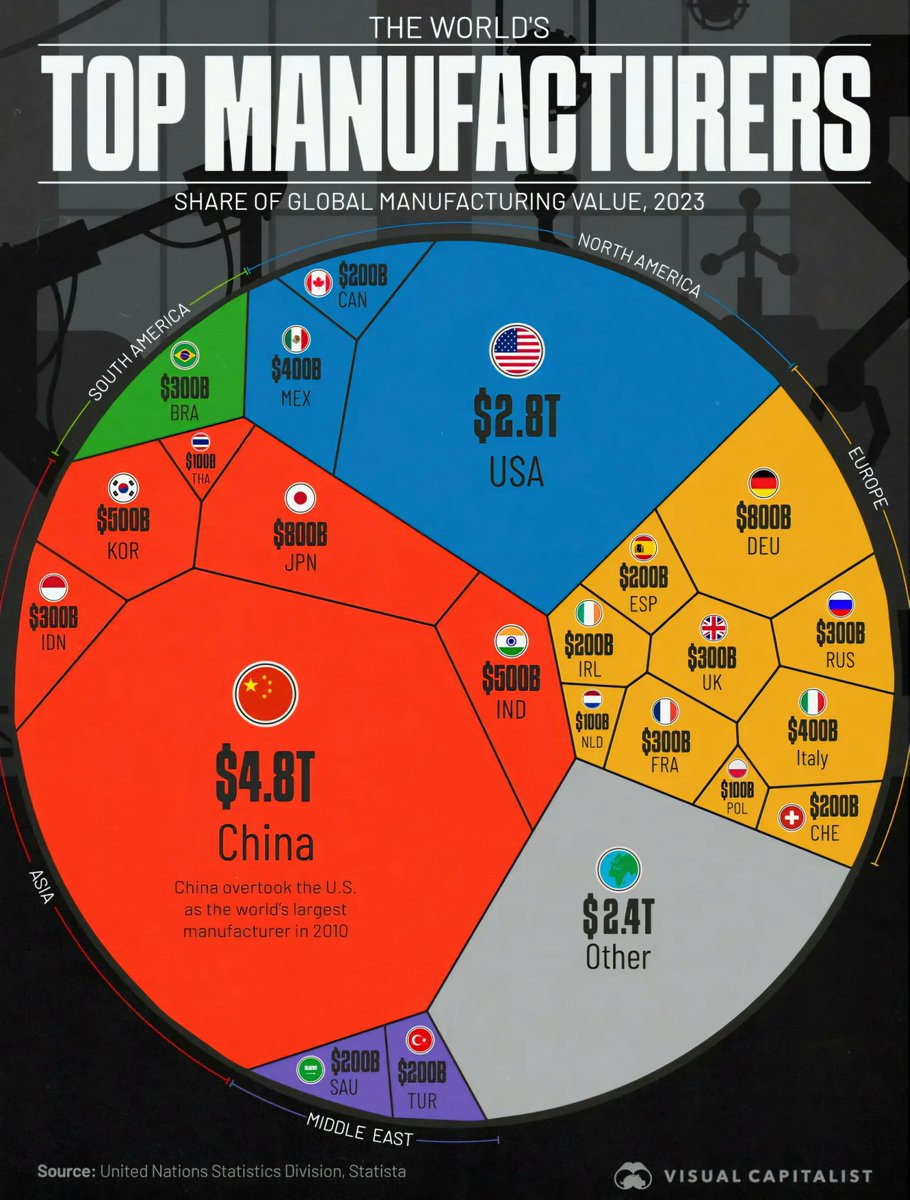
China continues to reign supreme as the world’s largest manufacturing powerhouse, with an impressive production value of $4.8 trillion in 2025. The nation’s extensive infrastructure, advanced technology, and a vast labor force sustain its leadership position. From electronics and textiles to machinery and chemicals, Chinese industries cover a broad spectrum of manufacturing sectors, contributing significantly to the global supply chain. The Chinese government has heavily invested in innovation and green manufacturing efforts, ensuring that the country maintains its competitive edge amid growing international concerns about sustainability and trade dynamics.
United States Holds Steady with $2.8 Trillion in Production
The United States ranks second with a robust $2.8 trillion in manufacturing output. While the U.S. doesn’t lead in sheer volume, it excels in high-tech, aerospace, and advanced automotive sectors. Continued investments in automation, robotics, and artificial intelligence have enhanced productivity, making American manufacturing more efficient and competitive. The industry also benefits from a highly skilled workforce and strong innovation ecosystems in regions like Silicon Valley and Detroit, fostering cutting-edge developments in manufacturing technology.
Japan and Germany: The Global Leaders in Quality and Precision
Japan and Germany, each contributing $800 billion to global manufacturing, remain famed for their precision engineering, automotive excellence, and technology innovations. Japan excels in electronics, robotics, and automobile manufacturing, leveraging a culture of quality and continuous improvement. Germany maintains its reputation for high-quality machinery, automotive engineering, and industrial equipment, with companies like Volkswagen, BMW, and Siemens leading the way. Both countries emphasize sustainable practices and advanced R&D, setting standards for the industry worldwide.
South Korea and India: Rising Manufacturing Giants
South Korea and India have cemented their positions as significant players, each with a manufacturing output of $500 billion. South Korea remains a powerhouse in semiconductors, consumer electronics, and automotive sectors, with companies like Samsung and Hyundai spearheading innovation. India’s manufacturing sector is rapidly expanding, fueled by government initiatives like “Make in India,” focusing on electronics, pharmaceuticals, and textiles. The country is experiencing a manufacturing renaissance, attracting foreign direct investment and boosting domestic production capacities.
Mexico, Italy, France, and the UK: Europe and North America’s Key Contributors
Mexico ($400 billion), Italy ($400 billion), France ($300 billion), and the United Kingdom ($300 billion) continue to play vital roles in the manufacturing landscape. Mexico benefits from its proximity to the U.S., serving as a manufacturing hub for automotive, aerospace, and electronics industries. Italy and France are renowned for their luxury goods, textiles, automotive components, and machinery. The UK focuses on aerospace, pharmaceuticals, and high-end manufacturing, leveraging its technological innovations and engineering expertise.
Emerging Markets Making Strides
Countries such as Russia, Indonesia, Brazil, Spain, Canada, Ireland, Turkey, Saudi Arabia, and Switzerland each contribute around $200-300 billion, showcasing diverse manufacturing strengths. Russia focuses on aerospace, defense, and heavy machinery; Indonesia and Brazil are expanding manufacturing in consumer goods and electronics; and countries like Switzerland and Canada lead in precision machinery and pharmaceuticals, respectively. Turkey and Saudi Arabia are investing heavily in industrial diversification, aiming to reduce reliance on oil and expand their manufacturing sectors.
Smaller but Growing Industries
Poland, the Netherlands, Thailand, and other nations contribute approximately $100 billion each. These countries are gaining ground in textiles, electronics, automotive parts, and high-tech manufacturing, often serving as critical links in global supply chains. For instance, Poland and the Netherlands are vital European manufacturing hubs, specializing in machinery and electronics, while Thailand is developing its automotive and electronics sectors.
The Rest of the World: A Collective $2.4 Trillion
Other nations collectively account for $2.4 trillion in manufacturing output, reflecting a diverse and expanding global industry. Emerging economies in Africa, Southeast Asia, and Latin America are gradually increasing their manufacturing capabilities, contributing to the overall growth of global production networks.
Conclusion
The manufacturing industry in 2025 showcases a dynamic landscape where traditional powerhouses maintain dominance while emerging economies rapidly expand their footprints. Countries like China, the U.S., Japan, and Germany continue to lead, driven by innovation, sustainability, and strategic investments. Simultaneously, nations such as India, South Korea, and Brazil are rapidly upgrading their manufacturing sectors, positioning themselves as future global leaders. The ongoing pursuit of technological advancement and eco-friendly practices will define the industry’s trajectory in years to come.
Source: United Nations Statistics Division, Statista, 2025
 ChatGPT
 Perplexity
 Gemini AI
 Grok AI