Select Language:
The Leading Nations in Global Manufacturing
1. China Dominates the Manufacturing Sphere with a Stunning $4.8 Trillion Output
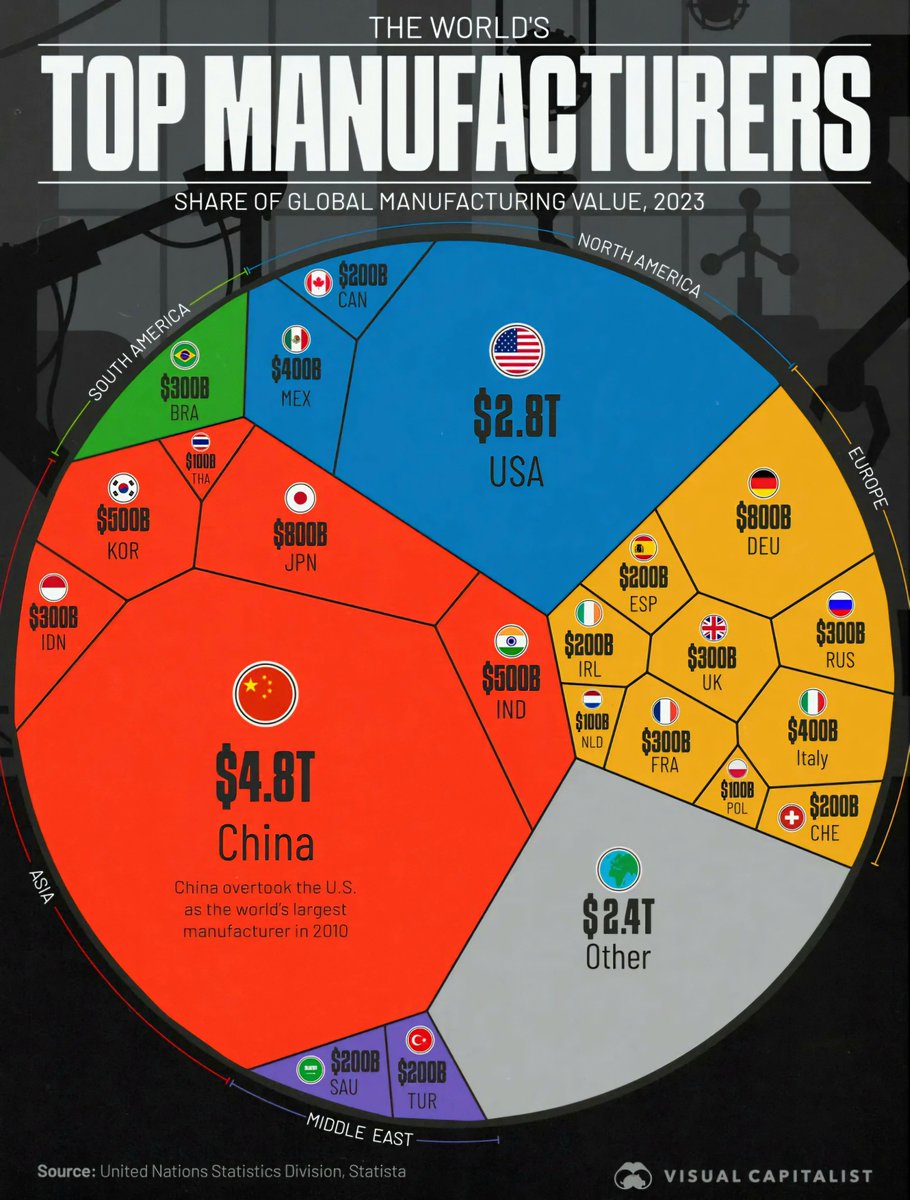
China continues to lead the world in manufacturing, with an impressive production value of $4.8 trillion. This figure underscores the nation’s status as the manufacturing powerhouse of the globe. China’s vast infrastructure, large labor force, and technological advancements have cemented its position at the forefront of global production. The country produces everything from electronics and machinery to textiles and consumer goods, fueling both domestic growth and exports worldwide.
2. The United States Maintains Its Stronghold with $2.8 Trillion in Manufacturing Output
The United States ranks second, contributing approximately $2.8 trillion to global manufacturing. American industry spans numerous sectors, including aerospace, automotive, pharmaceuticals, and technology hardware. Despite facing competition from Asian markets, U.S. manufacturing remains resilient thanks to innovation, advanced technology, and a skilled workforce. This position underscores America’s role as a significant player in global supply chains and industrial development.
3. Japan and Germany: The Industrial Giants Tying at $800 Billion Each
Japan and Germany, both renowned for their engineering prowess and quality manufacturing, share a valuation of around $800 billion. Japan is celebrated for its electronics, automotive, and robotics sectors, while Germany excels in automotive engineering, machinery, and industrial equipment. Their enduring reputation for quality and technological innovation continues to sustain their high positions in the manufacturing hierarchy.
4. South Korea and India: Emerging Giants with $500 Billion Each
South Korea and India each contribute approximately $500 billion to global manufacturing. South Korea’s vibrant industry focuses on semiconductor production, ships, and electronic components, driven by giants such as Samsung and Hyundai. India, rapidly expanding in sectors like pharmaceuticals, automotive, and textiles, leverages a large workforce to boost its industrial output, signaling its rising prominence in manufacturing.
5. Mexico and Italy: Significant Players with $400 Billion
Mexico’s proximity to the U.S. and its trade agreements have made it a leading manufacturing hub in North America, with a $400 billion output. Key sectors include automotive assembly, electronics, and machinery. Italy, renowned for its craftsmanship and luxury goods, also boasts a manufacturing output of $400 billion, emphasizing high-quality textiles, automobiles, and industrial machinery.
6. France, the UK, Russia, Indonesia, and Brazil: Notable Contributors
These nations each generate around $300 billion in manufacturing. France and the UK are pivotal in aerospace, luxury goods, and pharmaceuticals. Russia’s production heavily leans on energy equipment and machinery. Indonesia and Brazil, both resource-rich, have expanding manufacturing sectors including textiles, machinery, and agriculture-based products.
7. Spain, Canada, Ireland, Turkey, Saudi Arabia, and Switzerland: Diverse Leaders with $200 Billion
This diverse group showcases global manufacturing versatility. Spain and Canada have robust automotive, aerospace, and machinery industries. Ireland is increasingly becoming a hub for pharmaceuticals and tech exports. Turkey, with its strategic location, excels in textiles, automotive parts, and machinery. Saudi Arabia, while traditionally known for oil, is diversifying into petrochemicals and renewable energies. Switzerland maintains its high standards in precision machinery, pharmaceuticals, and watchmaking.
8. Poland, Netherlands, Thailand, and Other Countries Contributing $100 Billion or Less
Poland and the Netherlands have growing manufacturing sectors, especially in machinery, electronics, and food processing. Thailand is a critical player in electronics assembly and automotive manufacturing. Other nations on this list, collectively contributing over $2.4 trillion, encompass a broad range of emerging markets and specialized industries, further enriching the global manufacturing landscape.
9. The Broader Global Manufacturing Ecosystem
While these figures highlight key countries, the global manufacturing landscape is vast, with over $2.4 trillion generated by “other” nations. This includes smaller economies and emerging markets, demonstrating the widespread nature of industrial production that supports global supply chains and consumer markets.
10. What It All Means for Global Economics
The data, rounded and considering only countries with a minimum of $100 billion in manufacturing, reveals an ever-evolving industrial landscape. Countries like China, the U.S., Japan, and Germany emphasize advanced manufacturing and innovation, while emerging economies like India and South Korea showcase rapid growth.
This snapshot underscores that manufacturing is central to economic stability and growth, providing millions of jobs worldwide and enabling countries to develop infrastructure, technology, and global trade relationships.
Note: Figures are rounded and sourced from the United Nations Statistics Division and Statista, 2023.
 ChatGPT
 Perplexity
 Gemini AI
 Grok AI