Select Language:
G20 Countries’ Economic Growth from 2000 to 2024: A Detailed Overview
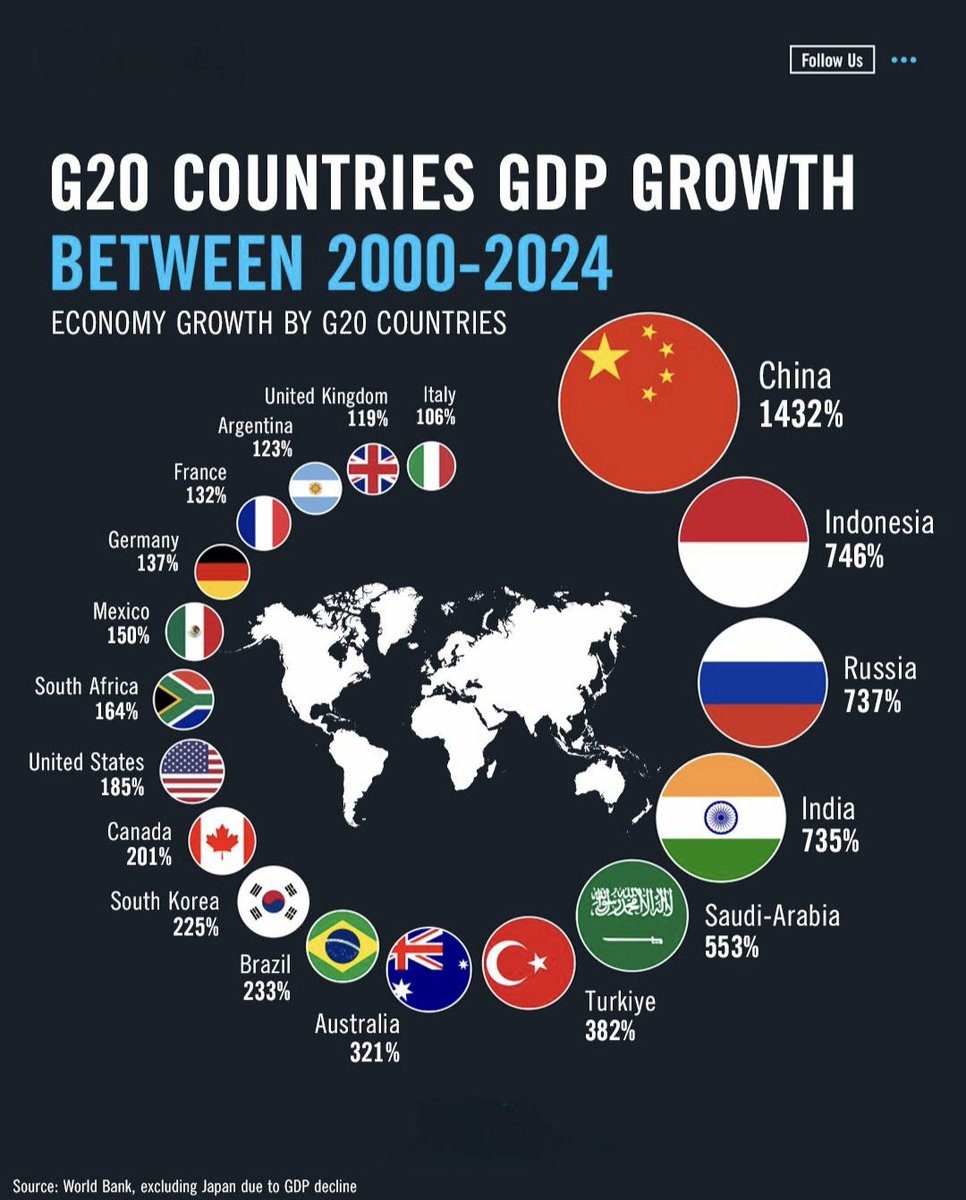
The global economy has experienced varied growth patterns over the past two decades. G20 nations, representing some of the world’s largest economies, show striking differences in their gross domestic product (GDP) expansion from 2000 to 2024. Here’s a comprehensive look at the staggering growth figures across these influential countries.
China’s Unprecedented Economic Surge
> 1,432% Growth
China’s transformation from a primarily developing nation to a manufacturing and technological powerhouse is evident in its extraordinary GDP growth of 1,432% over the last 24 years. This development has been fueled by massive infrastructure investments, export-driven manufacturing, and a rapid rise in technological innovation. China now stands as the second-largest economy globally, profoundly influencing global trade and politics.
Indonesia and Russia: Mid-2000s Boomers
> Indonesia’s 746% Growth
> Russia’s 737% Growth
Both Indonesia and Russia have experienced significant economic expansion. Indonesia’s growth reflects its increasing integration into the global market, a burgeoning middle class, and resource-driven industries. Russia’s growth stems from rising energy exports and strategic economic reforms post-2000, although recent geopolitical tensions have posed challenges.
India: The South Asian Economic Rise
> 735% Growth
India’s economy has seen remarkable growth thanks to a booming services sector, technological sector expansion, and infrastructure development. Its huge population has turned it into a critical global market, prompting increased foreign investments and economic reforms that have contributed to its near 735% growth.
Middle Eastern And Turbulent Economies
> Saudi Arabia’s 553% Growth
> Turkey’s 382% Growth
The Gulf nation of Saudi Arabia has diversified its economy away from oil dependence, with strategic investments in sectors like tourism and entertainment. Meanwhile, Turkey has leveraged its geographical position and young population to stimulate growth, despite regional tensions and economic fluctuations.
In Oceania and the Americas
> Australia’s 321% Growth
> Brazil’s 233% Growth
> Canada’s 201% Growth
> United States’ 185% Growth
> Mexico’s 150% Growth
Australia’s resource-rich economy and proactive policies have fostered steady growth. Brazil, once plagued by political and economic instability, has experienced periods of recovery, especially in agriculture and mining. Canada’s stable policies have supported consistent growth, while the U.S. maintains resilience through technological innovation and consumer strength. Mexico continues to grow, propelled by manufacturing and export sectors.
Asian Tigers and African Growth
> South Korea’s 225% Growth
> South Africa’s 164% Growth
South Korea’s boom, driven by technology and export industries, underscores its role as a global innovation hub. South Africa’s growth reflects its steady recovery from past financial crises and ongoing infrastructure development, despite facing socio-economic challenges.
European Economies and Latin America
> Germany’s 137% Growth
> France’s 132% Growth
> Argentina’s 123% Growth
> United Kingdom’s 119% Growth
European powerhouses like Germany and France showcase moderate but resilient growth figures, driven by manufacturing, technology, and services sectors. South America’s Argentina exhibits notable growth, although it still faces economic volatility. The UK’s post-Brexit economy continues its recovery journey with a focus on services and innovation.
Exclusion of Japan
Despite being a major global economy, Japan’s GDP has declined over this period, leading to its exclusion from this growth analysis.
Final Perspectives
The data illustrates a dynamic shift in global economic power, with emerging markets, particularly in Asia and the Middle East, experiencing rapid growth. Developed economies continue to grow steadily, adapting to new challenges and technological advancements. The next two decades look poised to reshape the global economic landscape, with nations like China, India, and Indonesia leading the charge.
Source: World Bank, 2025
 ChatGPT
 Perplexity
 Gemini AI
 Grok AI