Select Language:
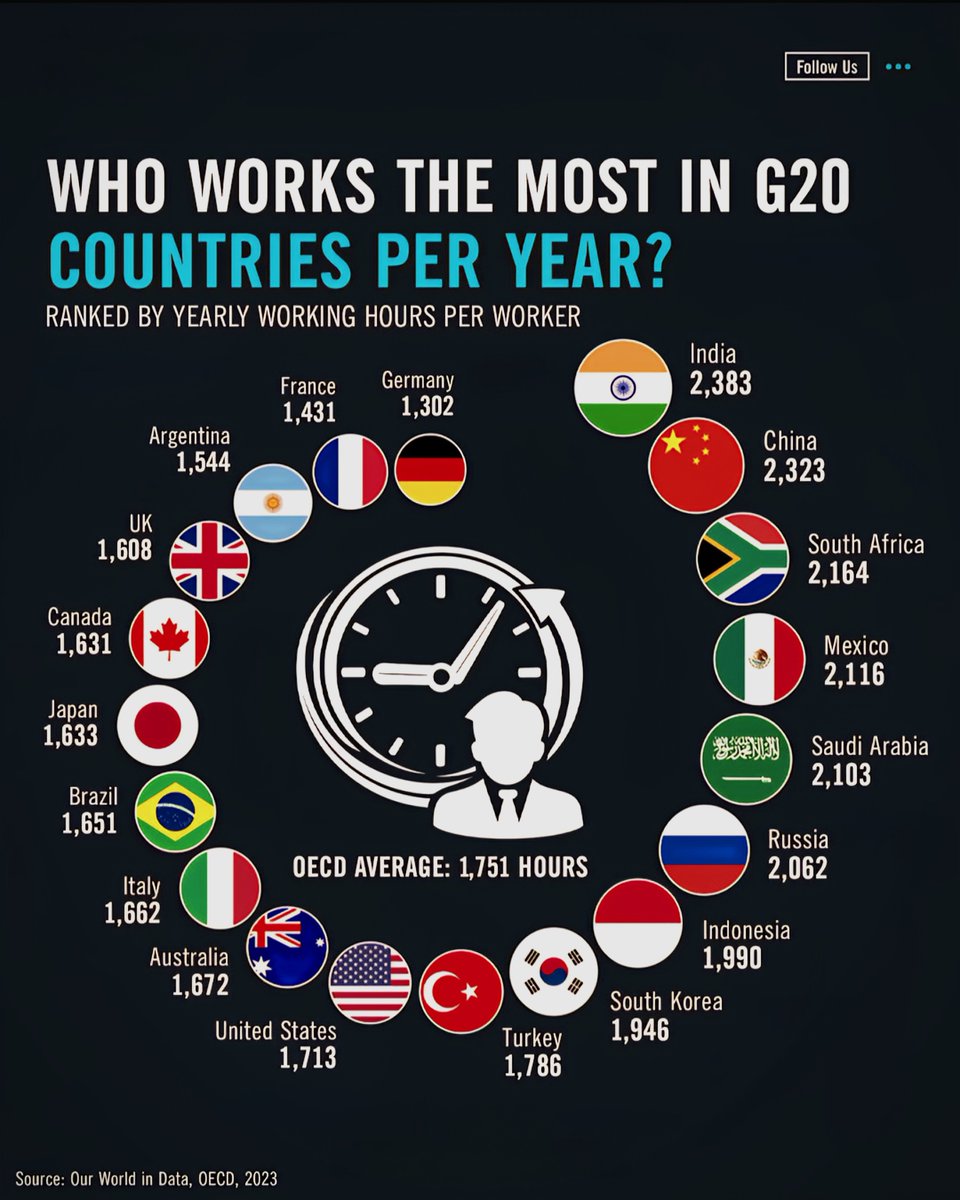
G20 Countries with the Longest Annual Working Hours in 2025
India Tops the List with the Highest Work Hours
India continues to hold the record for the highest annual working hours among G20 nations, clocking in at an astonishing 2,383 hours. Workers in India tend to put in long hours, reflecting the country’s diverse economic sectors and the intense work culture prevalent across various industries. This high number of work hours impacts workers’ quality of life but also underscores the country’s rapidly growing economy and the demand for labor.
China Remains Among the Top, with Over 2,300 Hours Annually
China, a global economic powerhouse, maintains its position with approximately 2,323 hours worked each year. The country’s expansive manufacturing, technology, and service sectors contribute to this considerable work schedule. Even as China embraces various labor reforms, the overall hours suggest a strong work ethic and a significant demand for productivity.
South Africa’s Work Culture: Over 2,160 Hours Each Year
South African workers dedicate around 2,164 hours annually. The country’s labor landscape features a mix of formal and informal employment sectors, leading to extended working hours, particularly in sectors such as mining, manufacturing, and agriculture. This figure points to ongoing discussions around work-life balance reforms within the nation.
Mexico and Saudi Arabia Maintain Significant Work Hours
Mexico reports an average of 2,116 hours annually, reflecting its vibrant manufacturing and service industries. Meanwhile, Saudi Arabia’s workforce spends roughly 2,103 hours working each year, emphasizing long hours in oil production, construction, and other key sectors vital to its economy.
Russia’s Work Hours Top 2,060
Russian employees contribute about 2,062 hours per year. The country’s diverse economy, with sectors like energy, manufacturing, and agriculture, sustains extensive work schedules, impacted further by regional disparities in working conditions.
Indonesia and South Korea: High, Yet Slightly Lower Hours
Indonesia’s workforce clocks in at close to 1,990 hours annually, with long hours stemming from a developing economy and labor-intensive industries. South Korea follows with approximately 1,946 hours, a reflection of its highly competitive corporate culture and emphasis on hard work.
Turkey’s Work Hours: Approaching 1,800
Turkey’s workers log an average of 1,786 hours per year. The country’s economy, marked by manufacturing, agriculture, and service sectors, sustains a relatively intense work culture, with ongoing debates about work-life balance reforms gaining momentum.
United States and Australia: Notably Fewer Hours
In 2025, the U.S. workers average about 1,713 hours annually, a significant decrease compared to other G20 nations, showing evolving labor policies and a focus on work-life balance. Australia follows with approximately 1,672 hours, reflecting similar economic shifts and labor practices.
European Countries Show the Lowest Work Hours
Italy sees around 1,662 hours worked yearly, while Brazil approximately 1,651 hours. Japan’s workforce averages about 1,633 hours, indicating a move toward more balanced work schedules, possibly influenced by labor reforms and cultural shifts. Canada’s workers put in roughly 1,631 hours, and the United Kingdom’s hours are around 1,608.
Argentina and France: Moderate Work Hours
Argentina’s workers contribute about 1,544 hours annually, while France’s workforce averages approximately 1,431 hours. Both countries exhibit a lighter work schedule compared to many emerging economies, often associated with stronger labor protections and social welfare policies.
Germany’s Relatively Short Working Hours
Germany stands out within the G20 for having the shortest annual work hours at just over 1,302. The country’s focus on productivity, technological innovation, and a robust social safety net contribute to this comparatively low figure, emphasizing quality over quantity in their work culture.
Summary Table of G20 Work Hours in 2025
| Rank | Country | Average Annual Hours |
|---|---|---|
| 1 | India | 2,383 |
| 2 | China | 2,323 |
| 3 | South Africa | 2,164 |
| 4 | Mexico | 2,116 |
| 5 | Saudi Arabia | 2,103 |
| 6 | Russia | 2,062 |
| 7 | Indonesia | 1,990 |
| 8 | South Korea | 1,946 |
| 9 | Turkey | 1,786 |
| 10 | United States | 1,713 |
| 11 | Australia | 1,672 |
| 12 | Italy | 1,662 |
| 13 | Brazil | 1,651 |
| 14 | Japan | 1,633 |
| 15 | Canada | 1,631 |
| 16 | United Kingdom | 1,608 |
| 17 | Argentina | 1,544 |
| 18 | France | 1,431 |
| 19 | Germany | 1,302 |
Source: Our World in Data, OECD, 2023
The data illustrates a clear global trend: while emerging economies tend to work longer hours driven by economic growth and labor demands, many developed nations are shifting towards shorter workweeks to improve worker well-being and productivity. The ongoing debates around work-life balance, automation, and labor reforms will likely shape future work hour trends in 2025 and beyond.
 ChatGPT
 Perplexity
 Gemini AI
 Grok AI